


Reprieve for ADC, Four Others as Appeal Court Halts Deregistration Judgement
A reprieve came the way of the African Democratic Congress (ADC) and four others as the Court of Appeal, Abuja, on Tuesday ordered the Independent National Electoral Commission (INEC) to stay the...

A reprieve came the way of the African Democratic Congress (ADC) and four others as the Court of Appeal, Abuja, on Tuesday ordered the Independent National Electoral Commission (INEC) to stay the execution of a Federal High Court judgment to deregister them.
In a unanimous decision, a three-member Court of Appeal panel led by Justice A. B. Mohammed faulted Monday’s judgment by Justice Peter Lifu of the Federal High Court in Abuja, saying he ignored its May 22 order directing him to halt proceedings. The appellate court held that the lower court breached judicial hierarchy and precedent by delivering judgment while an appeal was still pending.
The Court of Appeal described Justice Lifu’s action as the highest form of judicial impertinence and said it rendered him unfit for the bench because it amounted to judicial rascality.
As a result, the three members of the panel maintained that as a result, the court has the duty to ensure that the laws and orders are fully adhered to; therefore, granting the stay of execution on the matter. This court has the duty to invoke its powers in ensuring that its orders are made. The application for stay of execution is hereby granted. The enforcement of the judgment is stayed.
“Courts are enjoined to protect their integrity. This Court has supervisory authority over the trial court. The decision of the lower court to proceed with the judgment despite the express order of this court is a brazen violation of the hierarchy of the court and the 1999 Constitution,” the appellate court ruled.
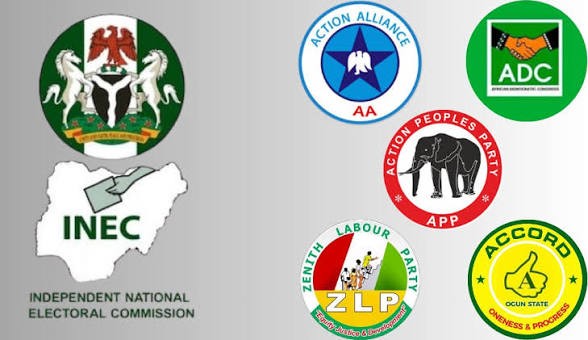
The appeal emanated from a judgement delivered by Justice Peter Lifu of the Federal High Court, yesterday, ruling that the Independent National Electoral Commission should deregister some political parties, including the African Democratic Congress (ADC), Action Peoples Party (APP), Action Alliance (AA), Accord Party (AP), and Zenith Labour Party (ZLP) for failing to meet the constitutional requirements in performance.
In the suit marked FHC/ABJ/CS/2637/2026 filed by the National Forum of Former Legislators, the plaintiff asked the court to determine the constitutional obligation to remove political parties that fail to meet the electoral performance thresholds set out in Section 225A of the 1999 Constitution (as amended), as reinforced by the Electoral Act 2022 and INEC’s regulations.
In their argument, the forum of legislators argued that the five affected political parties had consistently failed to secure 25 percent votes in a state during a presidential election or win elective positions at the national, state, and local government levels. The plaintiff also argued that the parties failed to achieve the required electoral performance in the 2023 general election and the subsequent bye-elections conducted by INEC.
The high court judgement had stirred reactions, sparking immediate outrage and swift legal countermeasures across Nigeria’s political landscape. Leaders of affected political parties and opposition blocs have condemned the court’s ruling, describing it as a direct assault on the nation’s democracy.
Many Nigerians also raised objections against the judgement, with indications that the judiciary itself is the one on trial due to this highly unusual conduct, adding that the judgement was premeditated to crush dissent and pave the way for a one-party state ahead of the 2027 general elections.
Not satisfied with the ruling, the affected political parties and the Independent National Electoral Commission (INEC) approached the Court of Appeal to seek a stay of execution of a judgement that was delivered by the Federal High Court judge.
In his argument before the panel of the appeal court, INEC’s lawyer Haliru Mohammed expressed the commission’s surprise at seeing the judgement of the lower court despite the existing judgement of the upper court to suspend the process. He added that INEC was neither notified of the judgement date nor served with any communication indicating that the decision would be delivered.
“My Lords, we are aware of an order that this court made on May 22, which stopped the delivery of the judgement of the lower court, which was initially reserved for delivery on June 5,” the lawyer said.
“We were not aware of any notice from the court regarding the delivery of the judgement. We only saw it as breaking news in the media.
“We therefore do not oppose the application of the appellant to stay the execution of the judgement,” Mr Muhammad said.
In the same vein, the lawyer to the Shuaibu Aruwa decried the daring approach of the lower court to the appellate court, thereby calling for the stay of execution on the matter.