


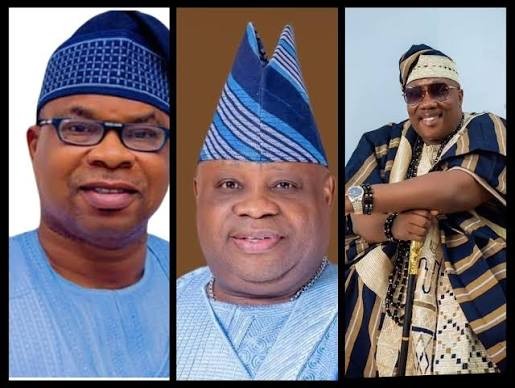
With barely six weeks to the Osun State off-cycle governorship election on August 15, 2026, political activity in the state is intensifying. Campaign visibility has grown across Osun, with streets filled with flyers and large banners carrying various political messages.
Every election matters, but Osun’s off-cycle governorship poll carries added significance. It will be the third election conducted under the recently signed Electoral Act 2026 and the final major contest before the 2027 general elections. The winning party will likely seek to use the victory as momentum going into the general election, while the APC and President Tinubu may view Osun as especially important because of its perceived ancestral ties to the president.
The race for the Osun State governorship is open to candidates from the fourteen accredited political parties in the state. However, it appears to be shaping into a two-horse contest between incumbent Governor Ademola Jackson Adeleke of the Accord Party and Asiwaju Bola Munirudeen Oyebamiji of the All Progressives Congress (APC). Dr Najeem Folasayo Salaam of the African Democratic Congress (ADC) has also emerged as a notable third-force candidate.
Each of the three candidates has distinct advantages. Governor Adeleke is campaigning on his record in office as the basis for re-election. Asiwaju Oyebamiji, a former state finance commissioner, has the support of former Governor Gboyega Oyetola, now Minister of Marine and Blue Economy, as well as the APC-led Federal Government. Dr Salaam, meanwhile, is a protégé of former Governor Rauf Aregbesola.
Another notable feature of the race is that the three leading candidates are all from the Osun West Senatorial District. Adeleke is from Ede North Local Government Area, Oyebamiji from Irewole Local Government Area, and Salaam from Ejigbo Local Government Area. This suggests that victory may depend less on their immediate political bases and more on the depth of their popularity across other regions and their ability to expand their influence beyond familiar strongholds.
The election’s outcome is likely to depend less on campaign rhetoric than on the issues voters consider most important, including internal party unity, voter turnout, security, and the credibility of the electoral process. Other key factors that may shape the outcome of the Osun State off-cycle governorship election also include the state’s political dynamics, insecurity and electoral violence, disinformation and misinformation, vote buying, and INEC’s preparedness.
The Political Dynamics
Since its creation in 1991, Osun State has remained one of Nigeria’s most fiercely contested governorship battlegrounds. Its elections are rarely decided by party affiliation alone; outcomes are often shaped by grassroots mobilisation, candidates’ personal appeal, governance records, regional loyalties, and shifting political alliances. The state’s history of changing party allegiance also explains why politicians approach its elections with caution.
So far, the political atmosphere has grown increasingly tense, with politicians recalibrating both internal party strategies and external alliances. Renewed rivalries are also emerging from grassroots communities to urban centres. This reflects the open nature of the race, where any candidate could win depending on their level of acceptance among voters.
Governor Ademola Adeleke’s camp has consistently highlighted his achievements since he took office in November 2022, particularly in infrastructure renewal, workers’ welfare, education, and healthcare. His supporters argue that these projects have boosted his popularity across many communities, especially among civil servants and rural voters.
However, opposition figures say the governor’s record may not be enough to secure re-election. APC candidate Bola Oyebamiji has repeatedly criticised Adeleke’s administration, accusing it of underdevelopment, payroll fraud involving ghost workers, and poor management of the state’s education and health sectors. ADC candidate Najeem Salaam has also criticised both the governor and the APC candidate, accusing them of contributing to the state’s governance problems. His endorsement by Aregbesola has further raised his profile as a potential contender.
Amid these fierce political dynamics, the leading candidates are holding their territories, suggesting that the Osun governorship election in 2026 is going to be more than an ordinary electoral exercise. It is likely to test the strength of incumbency, the effectiveness of opposition unity, the influence of grassroots mobilisation and the maturity of Nigeria’s democratic institutions.
Incumbency Vs Federal Might
Another factor that could influence the Osun governorship election is the possible contest between the incumbent governor’s political machinery and the Federal Government’s influence. Federal involvement in off-cycle elections is not new in Nigeria. In previous contests, the ruling party at the national level has often deployed significant political, organisational, and campaign resources to states it considers strategically important.
A similar pattern may emerge in the coming election, especially as the APC candidate has the President’s support. The ruling party may seek to use that backing to strengthen its position and bring Osun into its column. Because the election offers a chance to test campaign strategies, organisational strength, and voter sentiment ahead of the 2027 general elections, federal influence could be deployed to boost the APC’s chances.
On the other hand, Governor Ademola Adeleke also benefits from incumbency. As the sitting governor, he has greater public visibility, an established statewide political structure, and the chance to campaign on his administration’s record. His government has cited road infrastructure, prompt payment of salaries and pensions, improvements in education and healthcare, and social intervention programmes as evidence that continuity would serve the state’s interests.
Despite this, the governor has accused security personnel in Osun State of colluding with perpetrators of violence against residents. He argued that, despite the state’s history of political violence, the police have failed to make arrests because they have turned a blind eye. As a result, it remains unclear how incumbency and federal influence may be deployed in the election and how they could affect the outcome.
Insecurity and Electoral violence,
Ahead of the governorship election, Osun State is facing concerns over insecurity and political violence. There are fears that isolated incidents could escalate into wider unrest, disrupting campaigns, discouraging voters, and weakening confidence in the electoral process.
Citing security concerns, Inspector-General of Police Olatunji Disu paid a strategic visit to Osun ahead of the election. He met with security commanders, the Independent National Electoral Commission (INEC), traditional rulers, political parties, student leaders, and other stakeholders to review the state’s security arrangements and strengthen inter-agency cooperation. He also urged political actors and their supporters to obey the law, warning that the police would not tolerate any attempt to disrupt the electoral process. He warned politicians against harbouring criminal elements or using thugs to influence the election, stressing that anyone who undermines public peace would face the full weight of the law.
Electoral Flash Points
Following its election risk assessment, the electoral body identified 385 security flashpoints and about 200 hard-to-reach locations across the state’s 30 local government areas. It has shared the findings with security agencies to guide operational planning and introduced additional measures, including specialised training for election personnel and a neutrality oath for security officers deployed for the poll.
Against this backdrop, political analysts are urging the government to address insecurity before it escalates into a more serious challenge. Although security agencies have begun working with traditional institutions, religious leaders, and civil society organisations to promote peace, the problem must be resolved before the election to prevent voter apathy, voter suppression, and damage to the poll’s credibility.
Vote Buying and Voter Apathy:
Vote buying and voter apathy are two additional factors that could shape the Osun State election. Both were repeatedly identified in previous electoral cycles as major challenges capable of affecting the outcome and credibility of the governorship poll. While vote buying undermines the integrity of the ballot, voter apathy weakens democratic participation by reducing the number of citizens who cast their votes.
This practice has flourished amid economic hardship, inflation, and unemployment, which have left many voters vulnerable to politicians offering money in exchange for votes. Analysts warn that vote buying undermines democratic accountability by shifting electoral choices away from competence, policy, and performance toward immediate financial gain.
Similarly, voter apathy threatens electoral integrity in Nigeria by reducing participation and could significantly influence the outcome of the poll.
INEC Preparedness
Another key factor that could shape the Osun election is the preparedness of the Independent National Electoral Commission (INEC). As the electoral umpire, INEC must conduct the poll credibly and efficiently to build public trust and ensure the outcome is widely accepted.
A key area of focus will be the effectiveness of the Bimodal Voter Accreditation System (BVAS), introduced to improve voter accreditation and curb electoral malpractice. Its performance in previous elections has drawn both praise and criticism, and stakeholders expect INEC to strengthen reliability, provide adequate technical support, and prevent equipment failures from disenfranchising voters.
The 2026 Osun governorship election will be a major test of Nigeria’s electoral management system. INEC’s challenge goes beyond administering the poll; it must deliver a process that voters, political parties, and stakeholders consider fair, transparent, and credible.