
Constitution Review: Electoral Reform, Inclusivity, Local Government Autonomy, State Policing, Judicial Reform, Top Zonal Hearing
Key topics at the two-day Southwest public hearing in Lagos on the proposed 1999 Constitution amendment included electoral reform, greater inclusion for women, youths, and people with...

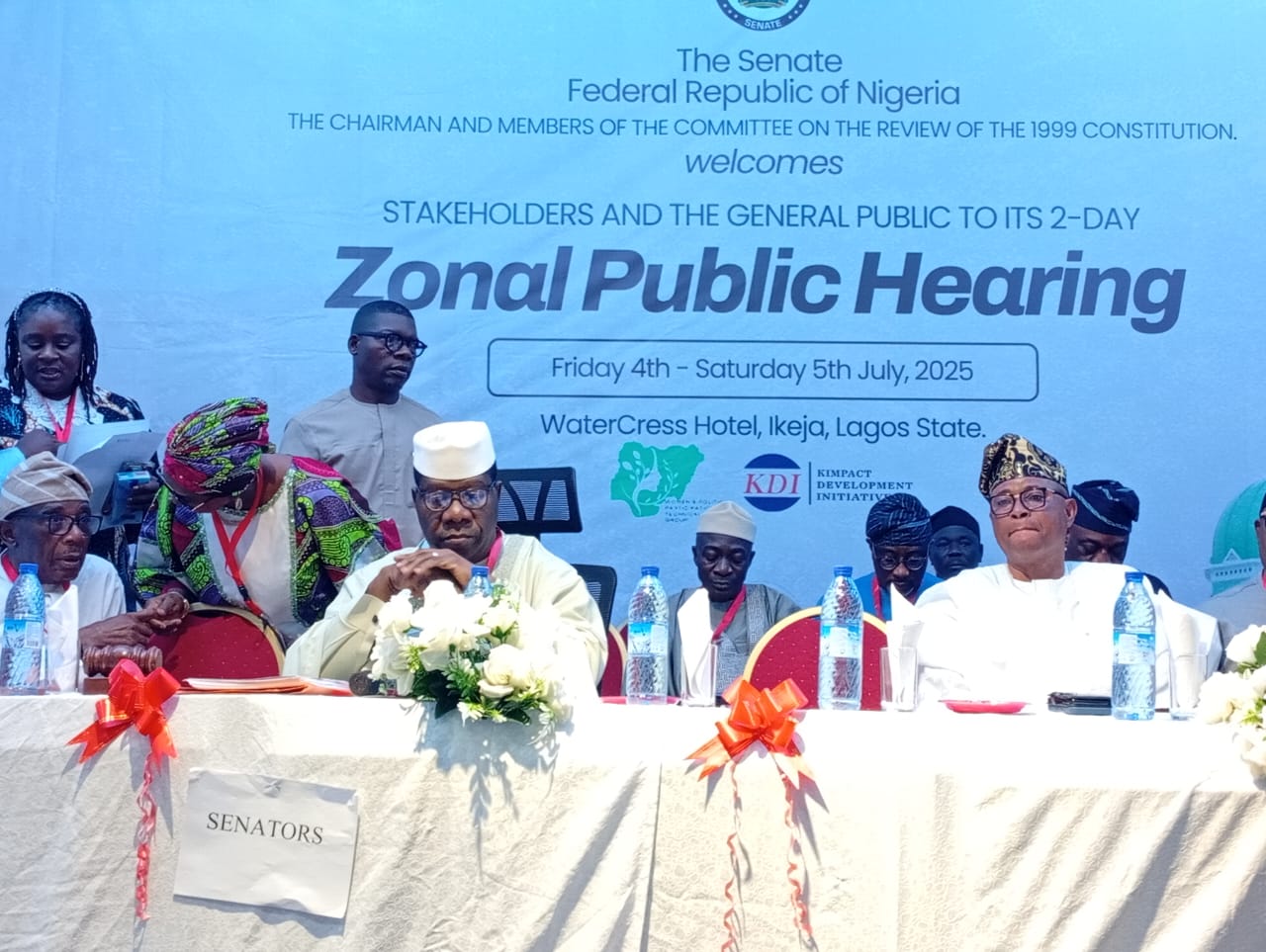
Key topics at the two-day Southwest public hearing in Lagos on the proposed 1999 Constitution amendment included electoral reform, greater inclusion for women, youths, and people with disabilities, judicial reform, local government autonomy, state policing, and devolution of power. The constitutional amendment hearing, which was held on July 4th and 5th, 2025, at the Watercress Hotel, was chaired by Senator Opeyemi Bamidele, the Senate Leader and Chairman of the Constitution.
The constitutional amendment hearing convened on 4th and 5th July 2025 at the Watercress Hotel was presided over by Senator Opeyemi Bamidele, Senate Leader and Chair of the Constitution Review Committee for the Southwest Zone. The session also included Senator Sharafadeen Alli, Senator Idiat Oluranti Adebule, and other Senate representatives from the region.
The hearing was attended by various stakeholders, including lawmakers, traditional rulers, representatives from the Southwest state Houses of Assembly, labour unions, women’s and youth organisations, and other relevant groups, who submitted their recommendations regarding the Nigerian Constitution.
The National Assembly is reviewing the 1999 Constitution to address persistent issues and new national needs. The House of Representatives is holding zonal public hearings to collect input from citizens nationwide.
Although amending the 1999 constitution has been attempted before, stakeholders at the hearing still shared their recommendations to promote consensus and successful reform.
Organised Labour Calls for Ongoing Minimum Wage Reviews, Electoral, Judicial, and Legislative Reforms

At the constitutional hearing, the Nigerian Labour Congress (NLC) called for prompt changes to address longstanding flaws in previous amendment proposals and highlighted concerns about workers’ rights and equal treatment for all Nigerians.
Mrs Funmi Sessi, NLC chairperson in Lagos, stated that organised labour opposes the proposal to move Labour provisions from the Exclusive to the Concurrent Legislative List in the 1999 Nigerian Constitution. She explained this change would allow state governors to set workers’ minimum wages.
Mrs Sessi reiterated that the organised labour’s stance against such a move would “void the national minimum wage system, which Nigeria signed up to through the ratification on June 16, 1961, of the International Labour Organisation (ILO) Minimum Wage-Fixing Machinery Convention No. 026. This will open the gates to slave wages across Nigeria.
“The removal of labour provisions would allow many state governors who already violate many laws to institutionalise the abuse of workers’ fundamental rights. Already, many state governments have shown such traits with the proscription of trade unions, even when trade unions are on the exclusive list.
“Our argument for the retention of the National Minimum Wage on the Exclusive Legislative List is also propelled by the fact that the National Minimum Wage is a tool for social inclusion and poverty reduction. The National Minimum Wage is a product of negotiations between Labour, the Organised Private Sector and the Government. During the negotiations, the government is represented at both the Federal and state levels, and some issues are taken into consideration with data provided by relevant federal and state institutions and agencies.”
Organised labour also called for reforms to Nigeria’s electoral system to restore trust in elections and support the country’s democracy and development.
In their memorandum, the labour representatives advocated for the adoption and implementation of the recommendations proposed by the Late Justice Uwais-led Electoral Reform Committee. These measures are intended to safeguard the independence of the Independent National Electoral Commission by granting it financial autonomy and restructuring the commission to include an electoral offences body, among other industry-standard reforms.
“On electoral reform, we have called for a holistic and genuine implementation of the Late Justice Uwais-led Electoral Reform Committee. The increasing anomalies, brigandage, criminality, acrimony, unrest and violence that have trailed recent elections in Nigeria attest to the deficiency of political decorum and democratic ethos by the political class.
“This trend has led to a serious erosion of public confidence in Nigeria’s electoral process, which is a grave threat to the sustenance of our hard-won democracy. The Nigeria Labour Congress insists, as we did before the 2007 electoral reform cycle, that the country needs an overhaul of our electoral laws now more than ever. A stitch in time might still save nine,” she warned.
Organised labour proposed judicial reform in the 1999 constitutional amendment, seeking clear legal provisions to ensure the judiciary’s financial independence. Mrs Sessi also urged the national assembly to grant fiscal autonomy to the judiciary, citing ongoing executive influence due to current financial arrangements.
“Pursuant to the ideals of equality before the law, balance between the administration of justice and its public perception, especially because justice shall not only be done, but must be seen to have been done, Organised Labour principally recommends fiscal autonomy and independence of the judiciary.
“Clear provisions should be made to guarantee the independence of the judiciary from control of the executive. funding of the judiciary should be under first-line items in the budgets and not tied to releases at the whims of the executive arm of government. Non-observance of section 162 (9) of the Constitution should be sanctioned. The section provides that any amount standing to the credit of the judiciary should be paid directly to the National Judicial Council (NJC) for disbursement to the heads of the courts established under the Constitution.
“The process of appointing judges while incorporating elements of advertisement, nomination and/or application and interviews should never be put up for election as the election of jurists will expose judges to individual biases and political scheming with huge risks to effective delivery of justice.
The labour unions also stretched their demands for full compliance with the existing alteration of the constitution, which grants the absolute autonomy to the state houses of assembly with the objection that the failure of the state legislative and judicial arms to the finances gives the executive the power to influence the integrity of the lawmakers in their respective states.
As a result, the labour unions asked the National Assembly to include that there is “full compliance with the 4th alterations concerning Section 121(3) of the 1999 Constitution, which grants full autonomy to State Houses of Assembly; a constitutional provision granting the Accountant-General of the Federation the power to deduct from source the money due to the legislatures and judiciaries of states from the monthly allocations of states whose executives fail to grant financial autonomies to the other two arms of government.” They said.
In their other demands, the organised labour called for devolution of power between the federal government and the state governments, stressing the limitation of powers placed on the states of the federation to perform optimally. They demanded the practice of true federalism in Nigeria, which would give the States more recognition to operate instead of being mere appendages to the federal government.
Group of State Lawmakers Advocated for State Policing and Increased Women’s Participation

In a succinct demand in the Nigeria Constitution amendment, the conference of the Southwest State Houses of Assembly asked the National Assembly to consider the implementation of an ongoing request for state policing across the country.
Rt. Hon. Elemide Oludaisi, the Speaker of the Ogun State House of Assembly, who spoke on behalf of the state lawmakers, emphasised the essence of state policing to the state’s security framework. He insisted that the localisation of the police system across the state is the solution to the widely expanding security challenges in the country
“The state policing, we know that it is going to be a very great catalyst and panacea for security to curb and eradicate all our security challenges in this part of the country, be it banditry or the farmers-herders crisis. We know that if we have state policing, we will know one another and be able to hold one another accountable and responsible for the crisis.
The southwest lawmakers also fault the reduction of women’s participation in key positions in the country. They demanded constitutional action for the inclusivity of women in key decision-making. “In governance, we are demanding more roles given to women, as we are for the She Houses of Assembly. In our operation, we always give recognition to our women, and that’s why we have deputy speakers who are women in some of our states. We stand by gender sensitivity. We are tendered towards such development,” the state lawmakers said.
Women Asked For Special Seats in National Assembly

In their demand for a more inclusive environment which will enable women to thrive, the National Council of Nigerian Women Society made a demand to the Senate to include in the Nigerian constitution a section that will preserve special seats for women in the National Assembly.
Addressing the Senate Constitution review committee on behalf of the south west region, Muminat Ajao, the Lagos president of the Society, maintained that their position is not a mere pleading for charity, but a significant step to correct the longstanding representation imbalance in the country. She asked the National Assembly to play an active role in ensuring that women’s ability to foster development in the country is celebrated by granting their demands
“We are here to correct the longstanding representation imbalance in our bold constitutional request. Women represent more than 49% of the Nigerian population yet occupy less than 5% of seats in the National Assembly. If this persistent under-representation has continued to make Nigeria reduce in development and responsive leadership.
“This is not about political charity; it is constitutionally relevant that we open the doors for capable and committed Nigerian women to serve their country at all levels. It creates a necessary framework for equitable participation, laying the groundwork for a more balanced and representative democracy in Nigeria. In every part of Nigeria, especially in the regions affected by insecurity and displacement, women are persistently being the backbones of the family and relatives of the survivors,” she said.
ActionAid made a Case For Youth Participation, LG Autonomy, fiscal reform, and electoral reform.
In its submitted memorandum of demands to the Senate Committee on Constitution Review, ActionAid, through its Coalition of Young People Under the Strategic Partnership Agreement II (SPA II) Project, enlisted some critical suggestions on inclusive governance, electoral reform, fiscal reform and local government autonomy.
The non-governmental organisation, in its presentation through Oluwatoyin Adejokun, its programme manager, wanted more inclusive youth participation and persons with disabilities in the Nigerian government and critical sectors of administration at the federal and state levels.
On the electoral reform, ActionAid advocated for voting rights for Nigerians in the diaspora. “It is recommended that Sections 77(2) and 117(2) of the 1999 Constitution be amended to extend voter registration and voting rights to Nigerian citizens residing outside Nigeria.”
They also recommended independent candidacy during the election and explicit mentioning of electronic transmission, as the constitution does not explicitly mention, urging the National Assembly to make the development compulsory.
They also recommended all pre-election petitions be conclusively determined before any elected official is sworn in. This will ensure that only candidates whose elections have been legally affirmed assume public office.
ActionAid also advocated for the elimination of caretaker committees, which implies that each state must have LGA elections every four years. They also call for the abolition of the State Joint Local Government Account and the direct crediting of LGA allocations from the Federation Account.
“We propose the introduction of a new provision in the constitution requiring LGAs to establish Youth Advisory Councils, Community Development Forums, and Gender Inclusion Committees. Amend the Constitution to create a National Local Government Electoral Commission (NALOGEC) as an independent body to conduct and supervise all LGA elections nationwide.
They also recommended “increasing the participation and inclusion of young people in elective positions; the reform should strengthen youth participation in politics by mandating at least thirty per cent representation for young people in party structures, candidate lists, and leadership positions. It is recommended that Section 49 of the 1999 Constitution be amended to ensure that 30% of party lists under the proposed proportional representation system are reserved for young people. The #nottooYoungtoRun Bill should also be reflected in the constitution.”
Similar recommendations concerning state creation, more local government creation, judicial reform, state policing, and local government were similarly made by other organisations that attended the hearing.
In his response, Senator Opeyemi Bamidele promised the stakeholders present at the hearing to submit all their recommendations to the National Assembly for consideration in the amendment of the 1999 constitution,