


Fact-Check: How Sharing Fake News Online Puts Nigerians at Risk
In today’s digital age, information travels faster than it used to be before. A single click on WhatsApp, Facebook, X (formerly Twitter), TikTok, or Instagram can send a message to thousands of...


In today’s digital age, information travels faster than it used to be before. A single click on WhatsApp, Facebook, X (formerly Twitter), TikTok, or Instagram can send a message to thousands of people within seconds.
Section 39 of the 1999 Constitution protects freedom of expression, including the right to hold opinions and share information without interference, reflecting the Constitution’s commitment to safeguarding free expression in any form or medium.
However, many social media users are unaware that sharing false information online, even when they did not create it, can open them to legal scrutiny under Nigeria’s Cybercrimes (Prohibition, Prevention, etc.) Act.
Misinformation and disinformation are rising in Nigeria, with false reports about elections, security, public health emergencies, banditry, terrorism, abductions, and communal conflicts frequently spreading online and causing panic and confusion.
Cybercrime Act on Misinformation and Disinformation?
Many people share content without checking its accuracy. Still, the consequences can be serious under the Cybercrimes (Prohibition, Prevention, etc.) (Amendment) Act 2024, which criminalises the intentional spread of false information through computer systems or networks when the sender knows it is false and shares it to disrupt law and order or threaten lives.
The prevalence of false reports about attacks, kidnappings, banditry, election violence, disease outbreaks, or the death of public figures has repeatedly gone viral in Nigeria. Such messages often trigger fear, unnecessary movement among people, and public disorder before authorities can clarify the facts.
Arrests Under the Cybercrime Act for Spreading Misinformation and Disinformation
The Nigeria Police Force on 10th April 2026 debunked a viral video circulating on social media alleging an ongoing terrorist attack in the Federal Capital Territory (FCT), Abuja.
This led to the arrest of Pam Joseph by the Nigeria Police Force for creating and sharing the false content, which authorities said was deliberately assembled from misleading online footage to cause panic, stir fear, and undermine public confidence in security in the nation’s capital.
The law also extends liability to those who “cause such messages to be sent”, meaning that anyone who knowingly helps circulate them may face legal consequences. Section 24 of the amended Act states that anyone who knowingly or intentionally sends a false message through a computer system to cause a breakdown of law and order or threaten life commits an offence and may, on conviction, be fined up to ₦7 million, imprisoned for up to three years, or both.
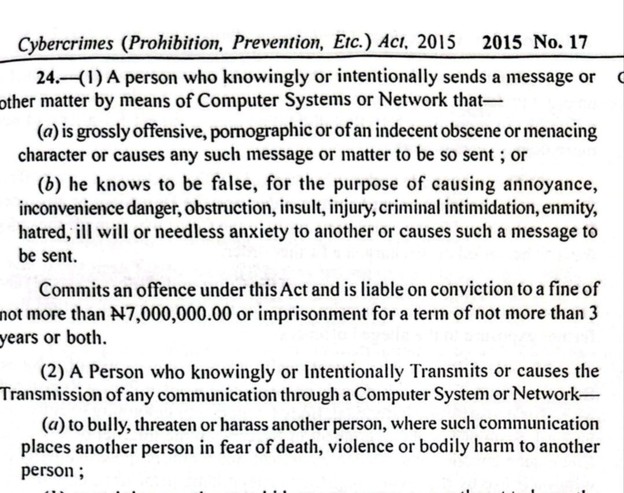
Excerpts from the Cybercrimes Act
Criminal Code Act on Misinformation and Disinformation?
The Criminal Code also makes clear that anyone who forwards a sensational message without verifying it may contribute to misinformation that causes public panic, harms reputations, or incites unrest.
Section 59 of the Criminal Code may apply to anyone who publishes or republishes false news intended to cause public fear, alarm, or disturb the peace. It prohibits the publication or reproduction of any statement, rumour, or report that is likely to cause fear and alarm to the public or disturb public peace, where the person knows or has reason to believe it is false.
The offence carries a possible three-year prison term. Lack of knowledge that the information was false is not a defence unless the defendant can show that they took reasonable steps to verify the accuracy of the statement, rumour, or report. As noted above, similar provisions have reportedly been adopted in state laws.
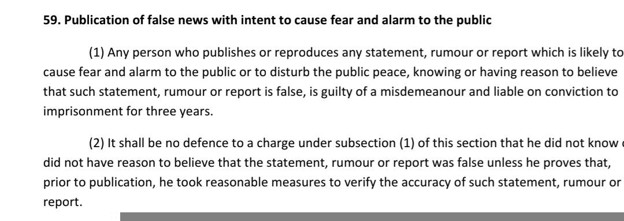
Part of the Criminal Code Act screenshot
As a result, many Nigerians fall foul of the Criminal Code and the Cybercrimes Act because they are unaware of these laws.
One example is @AdejumokeAder, who posted on June 2, 2026, that bandits had invaded Inisa and Oyan in Osun State’s Odo Otin Local Government Area, causing widespread panic and prompting schools to dismiss students early.
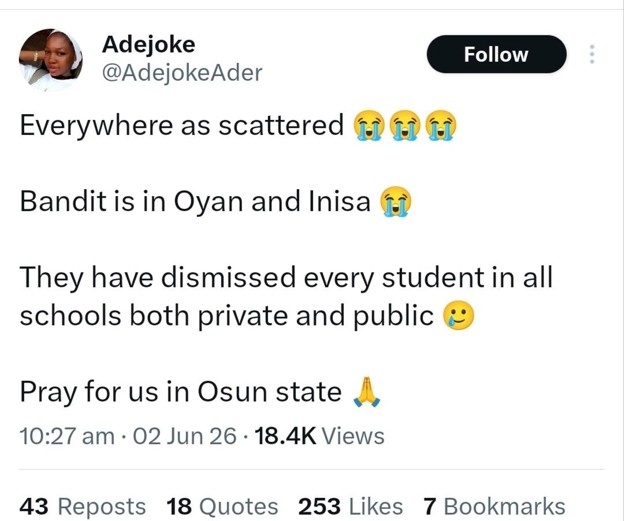
Screenshot from the X handle of AdejumokeAder
Following an NDRFactcheck report, the Nigeria Police Force Osun State Command said on its X handle, @NPF_Osun_State, that “The Command will take action against her unless she immediately posts a follow-up video disclaiming the false report and submits herself to clarify her reasons for the action, or she will face the full wrath of the law.”
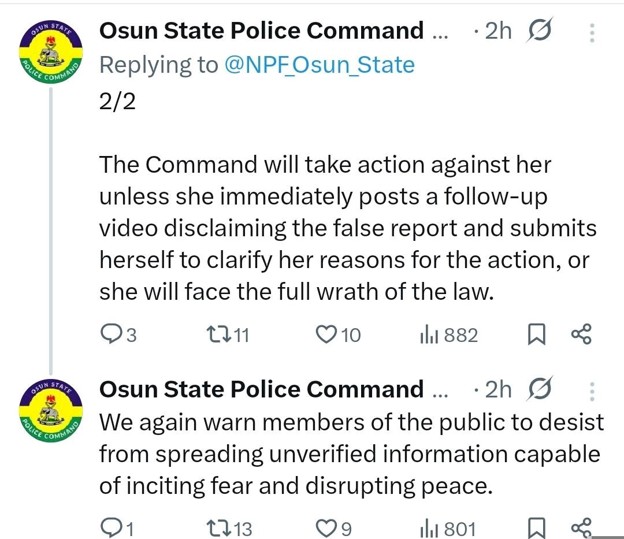
Screenshot from the X handle of Osun State Police Command
Responding to the police tweet, she said she had seen similar posts on Facebook and WhatsApp and that the rumour was already spreading. According to her, people were running in fear, schools were dismissing students, and even people in Lagos were calling to warn them to stay safe, which was why she shared the post.
This shows that the harm is not only legal but also social. When misinformation spreads unchecked, trust in credible institutions declines. People become unsure of what to believe, and real emergency warnings may be ignored because repeated false alarms have weakened public confidence.
Ultimately, although the Cybercrimes Act targets those who knowingly spread harmful falsehoods and the Criminal Code prohibits publishing or reproducing false statements likely to cause fear, alarm, or public disorder, the safest course for every Nigerian internet user is to pause and verify information before sharing it. In the digital age, a single careless click can spread misinformation, cause public harm, and lead to legal consequences.