






2027 Elections: INEC Begins 100-Day Countdown, Highlights Preparations, Achievements
As the Independent National Electoral Commission begins its 100-day countdown to the 2027 general elections, it says preparations have moved from planning to implementation, with nine of the 14 key...

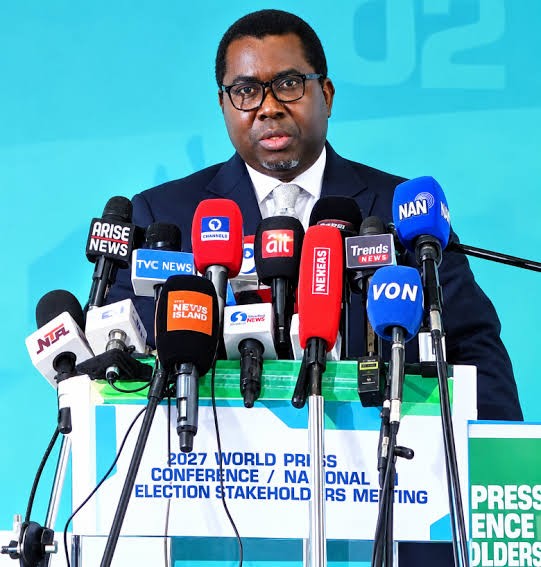
As the Independent National Electoral Commission begins its 100-day countdown to the 2027 general elections, it says preparations have moved from planning to implementation, with nine of the 14 key statutory milestones in its revised timetable completed.
INEC Chairman Professor Joash Amupitan disclosed this on Tuesday at a world press conference and national stakeholders’ meeting marking 100 days to the first ballot of the 2027 general elections. The event brought together key stakeholders in Nigeria’s democratic development.
The electoral commission chairman opened by expressing satisfaction with the elections conducted since he assumed office in October last year. He said the Anambra, Ekiti, and Osun governorship elections, as well as the FCT Area Council polls, allowed the commission to test its logistics, technology, and security arrangements ahead of the 2027 elections.
He also noted that beyond their internal assessment of the processes and activities and the reports submitted by local and international observers, every single one of these polls passed the benchmark of electoral integrity, underscoring the commission’s unwavering adherence to operational efficiency and credibility as they reaffirmed that the early deployment of ad hoc staff and sensitive materials, an agile logistics infrastructure, and precision-driven, intelligence-led security arrangements are the non-negotiable foundation for seamless election delivery nationwide.
Using the past activities as leverage, Professor Amupitan further said that the commission has gathered lessons learned from the experience that can reinforce the need for early deployment of personnel and sensitive materials, improved logistics, and intelligence-led security arrangements. He also noted that the timeline of the subsequent activities has been translated into an operational execution plan synchronised across the “23 Headquarters Departments and Directorates, 36 State Offices, the Federal Capital Territory (FCT), and all 774 Local Government Area (LGA) offices nationwide.”
Addressing the financial implications of the commission’s subsequent plans ahead of the coming elections, the INEC chairman stressed the need for robust financial backing and fiscal discipline. He noted that while the Federal Government has maintained its commitment to democratic governance through the timely release of statutory budgetary allocations to the commission, operating under a framework of transparent fiscal management, these funds have enabled the electoral body to meet international vendor obligations, finance the production of critical election technology, upgrade physical infrastructure, and sustain multi-stakeholder operational deployments nationwide.
Professor Amupitan, however, noted that the electoral commission expects the prompt release of the remaining budget to ensure seamless execution of the remaining activities, as he gave reports on the ongoing activities of the commission.
Lagos, Kano, Katsina Top PVC Registration
Giving the account of voter registration, Professor Amupitan said Nigeria’s National Register of Voters now stands at about 103 million following the conclusion of the three-phase Continuous Voter Registration (CVR) exercise and biometric verification.
He noted that Lagos has the highest number of registered voters, with 7,488,633, followed by Kano with 6,570,276 and Kaduna with 4,662,640. Katsina has 3,876,051 registered voters, Rivers 3,736,434, Oyo 3,588,111, Delta 3,525,988, Benue 3,057,225, Ogun 3,037,981 and Bauchi 3,012,547.
He also noted that Ekiti State has the lowest number of registered voters, with 1,055,708. It is followed by Bayelsa, which has 1,200,691 registered voters, while the FCT ranks next from the bottom with 1,732,043, followed by Yobe with 1,733,671 and Gombe with 1,768,566.
“Male voters account for 53,528,218, representing 51.75 per cent of the register, while female voters number 49,900,497, representing 48.25 percent. The age profile shows that the register is dominated by voters aged 35 to 49 years, who account for 43,265,946 voters, or 41.83 percent of the total. They are followed by voters aged 18 to 34 years, numbering 29,777,578, representing 28.79 percent. Voters aged 50 to 69 years account for 22,982,900, or 22.22 per cent, while those aged 70 years and above are the smallest age group, with 7,402,291 voters, representing 7.16 per cent.
INEC acquires 57,000 new BVAS, Establishes AI Department
The chairman of the electoral commission also announced the acquisition of 57,000 new Bimodal Voter Accreditation System (BVAS) devices as part of efforts to strengthen election technology.
Professor Amupitan said the devices had undergone software hardening, battery optimisation and biometric calibration, while a nationwide inventory and functionality test of the BVAS had been completed.
He noted that A six-day stress test of configured BVAS devices is scheduled for October 23 to 28, 2026. The commission is also upgrading its electronic results transmission system, with the enhanced eEC8A system designed to authenticate polling-unit result sheets before they are uploaded to the INEC Result Viewing Portal (IReV).
INEC has established an Artificial Intelligence Division within its ICT Department to support results verification and detect anomalies and possible cyber intrusions.
The INEC chairman also explained that the commission would do a nationwide mock accreditation and election simulation exercise, which is also scheduled for November.
Over 100,000 vehicles, 4,000 boats for election logistics
Addressing the transportation barrier the commission has been facing in the past polls, the chairman of the electoral commission disclosed that it has finalised an integrated logistics plan for the movement of personnel and election materials across the country.
In the plan, he said INEC had renewed its memorandum of understanding with major transportation bodies like the National Union of Road Transport Workers (NURTW), the Road Transport Employers Association of Nigeria (RTEAN), and the Maritime Workers Union of Nigeria (MWUN). This framework guarantees the early pooling, vetting, and mobilisation of over 100,000 vehicles and 4,000 boats to move personnel and materials.
He added that the commission has secured dedicated speedboats, 4×4 off-road vehicles, and local pack transport; escort protocols; and maritime safety equipment, including life jackets and waterproof material containers for difficult-to-access terrains in the Niger Delta, Lake Chad Basin, and high-altitude areas in the North-East and North-West.
According to INEC, sensitive materials will be moved from Central Bank of Nigeria vaults to Local Government Areas 72 hours before the elections and subsequently delivered to Registration Area Centers ahead of polling.
INEC Plans 1.4m Ad hoc Personnel
The commission disclosed that it would require 707,384 ad hoc personnel for each of the two election days, as it has done in the previous cycles, noting that the bulk of this workforce will be drawn from the National Youth Service Corps.
“This translates to 1,414,768 engagements across 176,846 polling units for the Presidential and National Assembly elections on January 16, 2027, and the Governorship and State Houses of Assembly elections on February 6, 2027. Recruitment opened on September 18 and will close on November 18, 2026”, said.
INEC said the National Youth Service Corps (NYSC) would remain a major source of ad hoc election personnel, with additional welfare, insurance, and security arrangements planned for corps members participating in the exercise.
INEC targets vote-buying, disinformation
The commission also announced plans to intensify monitoring of campaign finances and vote-buying ahead of the elections, stating that it is about to initiate joint security training for thousands of Electoral Security Personnel (ESPs) across national, state, and LGA commands. Precision-driven and intelligence-led security deployment will be done to guarantee the safety of voters, electoral materials, election personnel, and all stakeholders in the electoral process.
He noted that INEC would work with the Ministry of Justice, the Economic and Financial Crimes Commission (EFCC), the Independent Corrupt Practices and Other Related Offences Commission (ICPC) and the Nigerian Financial Intelligence Unit (NFIU) to monitor illicit campaign spending and financial inducements at polling locations.
Warning about the growing use of artificial intelligence, deepfakes, and voice cloning to spread false information during elections, the INEC chairman said the electoral commission has consistently raised awareness on fake and misleading information, adding that it will continue to intensify that effort as the elections draw near.
“We are responding on three fronts. The first is technology, through the AI Division and the AI auditing tools I mentioned earlier. The second is public education so that citizens can recognise synthetic content. The third is partnership with you in the media.
He further urged media organisations to establish fact-checking desks and use digital forensic tools to verify election-related information before publication. Amupitan specifically cautioned the media against announcing privately collated election results, stressing that the authority to declare election results rests with INEC.
Inclusive Election
Ahead of the election, INEC said it was also implementing measures to improve access to the electoral process for women, youths, and persons with disabilities. It said Braille ballot guides, voter education materials for persons with disabilities, magnifying glasses and sign-language interpreters would be provided as part of its inclusion strategy.
INEC said voter education activities would also be expanded through town hall meetings, native-language mobilisation, mobile cinema units and partnerships with civil society and community organisations.
The commission said it had moved decisively from planning into execution and expressed commitment to delivering a peaceful, transparent and credible 2027 general election.
“We reassure the nation and the international community of our total commitment to neutrality, operational excellence, and the sacred integrity of the ballot box,” Amupitan said.
Candidate nominations and Disputes
Professor Amupitan also addressed the nomination of the candidates, noting that political parties had submitted their candidate lists through the INEC Candidates Nomination Portal (ICNP), in line with Section 29 of the Electoral Act 2026.
The commission said it introduced a pre-uploading system for candidate names to protect the nomination process from unlawful exclusion and arbitrary substitution. The names were verified against INEC’s reports from party primaries and internal party appeal outcomes.
For the presidential election, INEC said 18 of the 22 registered political parties submitted a total of 36 presidential and vice-presidential candidates, stating that Accord, the All Progressives Grand Alliance (APGA) and the Youth Party did not field presidential candidates, while the New Nigeria Peoples Party (NNPP) withdrew its presidential nomination during the substitution window.
The commission said it received 112 formal complaints from aspirants, candidates and political parties over issues including unlawful withdrawal and substitution of candidates, typographical errors and other legal matters.
According to the commission, all the complaints had been investigated and resolved except those pending before the courts. However, he said some political parties and aggrieved aspirants had recently raised concerns following the Supreme Court judgement in INEC v. Zenith Labour Party, delivered on September 24, 2026.
The commission said the judgement affirmed the constitutionality of Section 77(5)-(7) of the Electoral Act 2026 and upheld its revised timetable for the 2027 general elections.








No Comment! Be the first one.