


EU-SDGN Election Observation Hub Deploys 843 Observers for Osun Election
…Makes Recommendations for Transparent, Credible, Peaceful Poll The European Union Support to Democratic Governance in Nigeria Election Observation (EUSDGN EOH) has deployed 843 observers...

…Makes Recommendations for Transparent, Credible, Peaceful Poll
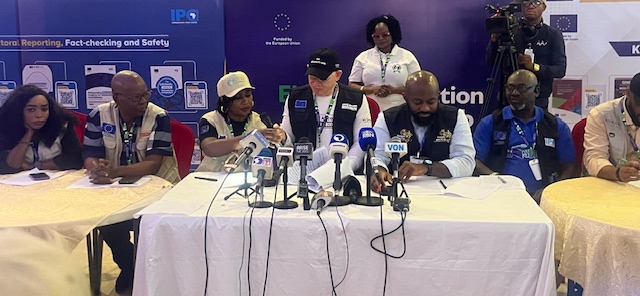
The European Union Support to Democratic Governance in Nigeria Election Observation (EUSDGN EOH) has deployed 843 observers across Osun State’s local government areas to provide comprehensive coverage of the August 15 governorship election.
The EUSDGN EOH, comprising the Centre for Media and Society (CEMESO), the International Press Centre (IPC), the Nigerian Women Trust Fund (NWTF), TAF Africa, the Kukah Centre (TKC), and Yiaga Africa, said at a press briefing in Osogbo on the eve of the election that the Hub will observe, document and report on the electoral process in strict adherence to the Declaration of principles for international election observation, the code of conduct for International Election Observers and in full compliance with the INEC Code of Conduct for Observers.
Below are excerpts from the group’s briefing:
INEC PREPAREDNESS
INEC has declared its operational, technological and logistical readiness for the election. The Resident Electoral Commissioner, Mrs. Oluwatoyin Babalola, has confirmed the configuration and full charging of all BVAS devices, the batching and distribution of non-sensitive materials and the arrival, inspection and delivery of the reprinted ballot papers with the inclusion of the SDP to the 30 LGA offices. An estimated 17,500 ad-hoc personnel have been recruited, trained and deployed for the election, and 97 Super Registration Area Centres (Super-RACs) and 105 RACs have been activated to decentralise deployment and support the timely opening of the 3,763 polling units by 8:30 am tomorrow.
The EU-SDGN EOH is aware that on Saturday, 1st August 2026, INEC conducted a mock accreditation exercise in four (4) locations in each of the three senatorial districts across 12 of the 30 LGAs in the State to test the functionality of the Bimodal Voter Accreditation System (BVAS). The exercise, which recorded a large turnout of potential voters, exposed some technical challenges, including the inability of some BVAS devices to recognise the biometrics of some voters at several polling units. INEC has since reported that the issues identified during the mock accreditation have been resolved and increased the number of BVAS devices from 4,427 to 5,130, with 1,367 BVAS as backups.
The Commission has also assured stakeholders that all polling unit result sheets will be scanned and transmitted directly to the INEC Result Viewing Portal (IReV) as soon as voting closes on Election Day. The Commission must sustain its vigilance and neutrality by ensuring the timely and flawless deployment of personnel and materials and the transparent, real-time collation, transmission and announcement of results on Election Day.
ELECTRONIC TRANSMISSION AND COLLATION OF RESULTS
The EU-SDGN EOH notes that Section 60(3) of the Electoral Act 2026makes it a legal requirement for Presiding Officers to electronically transmit the polling unit result (Form EC8A) to the INEC Result Viewing Portal (IReV). Where transmission fails due to communication failure, the signed physical EC8A remains the primary legal source for collation and declaration.
The EU-SDGN EOH is concerned about INEC’s introduction of an electronic EC8A on the BVAS as part of a validation step, without clearly stating where these results are sent or what purpose they serve. Furthermore, the results transmitted from polling units do not appear immediately on the IReV as they pass through an unexplained backend validation process before publication, with no public information on what is checked, who conducts the review, or how long it should take. This means that the physical EC8A, the scanned image on the IReV, the copy retained on the BVAS, and the electronically transmitted e-EC8A may exist with no explicitly stated rule on which version prevails if they differ.
The EU-SDGN EOH further notes that the IReV only publishes polling-unit results (EC8A) but not ward-level (EC8B) or Local Government-level (EC8C) collation results, leaving citizens unable to verify whether the total announced matches the individual polling unit results. In addition, Section 65 of the Electoral Act 2026 permits INEC to review a result declaration within seven days but only based on a report from its own officials, a narrow trigger that may limit this safeguard where the officials responsible for reporting are unwilling or unable to act.
PwDs have demonstrated encouraging levels of awareness, PVC collection and confidence in INEC’s preparations. The EU-SDGN EOH calls on INEC, security agencies, political parties, civil society organisations, and relevant stakeholders to ensure the full, safe, and unhindered participation of women, youths, and PwDs in the electoral process, including through the deliberate provision of transportation and assistive devices, gender-sensitive security planning, and priority voting for vulnerable persons.
VOTER INDUCEMENT, DISINFORMATION AND POLITICAL TENSION
The EU-SDGN EOH has identified the menace of vote buying and voter inducement as the highest threat to the credibility of tomorrow’s election, with reports of financial and material inducements circulating in the run-up to the poll. The Hub notes that INEC has indicated that plain-clothes financial intelligence officers, working with the EFCC and ICPC, will be deployed around polling units to deter and prosecute vote trading. Decisive evidence-based actions must be taken to monitor the activities of individuals involved in this ignominious act of wanting to turn our democracy into a plutocracy. They must be arrested, investigated and prosecuted to serve as a deterrent to others.
The pre-election information environment remains vulnerable to fake news, misinformation, disinformation and inflammatory political communication, particularly on Facebook, WhatsApp, TikTok, and X (Twitter). The Hub urges the media, civil society organisations, and regulatory bodies to intensify conflict-sensitive reporting and real-time fact-checking to prevent the escalation of tensions before, during and after the election.
EU-SDGN ELECTION OBSERVATION HUB RECOMMENDATIONS
To INEC
- Ensure the timely distribution of sensitive election materials to all polling units to guarantee that accreditation and voting commence by 8:30 am.
- Guarantee the seamless electronic transmission of validated polling unit results to the IReV portal in real time and maintain adequate BVAS backup capacity to avoid disruptions during accreditation and voting.
- Publish a clear protocol explaining the end-to-end results-transmission process, including the purpose of the electronic EC8A and the backend validation step preceding publication on the IReV, stating which version of a result prevails in the event of a discrepancy.
- Publish Ward (EC8B) and Local Government (EC8C) collation result sheets on the IReV alongside polling unit results to allow citizens, political parties and observers to verify results at every stage of collation.
- Ensure transparent and timely announcement of results at all levels, from polling units to Registration Areas, Local Government Areas and the State Collation Centre.
- Deploy trained personnel and adequate assistive voting devices to support the priority voting of women, youths, PWD, and other vulnerable persons.
To Political Parties and Candidates
- Respect the sanctity of the 30th July 2026 Peace Accord in its spirit and letter, accept the outcome of the election as declared by INEC and pursue any grievances through lawful and judicial means rather than protests, violence or self-help.