



First Batch of Nigerians Evacuated Home After Xenophobic Attacks in South Africa
Amid conflicting reports that 258 or 268 Nigerians were involved, the first group fleeing xenophobic violence in South Africa arrived in Nigeria on Thursday aboard an Air Peace flight, marking the...

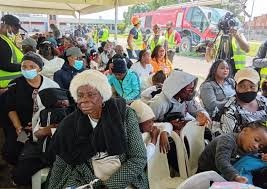
Amid conflicting reports that 258 or 268 Nigerians were involved, the first group fleeing xenophobic violence in South Africa arrived in Nigeria on Thursday aboard an Air Peace flight, marking the start of the federal government’s voluntary evacuation exercise.
The repatriation, originally scheduled for Monday, was postponed until Wednesday because of documentation issues. The returnees arrived at Murtala Muhammed International Airport in Lagos, where they were received by the Minister of State for Foreign Affairs, Sola Enikanolaiye.
Receiving the returnees on behalf of the federal government, Minister of State for Foreign Affairs, Sola Enikanolaiye, described the evacuation as a demonstration of President Bola Tinubu’s commitment to the welfare, safety and dignity of Nigerians living abroad.
The minister further disclosed that the federal government was engaging South African authorities at the highest diplomatic levels to ensure the protection of Nigerian nationals and address the factors responsible for the attacks.
According to the Ministry of Foreign Affairs, the evacuation exercise was coordinated in collaboration with the Nigerian High Commission in Pretoria and several government agencies, including the Ministries of Humanitarian Affairs, Aviation and Health, as well as the Nigeria Immigration Service and security agencies.
The federal government approved multiple evacuation flights to assist Nigerians willing to return home, as fears continue to grow among migrants affected by threats, intimidation, and attacks.
Foreign Affairs Minister Bianca Odumegwu-Ojukwu had disclosed earlier that more than 1,000 Nigerians have indicated interest in returning home, with the number of applicants continuing to rise as the security situation worsens. She said the evacuation became necessary after violent attacks forced many Nigerians to seek urgent relocation for their safety.
Odumegwu-Ojukwu said she could not attend the reception because she was in Addis Ababa holding talks to facilitate the transfer of more than 100 Nigerian prisoners from Ethiopian correctional facilities to Nigeria.
She said the prisoners are being held in Kaliti and Aba Samuel prisons in Addis Ababa and that four Nigerians have died in custody due to health complications and related causes.
The Ministry of Foreign Affairs stated that the federal government, in collaboration with relevant agencies, had put in place reception and support arrangements to assist returnees upon their arrival in Nigeria.
She explained that the Nigerian High Commission in Pretoria secured waivers from South African authorities to enable Nigerians with immigration-related challenges to return home voluntarily rather than face detention.
The screening of interested Nigerians, which began last Thursday, was extended until Sunday due to the increasing number of applications.
The Ministry of Foreign Affairs stated that the federal government, in collaboration with relevant agencies, had put in place reception and support arrangements to assist returnees upon their arrival in Nigeria.
Background of the Crisis
South Africa has experienced recurring outbreaks of xenophobic violence for more than two decades, often driven by economic hardship, high unemployment, poverty, and anti-immigration sentiments in some communities.
The latest tensions escalated following protests in certain communities calling for the removal of undocumented migrants. In some instances, groups reportedly issued ultimatums demanding that foreign nationals vacate neighbourhoods and informal settlements.
Nigerians, alongside migrants from Mozambique, Zimbabwe, Malawi, Ghana, and other African countries, have been among those affected by the violence. Many have reportedly faced intimidation, threats, forced displacement, and attacks on their businesses and homes.
Several Nigerian-owned businesses were vandalised or looted, leaving traders, artisans, and informal workers with significant economic losses. Many Nigerians also sought refuge in churches, community centres, and temporary shelters, while others remained indoors for fear of being attacked.
Students, professionals, and families living in migrant-populated communities have also reported experiencing hostility and uncertainty, with many now viewing voluntary repatriation as their safest option.