


Political participation in Nigeria is under renewed scrutiny as major parties set nomination forms at millions of naira, limiting access for wealthy elites and deepening concerns about the commercialisation of democracy.
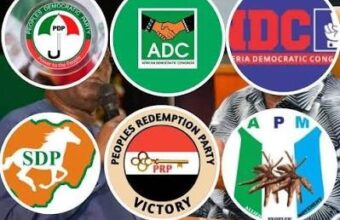
Ahead of the 2027 general elections, Nigeria’s dominant parties, including the All Progressives Congress (APC), the Peoples Democratic Party (PDP), the African Democratic Congress (ADC), and the Nigeria Democratic Congress (NDC), have maintained steep pricing structures for aspirants.
For instance, the APC fixed its presidential nomination and expression of interest forms at about N100 million, while the PDP has historically charged around N40 million for the same position, although it has yet to officially announce its fees for the election cycle.
Beyond the presidency, the costs are cut across other offices. In the APC, governorship aspirants pay about N50 million, Senate aspirants pay N20 million, and House of Representatives candidates pay N10 million.
The African Democratic Congress (ADC), like the PDP, has fixed N90 million for presidential aspirants, Presidential: N90,000,000, Governorship: N30,000,000, Senate: N10,000,000, House of Representatives: N5,000,000, State Houses of Assembly: N2,000,000.
However, comparable fee structures exist across other parties, often accompanied by administrative charges, delegate mobilisation expenses, and campaign logistics.
In a bid to promote inclusion, some political parties have introduced discounted nomination forms for women and persons with disabilities (PWDs).
The ADC concessionary rates and discounts for specific groups include Youth Aspirants (18–35): 50% discount and Women & Persons with Disabilities (PWDs): 25% discount.
Implications for Aspiring Nigerians Without Financial Power
Mr Olamide Adejumo, a public policy analyst, said the high cost of political party nomination forms in Nigeria has far-reaching implications for citizens and the country’s democracy.
He mentioned that when political forms are priced in millions of naira, participation is effectively limited to the wealthy or those with strong financial backing.
According to him, “When the cost of nomination forms runs into tens of millions, you are not selecting leaders; you are auctioning political power to the highest bidder, which may exclude many competent Nigerians who lack the financial means but possess the capacity to lead.”
Mr Adejumo mentioned that internal party democracy is weakened if fewer people can afford nomination forms, competition is reduced, and party elites are given greater control over who emerges as candidates.
“When only the rich can run, governance naturally tilts in favour of the rich, leaving ordinary citizens under-represented. This weakens internal democracy and reduces the quality of candidates presented to voters.”
“There is also a growing disconnect between leaders and the general population. When political offices are dominated by the wealthy, leaders may not fully understand or prioritise the everyday struggles of ordinary Nigerians. Over time, this widens the gap between the government and the people.
“When political offices are dominated by the wealthy, policy decisions are more likely to reflect elite interests rather than the needs of the majority.” Echoing this, a grassroots mobilisation expert said, “Leaders who emerge from such a system often lack lived experience of the struggles facing ordinary Nigerians.” He added.