
Stakeholders Call for Safeguards Amid Growing Threats to Press Freedom in Nigeria
Important voices from Nigeria’s media, civil society, and institutions are urging prompt, concrete steps to improve press freedom, warning that its decline could threaten the nation’s democracy and...

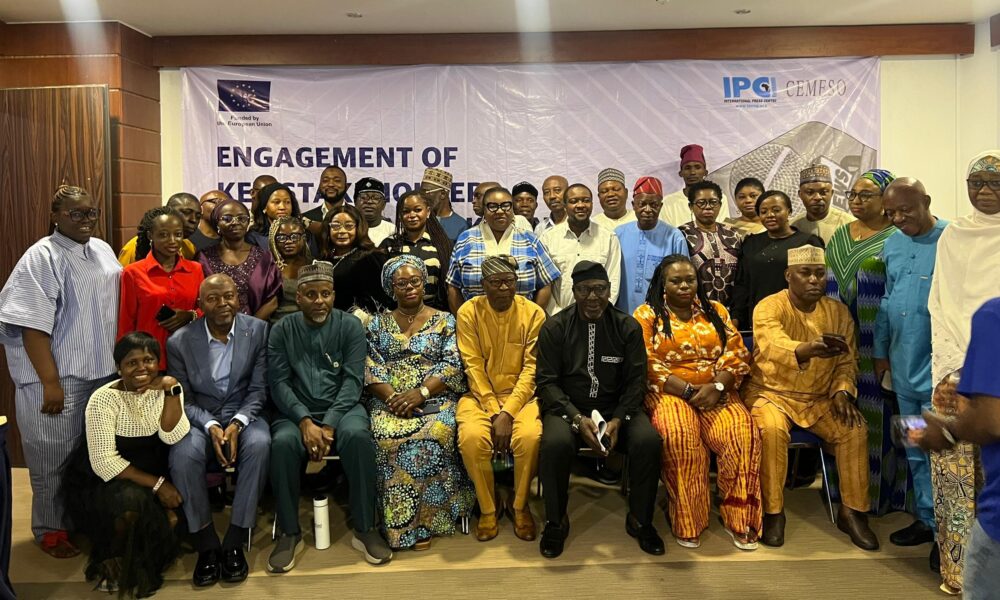
Important voices from Nigeria’s media, civil society, and institutions are urging prompt, concrete steps to improve press freedom, warning that its decline could threaten the nation’s democracy and accountability.
The call was made during a day’s “Engagement of Key Stakeholders to Tackle Attacks on Media Professionals and Strengthen Media Protection”, held under Component 4 (Support to Media) of the European Union Support to Democratic Governance in Nigeria Programme Phase II (EU-SDGN II), convened by the International Press Centre. The engagement revealed that numerous journalists in Nigeria are subjected to attacks, including beatings, physical assaults, and unlawful detention. These incidents are frequently attributed to political affiliates and security personnel. PC) and the Centre for Media and Society (CEMESO).
The engagement revealed that numerous journalists in Nigeria encounter various forms of violence—including beatings, physical assaults, and unlawful detention—frequently carried out by political loyalists and security personnel.
During his opening remarks, Mr Lanre Arogundade, Executive Director of IPC, emphasised the persistent and escalating concerns regarding journalist safety, noting that threats to media professionals are on the rise both internationally and in Nigeria.
“As we gather, we must acknowledge a sobering reality: the work of journalists and media practitioners has become increasingly dangerous,” he said.
“Across the globe and here in Nigeria, media professionals continue to face threats ranging from harassment and intimidation to unlawful detention and, in extreme cases, loss of life.”
He noted that media protection goes beyond the interests of journalists alone, describing it as central to societal development and democratic stability.
“Media protection is not solely a media issue—it is a societal imperative. A protected media space ensures that citizens are informed, voices are heard, and power is held accountable. Without these, the foundations of democracy and peace are significantly undermined.”
Mr Arogundade described the engagement as timely, saying it provided a platform for stakeholders to assess existing challenges, identify gaps in protection mechanisms, and develop sustainable solutions.
He emphasised the need for a multi-stakeholder approach involving government institutions, security agencies, the judiciary, civil society organisations, media institutions, and international partners.
Additionally, he urged stakeholders to prioritise the effective implementation of protective laws, improve rapid response systems for journalists under threat, and foster a culture where press freedom is respected in practice. He also highlighted the responsibility of journalists to uphold ethical standards, promote conflict-sensitive reporting, and combat misinformation.
Also speaking, the Executive Director of CEMESO, Dr Akin Akingbulu, said the engagement was not a routine gathering but a necessary response to a deteriorating media environment.
“This is not a platform for rehearsing grievances without consequence. It is a structured, evidence-led dialogue where every institution represented here will be asked to look directly at what the documentation shows and to leave with specific, time-bound commitments.”
“When journalists cannot report without fear, the damage does not stop at the press. It travels directly into governance,” the address noted.
Highlighting the risks faced by journalists, the discussion revealed that covering elections in Nigeria still exposes reporters to threats against their safety, livelihood, and liberty.
“They speak of a professional environment in which covering an election can still mean risking one’s safety, one’s livelihood, or one’s liberty,” Dr Akingbulu added.
“We have brought together the institutions that hold actual authority over the conditions this engagement is concerned with; change in this environment will not come from advocacy alone. It will come from the decisions of institutions.”
As part of ongoing efforts to improve journalist safety, the conveners disclosed plans to engage the Office of the Inspector General of Police to develop a Memorandum of Understanding (MoU) focused on safeguarding journalists, particularly ahead of future elections.
Several stakeholders at the event expressed commitments and recommended ways to strengthen press freedom and protect journalists.
A former Editor-in-Chief of The Guardian, Mr Martins Oloja, emphasised the importance of quality journalism in promoting accountability.
“Journalism has gone beyond the interpretation of press releases. The more people believe the government has something to hide, the more voices are held accountable. This is where quality works come from,” he said.
He also identified knowledge gaps as a major challenge, adding that “knowledge gaps are also a barrier. We need to keep sharing knowledge to strengthen our democracy and have a threat-free country for journalists.”
Dr. Yemisi Bamigbose, Executive Director of the Broadcasting Organisations of Nigeria (BON), pledged institutional support for implementing recommendations from the engagement.
“On behalf of BON, I promise on behalf of my organisation that whatever recommendations we bring together, we shall implement. We can’t afford to lose our members to violence and other attacks.”
Representing the National Orientation Agency (NOA), Dr. Olukemi Afolayan assured stakeholders of the agency’s commitment to promoting democratic values and supporting journalist protection initiatives.
“I encourage stakeholders to continue to strengthen democratic values. We would support initiatives that enhance the protection of journalists. We shall continue to play our roles,” she said.
Similarly, the National Human Rights Commission highlighted the broader societal impact of attacks on journalists.
Society faces serious consequences when journalists come under attack. We have investigative cases from End SARS to sex for grades issues. The role of investigative journalism in strengthening accountability can not be denied,” said Mrs Fatima Ahmed, who represented the Executive Secretary, Dr. Tony Ojukwu.
She added that the commission would continue to collaborate with law enforcement agencies and explore legal frameworks to better protect journalists.
The Nigeria Press Council also pledged to collaborate with journalists to safeguard their rights, while the National Broadcasting Commission advised broadcasters to exercise editorial responsibility.
“Freedom of expression comes with responsibilities. Fact-check your news,” the commission stated.
On his part, Deputy Executive Director of Media Rights Agenda, Mr Ayodele Longe, raised concerns over unlawful arrests of journalists.
“We have seen many cases of journalists arrested illegally for discharging their duties. We have followed up with several issues in the past, and journalists must not be afraid to report cases of threats and violence.”
He added, “This is not the time to let things slide; we need to work together towards strengthening accountability and press freedom in Nigeria.”
The President of the Nigeria Union of Journalists (NUJ), Comrade Alhassan Yahya, called for introspection within the profession, noting that internal challenges also contribute to the vulnerability of journalists.
“Most of the issues are internal issues. It is time for us journalists to change our attitude. We need to advocate for ourselves,” he said.
He pointed to low awareness of existing protection mechanisms and the need for improved sensitisation and better remuneration.
“Less than 1% of journalists know the mechanisms available to them. There is the issue of awareness; we need to sensitise the populace.”
Report on Journalist Attacks
The Executive Director of International Press Centre, Mr Lanre Arogundade, presented a verified incident data report documenting patterns of attacks on journalists, their sources, and the systemic issues enabling such violations.
The session included data presentations, contextual analysis, firsthand testimonies from journalists, and institutional dialogues, all aimed at fostering practical solutions.
According to the report, most journalists were beaten with sticks, physically assaulted and detained unlawfully; some were harassed by political loyalists, while cases of physical assault from government security personnel were reported.
Mr. Arogundade said, “What that evidence shows about the pattern of attacks and the structural conditions that sustain them will be presented to this room in full, urging participants to treat the findings with the seriousness it has earned.
Recommendations from the report included strengthening institutional advocacy for press freedom, ending the culture of impunity for attacks on journalists, reforming legislative frameworks on expression, addressing structural vulnerabilities within the media, and ensuring protection ahead of the 2027 elections.
Professor Tunde Akanni emphasised the need for collaboration among media development organisations and stakeholders.
“Media development organisations should ensure collaboration with stakeholders to advocate for changes on issues affecting the media space. We need to design strategies that address these issues,” he said.
The engagement concluded with a renewed commitment by stakeholders to move beyond rhetoric and adopt concrete measures aimed at improving the safety of journalists and strengthening press freedom in Nigeria.