The Special Seat Bill, which seeks to address gender imbalance in Nigeria’s parliament by adding seats, is still stalled at its second reading despite pressure from civil society and women’s groups. The Special Seats bill seeks to establish 74 additional legislative positions per state and in the Federal Capital Territory across the Senate, House of
The Special Seat Bill, which seeks to address gender imbalance in Nigeria’s parliament by adding seats, is still stalled at its second reading despite pressure from civil society and women’s groups.
The Special Seats bill seeks to establish 74 additional legislative positions per state and in the Federal Capital Territory across the Senate, House of Representatives, and state assemblies. These seats would be reserved exclusively for women, aiming to increase women’s representation beyond the current level of 5%.
Although a vote was scheduled for between November 4 and 6, 2025, the bill is still held up at its second reading in the House of Representatives and has not yet passed through the Senate.
Purpose of the Special Seat Bill
On July 9, 2024, the House of Representatives approved a Constitution Alteration Bill for Second Reading that would create special seats for women in both the National and State Assemblies. The bill proposes adding one seat per state and the FCT in the Senate and House of Representatives, totalling 74 seats reserved for women.
The bill proposed three special seats for women in each of the 36 State Houses of Assembly, totalling 108 seats. It has been sent to the Committee on Constitution Review for further consideration.
The objective is to substantially enhance the representation of women in the National and State Houses of Assembly, aiming for a more balanced distribution. At present, women occupy less than 5% of seats in the National Assembly, which ranks among the lowest proportions worldwide.
The bill, if passed, would raise female representation to approximately 20% at the federal level, closer to the United Nations-recommended 35% affirmative action threshold. Women would still hold only 17% of seats in the House of Representatives and 25% in the Senate, falling short of the United Nations’ 30% benchmark for female inclusion in leadership.
The Importance of Passing the Bill into Law
Although women constitute roughly half of Nigeria’s population, they continue to be markedly underrepresented in both elected and appointed political roles across all tiers of government.
Since 1999, women’s participation in governance has remained below the 35% inclusion goal, which may hinder progress toward Sustainable Development Goal 5 by 2030.
Currently, women represent 14.6% of the Nigerian parliament, compared to 85.5% for men. Across both the Senate and the House of Representatives, there are 451 male members and 17 female members.
The proportion of women in Nigeria’s parliament is lower than in other African countries, indicating their underrepresentation in decision-making.
As reported by the Inter-Parliamentary Union, Nigeria has the lowest rate of women’s representation in Africa at 7%. Specifically, women make up 3.9% of the House of Representatives and 2.8% of the Senate in Nigeria.
Countries like Rwanda, South Africa, and Burundi have the highest representation of women’s participation in the decision-making process.
Inclusive democracy lets everyone—not just the powerful, wealthy, or majority—help shape decisions. This broad participation gives democracy legitimacy and strength.
Women’s Groups, CSOs Advocate for the Passage of the Bill
Following the second reading of the Special Bill in 2024, limited progress has been made. Nevertheless, Civil Society Organisations, government officials, labour leaders, gender advocacy groups, stakeholders, journalists, and members of the public continue to advocate for the passage of the special seats for women in parliament.
At the 2025 National Public Hearing on the 1999 Constitution Review in Abuja, women-led groups like the Network of Women with Disabilities and NILOWV advocated for the Gender Inclusion bills.
A former Senator from Cross River South, Florence Ita-Giwa, explained that passing the gender inclusion bill would be a vital step towards equitable governance, noting that it “doesn’t lower the standard for women; instead, it elevates them. We cannot celebrate women only on Women’s Day. Women can lead, shape policy, and strengthen our democracy.”
“I appeal to my colleagues and indeed to the nation. Can you allow women to rule? Women cast their votes during elections, and I cannot deny the support of men in my own political journey. I rose to the position of Deputy Minority Leader through the backing of men. Now, we need that same support for women in leadership,” she said.
Also, Dr. Irene Awuna Ikhegh, President of NILOWV, speaking on behalf of women across the 36 states and the FCT, described the bill as critical to Nigeria’s democratic growth.
“Women represent more than 49% of Nigeria’s population, yet we hold less than 5% of seats in the National Assembly. This underrepresentation undermines development, stability, and responsive leadership,” she said. “This bill will open doors for capable, committed Nigerian women to serve at all levels.”
“If passed, this legislation will transform decision-making, create balance, and send a strong signal about Nigeria’s commitment to gender equality. The fact that the hearing is happening openly, in front of the people, shows democracy at work. Women are standing up for themselves, and in the end, we shall certainly be favoured,” she said.
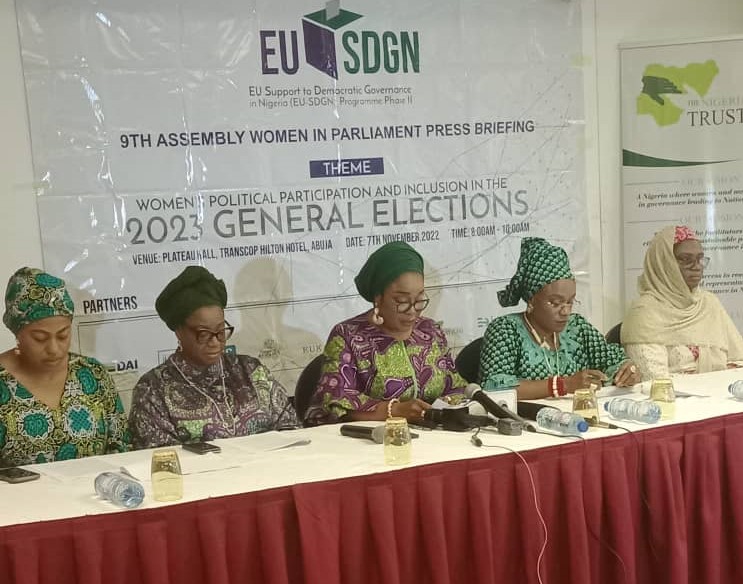
Advocating for the passage of the bill, a coalition of European Union-funded partners under the European Union Support to Democratic Governance in Nigeria (EU-SDGN II), which comprises Organisations such as PLAC, IPC, CEMESO, launched an Electoral reform which includes advocating for the inclusion of women in politics.
The National Chairperson of the Nigeria Association of Women Journalists (NAWOJ), Aisha Ibrahim, described the bill as a “moral and political statement of Nigeria’s commitment to true democracy. “If we fail this time, it’s not just a missed opportunity; it is a bad omen for our democracy. Success will demonstrate what collective purpose and strategic communication can achieve.”
Ms. Farida Nabegu, who founded the Uplifting Youth and Social Development Aid Initiative (UYSDAI), discussed obstacles that prevent women from taking an active role in decision-making and highlighted why the Nigerian government should consider the Special Seat Bill.
She recommended that the Nigerian government promote women’s participation by appointing more women to leadership roles and making advancement in governance easier for them. She also urged increased support among women, more mentoring groups, and advocacy and education to challenge stereotypes.
“Lastly, implementing and enforcing laws and policies that empower women to thrive.” She added.