The President of the Senate, Godswill Akpabio, has called for constitutional reforms aimed at increasing women’s involvement in politics and reinforcing Nigeria’s democratic institutions. During a consultative session with national chairpersons, secretaries, and women leaders of registered political parties in Abuja, Akpabio emphasised the necessity of establishing a more inclusive and accountable democracy through comprehensive
The President of the Senate, Godswill Akpabio, has called for constitutional reforms aimed at increasing women’s involvement in politics and reinforcing Nigeria’s democratic institutions.
During a consultative session with national chairpersons, secretaries, and women leaders of registered political parties in Abuja, Akpabio emphasised the necessity of establishing a more inclusive and accountable democracy through comprehensive reforms.
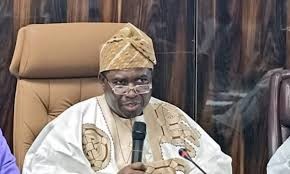
The Senate President, through the Senate Chief Whip, Senator Tahir Monguno, stated that the meeting with political stakeholders was intended to discuss democratic reforms at various levels.
He said, “We are here to discuss key national issues: justice, security, inclusion, accountability, judicial and electoral reforms, local government autonomy, special seats for women, state policing, and human rights. These are not just tasks, but fundamental pillars of our developing nation.”
He stated, “An election is essential to the functioning of democracy, and justice is fundamental to maintaining peace. The failure of electoral processes undermines public trust, while delays in justice erode confidence in the legal system. Therefore, it is necessary to strengthen both our electoral systems and judicial institutions. We should enhance the capacity of the Independent National Electoral Commission, protect the judiciary from corruption, and work to restore public confidence in these institutions.”
The Senate President compared other democracies, noting that India improves voting access in remote areas and South Africa’s constitution protects judicial independence.
He emphasised on the need to grant local government full autonomy, while also advocating for gender inclusion as critical to democratic growth citing examples from other countries.
According to him, “True federalism begins at the grassroots. If the government does not work in the village, it has failed in the capital. We must free our local governments from the chains of dependency. Development must have a human face and that face must be visible in every ward, every street, every home.”
“And what of the women of Nigeria who are the pillars of every family, the architects of every community? A democracy that sidelines its women weakens itself.
“Across the world, the evidence is clear: in Rwanda, women lead more than sixty per cent of parliament; in Finland, women shape policy and governance with distinction. Where women rise, nations thrive. It is time for Nigeria to move from the language of sympathy to the policy of inclusion.”
On national security, the Senate President reiterated the call for state policing, describing it as a practical solution for a country as vast as Nigeria.
“A nation as vast as ours cannot be protected from a single command post. The call for state policing is not rebellion; it is realism. In the United States, in India, and even in Brazil, local policing works side by side with national forces that are coordinated, not conflicting,” he said.
He, however, cautioned that security must not come at the cost of citizens’ freedoms: “The hand that guards must not gag. The shield of the state must never become a sword against its citizens.”
However, the Deputy National Chairman of the Inter-Party Advisory Council (IPAC), Dipo Olayoku, reaffirmed the group’s commitment to transparent and inclusive elections while calling for amendments to the Electoral Act 2022.
He said, “IPAC has been at the vanguard for constitution and Electoral Act Amendments with a view to consolidating, deepening and strengthening the nation’s democracy. This is imperative after flaws were witnessed in each election cycle.”
Olayoku maintained that reforms before the 2027 general election would help enhance the credibility and integrity of Nigeria’s electoral process, promote political stability and strengthen democratic governance.
“We believe that a revised Electoral Act and constitution amendments preceding the 2027 general election will address identified concerns as well as significantly enhance the credibility and integrity of Nigeria’s electoral process, promote political stability and strengthen democratic governance.”
He further urged the scrapping of the State Independent Electoral Commissions (SIECs) and the transfer of responsibility for conducting local government elections to INEC to ensure uniformity and independence.
To strengthen the Commission’s autonomy, IPAC proposed the removal of the President’s power to appoint the INEC Chairman, Secretary, and National Commissioners.
He advocated for the setting up of the Independent Appointment Committee composed of representatives from all registered political parties, civil society organisations, the National Judicial Council, and committees of the National Assembly.
The council also demanded the restoration of funding for political parties to ensure fair competition and called for greater financial transparency and accountability mechanisms within parties.