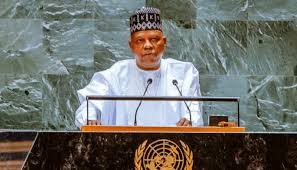
Nigeria is urging international partners to provide enhanced support in addressing significant security concerns, while also advocating for Africa to have a permanent, veto-holding seat on the United Nations Security Council. During the first plenary session on Peace, Security, Governance, and Multilateralism at the 7th African Union–European Union Summit in Luanda, Angola, Vice President Kashim
Nigeria is urging international partners to provide enhanced support in addressing significant security concerns, while also advocating for Africa to have a permanent, veto-holding seat on the United Nations Security Council.
During the first plenary session on Peace, Security, Governance, and Multilateralism at the 7th African Union–European Union Summit in Luanda, Angola, Vice President Kashim Shettima, speaking on behalf of President Bola Tinubu, made the proposals.
The summit is a two-day event from 24th to 25th November that brings together leaders from across Africa and Europe to address pressing global challenges, peace, and security collaboration, enhancing continental integration, and promoting sustainable development.
Speaking at the summit, President Tinubu urged the European Union to collaborate with Africa in co-creating solutions for peace and security.
He said, “Sustainable stability can only be achieved when such initiatives are anchored on African-led frameworks,” adding that local ownership of security measures is essential for long-term effectiveness.
He also cautioned against externally designed security interventions, particularly the growing reliance on private military companies. He noted that such approaches often fail and undermine the sovereignty of nations, leaving countries dependent on foreign actors.
“It is time for Africa to occupy permanent seats on the UN Security Council, with all attendant privileges, including the veto,” he added.
President Tinubu called for genuine, text-based negotiations under the Intergovernmental Negotiations (IGN) framework to achieve this goal, emphasising that Africa must have a decisive voice in global decisions affecting the continent.
Highlighting ongoing security threats in Africa, Tinubu pointed to armed conflicts, illicit arms proliferation, climate-related pressures, and irregular migration as critical issues requiring stronger AU–EU cooperation.
Citing examples from Nigeria’s experience, he noted that regional instability fuels terrorism, insurgency, and organised crime, with cross-border implications for peace and development.
On Nigeria’s counterterrorism operations, he highlighted the country’s combined kinetic and non-kinetic approach, which includes the Multinational Joint Task Force (MNJTF).
He mentioned that over 120,000 individuals associated with Boko Haram, including family members, have surrendered so far in 2025, marking significant progress in the fight against terrorism.
The presidency also referenced the recent Sea-Lift Agreement between the Nigerian Navy and the African Union Standby Force, describing it as a critical initiative that strengthens Africa’s capacity for rapid deployment in peacekeeping and humanitarian missions.
However, as Nigeria continues to face significant security challenges, including terrorism, insurgency, and organised crime. Having a permanent seat on the UN Security Council would allow Nigeria to advocate directly for solutions informed by its experience, ensuring that international responses support rather than undermine national and regional sovereignty.
A permanent seat on the UN Security Council would also strengthen Nigeria’s leadership within Africa, giving it greater authority to promote African-led frameworks for peace, security and sustainable development.
Through participating at the highest level of decision-making, Nigeria could facilitate stronger cooperation between the African Union and international partners, including the European Union, and push for more effective mechanisms to address armed conflicts, climate pressures, irregular migration, and illicit arms proliferation.