The International Press Centre (IPC) has released a report focused on restoring public trust in Nigeria’s electoral system and highlighting the need for gender-inclusive media to support democracy. Unveiled in Abuja, the report presents the results of a nationwide, media-driven dialogue series held across Nigeria’s six geo-political zones from 2023 to 2025. This initiative falls
The International Press Centre (IPC) has released a report focused on restoring public trust in Nigeria’s electoral system and highlighting the need for gender-inclusive media to support democracy.
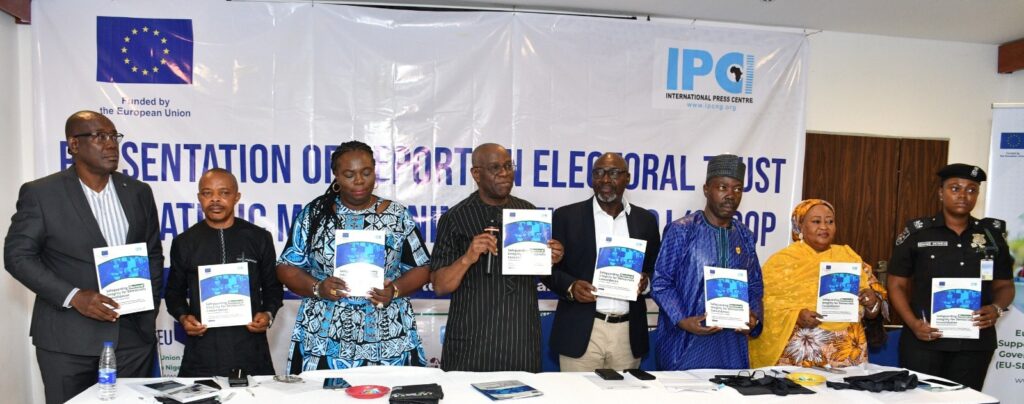
Unveiled in Abuja, the report presents the results of a nationwide, media-driven dialogue series held across Nigeria’s six geo-political zones from 2023 to 2025. This initiative falls under Component 4: Support to Media of the European Union Support to Democratic Governance in Nigeria (EU-SDGN II) programme.
Attendees included representatives from INEC, the National Orientation Agency, NAWOJ, the National Assembly, political parties, media, and civil society groups.
In his keynote address, Professor Okey Ibeanu of the University of Nigeria, Nsukka, stated that trust establishes the essential solidarity required to maintain the democratic system. He further noted that such trust is sustained by citizens’ confidence that leaders will adhere to established rules and act appropriately.
He asserts that the integrity of elections relies on the expectation that established rules will be observed and that those responsible possess the capability to conduct credible polls. Restoring confidence in the electoral process necessitates consideration of institutions beyond INEC, including the judiciary, legislature, security agencies, and the media, all of which are instrumental in fostering public trust.
“When this trust breaks down, the electoral process might as well be a system of robbery. There is a need for a social reconstruction that rebuilds trust across the board among citizens, and between citizens and institutions.”
Mr. Lanre Arogundade, Executive Director of the International Press Centre (IPC), presented an overview of the Safeguarding Electoral Integrity for Democratic Consolidation Report, which is based on IPC’s media-led, multi-stakeholder dialogues conducted throughout Nigeria’s six geopolitical zones. He emphasised that credible elections depend on all stakeholders consistently upholding transparency, accountability, and integrity to ensure the advancement of democracy.
He stated that credible elections require transparency, accountability, and cooperation from all parties involved—whether they are institutional, political, or civic.
Emphasising the importance of the report, Mrs Stella Nwafo, programme manager at the International Press Centre, stated that the event is more than just unveiling a document; it represents a renewed commitment to restoring confidence in Nigeria’s electoral process, institutions, and elections.
The report indicates that recent research and stakeholder consultations have demonstrated that public trust in electoral institutions is significantly influenced by the quality, consistency, and credibility of information provided throughout the electoral process.
“The media must not only report events, but also interrogate narratives, amplify marginalised voices, and hold all actors, political parties, security agencies, electoral bodies, and civil society accountable.” The report states.
The report is set against ongoing structural issues and public perception challenges that became evident during Nigeria’s 2023 general elections, which were closely watched by local and international observers.
Highlighting one of the forum’s key messages, IPC in the report emphasised that scrutiny of the electoral process should not be limited to the Independent National Electoral Commission (INEC).
“It is important to ask whether we have done enough to hold all stakeholders accountable for their roles, and just as crucially, whether we as media and civil society organisations have upheld transparency and responsibility in our own conduct.”
MOU with NAWOJ and GOCOP
Additionally, as part of the initiative to formalise collaboration, the event featured the signing of a Strategic Memorandum of Understanding (MoU) among IPC, the Nigeria Association of Women Journalists (NAWOJ), and the Guild of Corporate Online Publishers (GOCOP).
The agreement is intended to establish a conducive framework for effective, inclusive, and gender-sensitive reporting on elections, serving the public interest. Additionally, it aims to introduce performance benchmarks that promote greater accountability and elevate professional standards, with an emphasis on coverage of gender-related electoral matters and campaign commitments.
Aisha Ibrahim, National Chairperson of the Nigeria Association of Women Journalists (NAWOJ), stressed the importance of inclusive elections with active female participation as candidates, observers, and commentators. She noted that amplifying women’s voices strengthens social trust and democratic legitimacy.
She called upon electoral bodies, security agencies, and political parties to maintain transparency, fairness, and effective communication with the public, including transparent procedures for result counting and transmission, as well as impartial dispute resolution processes, to restore public confidence.
The MoU aims to encourage election reporting that is inclusive, impactful, and focused on the public interest, especially regarding gender issues and monitoring campaign promises. Additionally, it establishes benchmarks for performance to enhance accountability and raise professional standards in political journalism.
The position of the Nigeria Association of Women Journalists is as follows:
1)Trust in Election.
The Nigeria Association of Women Journalists (NAWOJ) recognises that trust is the lifeblood of any democratic process. When citizens believe that elections are credible, transparent, and fair, they are more likely to participate and accept outcomes peacefully. Conversely, a lack of trust fuels apathy, misinformation, and post-election violence.
The NAWOJ’s position is that restoring and sustaining trust in elections requires responsible journalism, gender inclusion, and citizen-focused communication.
2) The Importance of Trust in Elections
Legitimacy of Governance: Trust ensures that elected leaders are accepted as the true representatives of the people.
Citizen Participation: When voters believe their votes matter, turnout increases especially among women and youth.
Conflict Prevention: Transparent communication before, during, and after elections reduces tension and misinformation.
3) NAWOJ’s Perspective
- Promoting Transparency Through Ethical Journalism: NAWOJ believes journalists are the bridge between electoral institutions and the public. Women journalists, in particular, bring perspectives of fairness and human impact to political reporting. They advocate for fact-based, issue-driven reporting rather than sensationalism. NAWOJ promotes media accountability to build confidence in the electoral process.
- Combating Misinformation and Hate Speech: Distrust often grows from fake news, especially on social media. NAWOJ trains members to verify information and avoid amplifying unverified claims that can undermine electoral credibility.
It encourages collaboration with fact-checking organisations. It calls for the responsible use of media platforms during election seasons.
- Encouraging Women’s Participation: NAWOJ insists that inclusive elections are trusted elections. Women must be visible as voters, candidates, election observers, and commentators. By amplifying women’s voices, NAWOJ promotes broader social trust and legitimacy in democracy.
- Holding Institutions Accountable
NAWOJ urges electoral bodies, security agencies, and political parties to maintain openness, fairness, and communication with the public. Transparency in vote counting, result transmission, and dispute resolution is essential for restoring public confidence.
- Challenges Identified by NAWOJ
Some of the challenges identified by NAWOJ include persistent gender bias in political reporting and representation. Disinformation campaigns that target female candidates or journalists. Limited access to information from electoral bodies, which weakens accurate reporting, and Safety concerns for journalists covering politically charged environments.
- NAWOJ’s Call to Action
- Media Reforms: Strengthen ethical standards and gender balance in newsroom leadership.
- Civic Education: Partner with INEC, civil society, and schools to promote informed voting.
- Digital Responsibility: Use social media to promote peace, transparency, and participation.
- Institutional Collaboration: Engage with government agencies to enhance openness and information flow.
NAWOJ maintains that empowering and supporting female journalists contributes to upholding integrity, combating misinformation, and elevating citizen voices, all of which are fundamental to building public trust and consolidating democratic principles.