





INEC Explains Omission of Candidates’ Names, Gives Parties 14 Days to Seek Redress
In response to the controversy over the omission of governorship candidates from its latest publication, the Independent National Electoral Commission (INEC) said it acted in line with the Supreme...


In response to the controversy over the omission of governorship candidates from its latest publication, the Independent National Electoral Commission (INEC) said it acted in line with the Supreme Court judgment affirming the constitutionality of requiring political parties to submit their membership registers.
INEC has faced criticism from candidates whose names were omitted, some of whom have threatened legal action against the commission.
In a statement issued on Tuesday, 13 October, INEC said it would consider appeals from political parties submitted within 14 days of the list’s publication, in accordance with the Electoral Act.
The statement reads:
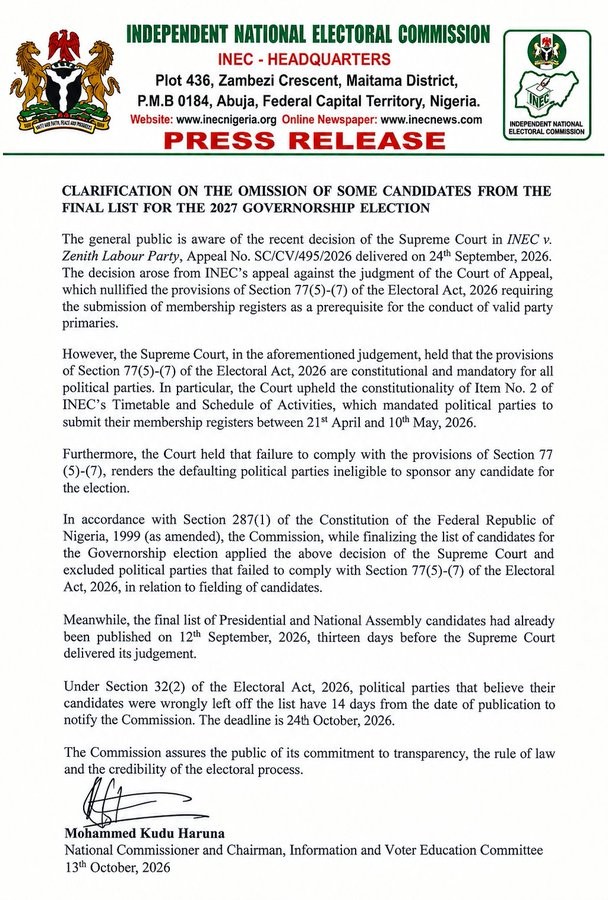
“CLARIFICATION ON THE OMISSION OF SOME CANDIDATES FROM THE FINAL LIST FOR THE 2027 GOVERNORSHIP ELECTION.
“The general public is aware of the recent decision of the Supreme Court in INEC v. Zenith Labour Party, Appeal No. SC/CV/495/2026 delivered on 24th September, 2026. The decision arose from INEC’s appeal against the judgement of the Court of Appeal, which nullified the provisions of Section 77(5)-(7) of the Electoral Act, 2026, requiring the submission of membership registers as a prerequisite for the conduct of valid party primaries.
“However, the Supreme Court, in the aforementioned judgement, held that the provisions of Section 77(5)-(7) of the Electoral Act, 2026 are constitutional and mandatory for all political parties. In particular, the Court upheld the constitutionality of Item No. 2 of INEC’s Timetable and Schedule of Activities, which mandated political parties to submit their membership registers between 21st April and 10th May, 2026.
“Furthermore, the Court held that failure to comply with the provisions of Section 77 (5)-(7) renders the defaulting political parties ineligible to sponsor any candidate for the election.
“In accordance with Section 287(1) of the Constitution of the Federal Republic of Nigeria, 1999 (as amended), the Commission, while finalising the list of candidates for the Governorship election, applied the above decision of the Supreme Court and excluded political parties that failed to comply with Section 77(5)-(7) of the Electoral Act, 2026, in relation to fielding of candidates.
“Meanwhile, the final list of Presidential and National Assembly candidates had already been published on 12th September, 2026, thirteen days before the Supreme Court delivered its judgement.
“Under Section 32(2) of the Electoral Act, 2026, political parties that believe their candidates were wrongly left off the list have 14 days from the date of publication to notify the Commission. The deadline is 24th October, 2026.
“The Commission reassures the public of its commitment to transparency, the rule of law and a credible electoral process.” The statement was signed by Mohammed Kudu Haruna, National Commissioner and Chairman of the Information and Voter Education Committee.
While some candidates, including the PDP’s Isa Pantami, have given INEC three days to correct their omission, others have yet to write, believing the commission should rectify errors it caused.







No Comment! Be the first one.