





Beyond the Ballot Summit Sparks Debate on Misinformation, AI and the 2027 Elections
The two-day Beyond the Ballot summit began on Monday with an engaging opening day, introducing participants to forms of disinformation, foreign information manipulation and interference, and the role...

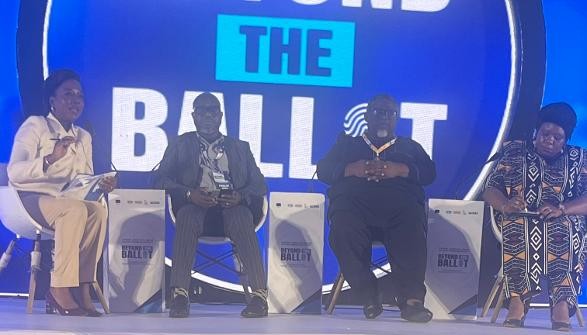
The two-day Beyond the Ballot summit began on Monday with an engaging opening day, introducing participants to forms of disinformation, foreign information manipulation and interference, and the role of artificial intelligence (AI) in election management and democracy more broadly. It also highlighted differing views among Nigerians on AI.
Supported by the European Union (EU-SDGN III), the Summit brings together over 300 stakeholders from INEC, media, civil society organisations, security, and technology sectors. It is being jointly organised by the International Press Centre, the Centre for Media and Society, and DAI.
The “Beyond the Ballot: Safeguarding Electoral Information Integrity in the Age of AI” summit was chaired by Prof. Atahiru Jega, former INEC Chairman, who warned against the unchecked use of artificial intelligence, stating that protecting electoral information from digital manipulation and malicious actors is now a critical priority for everyone involved.
Rather than avoid technology, he urged electoral management bodies—particularly the Independent National Electoral Commission (INEC)—to adopt AI-powered tools. He proposed official, INEC-backed chatbots with verified data to help voters quickly verify information, ask questions, and debunk false online claims or deepfakes before they cause harm.
Setting the tone for the summit, Dr Lanre Arogundade, the Executive Director, International Press Centre, in a statement on behalf of the organisers, said the summit was held against the background of certain presumptions: “During the 2023 general elections, the Nigeria Factcheckers’ Coalition found 63 per cent of presidential and National Assembly claims it reviewed were entirely false. False claims reached a second platform within eleven minutes on average. Over 1.2 million accounts following leading presidential candidates were judged inauthentic. Turnout fell to 26.7 per cent, the lowest since 1999.
Second, “Nigeria has about 148 million internet users. A recent survey of 829 voters across all six geopolitical zones found that 52 per cent get political news primarily from social media. In the South-East, over 82 per cent do so, and more than four in ten do not verify what they receive. Meanwhile, two-thirds of Nigerians (66.5 per cent) are extremely or genuinely concerned about AI-generated political misinformation.
“Third, the threat extends beyond Nigeria. Researchers documented 189 disinformation campaigns across Africa—four times the 2022 total—with West Africa most targeted at seventy-two. Researchers recorded organised social-media manipulation in at least eighty-one countries. Platforms have exposed and removed foreign-linked networks that reached Nigerian audiences.
“This Summit’s premise is simple: awareness alone is insufficient. Nigeria needs a trusted, coordinated, rights-respecting system enabling institutions to anticipate threats, verify evidence, escalate incidents, communicate authoritatively, and learn from each response.
“We welcome the Independent National Electoral Commission’s recent steps, including its new AI unit and assurance that algorithms will not decide the 2027 vote. We must ensure all institutions’ people, systems, and safeguards are ready before voting begins.”
At the “Beyond the Ballot: Safeguarding Electoral Information Integrity in the Age of AI” summit, the European Union Ambassador to Nigeria and ECOWAS, Gautier Mignot, warned that artificial intelligence (AI) and foreign information manipulation could severely undermine Nigeria’s 2027 general elections.
Addressing electoral stakeholders, Mignot described modern information manipulation as a fundamental attack on the public. Elections Can Be Undermined Remotely: He warned that “an election can be undermined without a single ballot being altered.” Malicious actors target information, he said, but their deeper aim is to undermine public trust.
In his remarks at the summit, the INEC Chairman stated that the election management body is not averse to technology and artificial intelligence, explaining INEC’s readiness for the 2027 elections.
“Our commitment to 2027 is rooted in technological resilience and transparency. We are prioritising voter education. Moving beyond “how to vote” to “how to verify,” ensuring citizens can distinguish official INEC communications from AI-generated deepfakes. Educating citizens on genuine platforms or Apps they can use to quickly verify deepfakes. As Aminu Kajuru, a digital communication expert, puts it, Nigeria should not wait until false information goes viral before responding, but institutions must use the “pre-bunking” method by educating citizens in advance about common misinformation tactics and giving them simple tools to verify information and, in addition, use short audio messages in local languages and Pidgin English, particularly through WhatsApp, to teach citizens how to identify fabricated information.
“Technological Safeguards: Strengthening our digital infrastructure to withstand Foreign Information Manipulation and Interference (FIMI). This requires investments in infrastructure and the support of our vendors.
“Real-time Response: INEC is establishing robust internal mechanisms to debunk viral misinformation within minutes of its emergence. And also partnering with global social media platforms such as TikTok, Facebook, Instagram, WhatsApp, YouTube, Facebook Messenger, Telegram, X (formerly Twitter), etc. We already have an MOU with TikTok,” he stated.
In a keynote address, Prof. Abigael Ogwezzy-Ndisika of the University of Lagos warned that the 2027 elections face severe digital threats, building on past issues like cloned statements and fake result sheets in 2023. Key vectors include sophisticated deepfakes, information manipulation, and foreign interference utilising local influencers.
She proposed an Electoral Information Integrity Response Protocol featuring early-warning systems, forensic verification, and rapid communication channels, while cautioning against overreaching measures like internet shutdowns.
Other informative and engaging sessions included an evidence briefing by Dr. Monday Ashibogwu and Prof. Lambe Mustafa and a fireside conversation on understanding FIMI in Nigerian and international contexts. Prof Umaru Pate moderated the conversation, with Kunle Adebajo of the Academy of Open Source Investigations and Elonal Hickok of the Global Network Initiative as panellists.
One of the most interesting sessions of Day One was on Votes, Voices, and Algorithms. Who is most exposed? It was moderated by Ms Maupe Ogun-Yusuf and featured Mr Dayo Oketola, Chief Press Secretary to the INEC Chairman, Mr. Ade Atobatele, Founder of Bootstrap Africa, and Dr. Toyosi Akerele-Ogunsiji, Founder of Rise Network.
The summit concludes tomorrow with other panel discussions, after which a communique will be issued with recommendations and next steps for action.








No Comment! Be the first one.