Dismissed Ministers List Accomplishments Amid Surprise Over Finance Minister’s Removal
The two dismissed Ministers, Wale Edun (Finance) and Umar Dangiwa (Housing and Urban Development), have highlighted their achievements in office, claiming their contributions helped drive national...

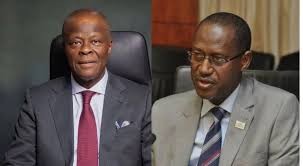
The two dismissed Ministers, Wale Edun (Finance) and Umar Dangiwa (Housing and Urban Development), have highlighted their achievements in office, claiming their contributions helped drive national progress and the president’s Renewed Hope Agenda.
In their respective reactions to the news of their dismissal, Mr Edun and Mr Dangiwa stated their roles in ensuring the country’s economic stability and growth, as well as their impact on job creation through the country’s housing department.
Mr. Wale Edun, who previously served as Minister of Finance and coordinating minister of the economy, was dismissed from his post yesterday and replaced by Mr Taiwo Oyedele, the Minister of State. Additionally, Umar Dangiwa, the former Minister of Housing and Urban Development, has been succeeded by Mr Muttaqha Rabe Darma (PhD), who has been nominated and designated as the minister for that ministry.
A statement released Tuesday by Yomi Odunuga, Special Adviser, Media and Publicity to the Secretary to the Government of the Federation, George Akume, stated that two ministers were to complete their handover to their new successors on Thursday.
It further added that the reshuffling of the cabinet was aimed at strengthening cohesion and synergy in governance as well as achieving more impactful delivery on the economy to Nigerians through the Renewed Hope Agenda.”
“He said the President, in approving the cabinet reshuffle, has fully exercised his powers as conferred on him by Sections 147 and 148 of the Constitution of the Federal Republic of Nigeria (1999, as amended).
“The President thanked the outgoing ministers for their services to the nation while wishing them the best in all their future endeavours. The President, Akume, noted and equally assured all cabinet members that “the process of reinvigoration shall be continuous”.
Mr Wale Edun’s dismissal from office came as a shock to Nigerians, especially as he had been one of the president’s closest allies, having served as the Lagos State Commissioner for Finance during President Tinubu’s administration when he was Lagos State Governor. Apart from that, Mr Wale Edun was the head of the transition committee that ushered in the new administration before he was appointed Minister in August 2023.
Meanwhile, there are speculations that the tension stemmed from complaints about Mr Edun’s management of the country’s budgetary allocations as well as the administration’s lack of capital budget releases and slow budget planning, which have repeatedly disrupted the country’s January-December budget cycle under his watch.
Furthermore, the outgoing minister was reportedly criticised by his fellow ministers, heads of departments, agencies and lawmakers for the slow release of funds for capital budgets, leading to the accusation that Mr Edun had recorded “zero implementation” of the 2025 capital budget despite the National Assembly approving a N1.15 trillion request to fund capital components.
Although the President intervened in the matter, he was said to be dissatisfied with the responses, as Mr Edun stated that the government had stopped the “unsustainable” practice of “printing money” to pay contractors and was now focusing on debt servicing.
Recently, the immediate coordinating minister has boasted to the world economic bodies that Nigeria was not seeking their support as the country’s economic resilience was visible for all to see, even though President Tinubu just approved securing another $6 billion external borrowing. Mr Edun has also been seen on different occasions contradicting the President on some economic developments and issues in the country.
Reacting to the development, Mr Edun recounted the country’s achievements during his tenure as the Minister of Finance and the coordinating minister of the economy, stating that he had contributed to the implementation of the administration’s economic agenda at a pivotal moment in Nigeria’s journey.
He further acknowledged the economic reforms introduced by the President, which “worked collectively across government to advance critical reforms that stabilised the macroeconomic environment, strengthened fiscal sustainability, and laid the foundation for inclusive and long-term growth. Key results of these efforts include growth improving from a rate of 2% to over 4% and inflation falling from 35% to 15%.
“These outcomes were driven by a shared commitment to restoring public trust and enabling faster and inclusive growth through greater investor confidence and improved economic coordination.
“I am proud of what we achieved alongside colleagues in the Federal Executive Council, State Governors, our partners in the public and private sectors, and the many dedicated professionals whose work continues to support the nation’s economic transformation.
Mr Edun also stated that while there is much left to be done, the direction is clear and the foundations are firmly in place to make the country a better place.
“I thank, too, all stakeholders, both domestic and international, for their collaboration, engagement, and support throughout this period of service. “The work of economic reform is, by its nature, a continuous process; I remain optimistic about Nigeria’s trajectory. I wish my successor and the entire government the very best as they continue the work of improving the lives of Nigerians.
I remain fully committed to the service of our country and supporting Mr President,” he said
Also, in his reaction to his dismissal, Arc. Ahmed Musa Dangiwa expressed his gratitude for serving and acknowledged the achievements he recorded as the minister of housing and urban development.
He stated that during his tenure, the housing sector served as a key driver of economic growth, job creation, and social inclusion. He cited the implementation of the Renewed Hope Housing Programme, the strengthening of public-private partnerships in housing delivery, and ongoing reforms in land administration and housing finance as key achievements during his tenure.
“I am grateful to my colleagues in the Federal Executive Council, stakeholders across the housing value chain, and the dedicated staff of the ministry and its agencies for their commitment and hard work. Together, we laid strong foundations for a more structured and sustainable housing delivery system in Nigeria,” he added.
While acknowledging the directive to hand over in line with the president’s decision, he assured a smooth and orderly transition, reaffirming his commitment to the continued success of the ministry.
A DEPLETING FEDERAL EXECUTIVE COUNCIL (FEC)
Meanwhile, the Federal Executive Council (FEC), the highest decision-making body of the executive branch of government, is gradually showing signs of depletion, with recent resignations, sackings, and looming political ambitions ahead of the 2027 general elections further reducing the numbers of the inner cabinet of the government.
While the President had dismissed some ministers in the past and brought their replacements, some of the ministers exiting are not necessarily due to performance but to pursue electoral ambitions in their respective states.
Recall that there was a memo released by the Secretary to the Government of the Federation (SGF), Senator George Akume, asking the ministers in the cabinet who are interested in pursuing any political ambition ahead of the 2027 general elections to resign their positions before March 31st, 2026.
In alignment with the directives, some of the ministers have tendered their resignations to pursue their political ambitions. Among those who have already exited the cabinet is Yusuf Maitama Tuggar, the former Minister of Foreign Affairs, who has declared interest in the Bauchi State governorship race. Similarly, Saidu Ahmed Alkali, former Minister of Transportation, has resigned to pursue the Gombe State governorship.
In the same vein, Yusuf Tanko Sununu stepped down as Minister of State for Humanitarian Affairs and Poverty Reduction on March 30, 2026, to contest a senatorial seat in Kebbi State, while Nkeiruka Onyejeocha has also exited the cabinet as Minister of State for Labour and Employment, on April 3, 2026 to return to legislative politics, seeking a seat in the House of Representatives from Abia State. Also, the recent promotion of Mr Taiwo Oyedele as the Minister of Finance has left the position of the Minister of State for Finance vacant.