APC Wraps Up Primaries, Names Tinubu Presidential Candidate for 2027
On Sunday, the All Progressives Congress (APC) concluded its primaries for all elective offices and announced President Bola Ahmed Tinubu as its presidential candidate for the 2027 election. In a...

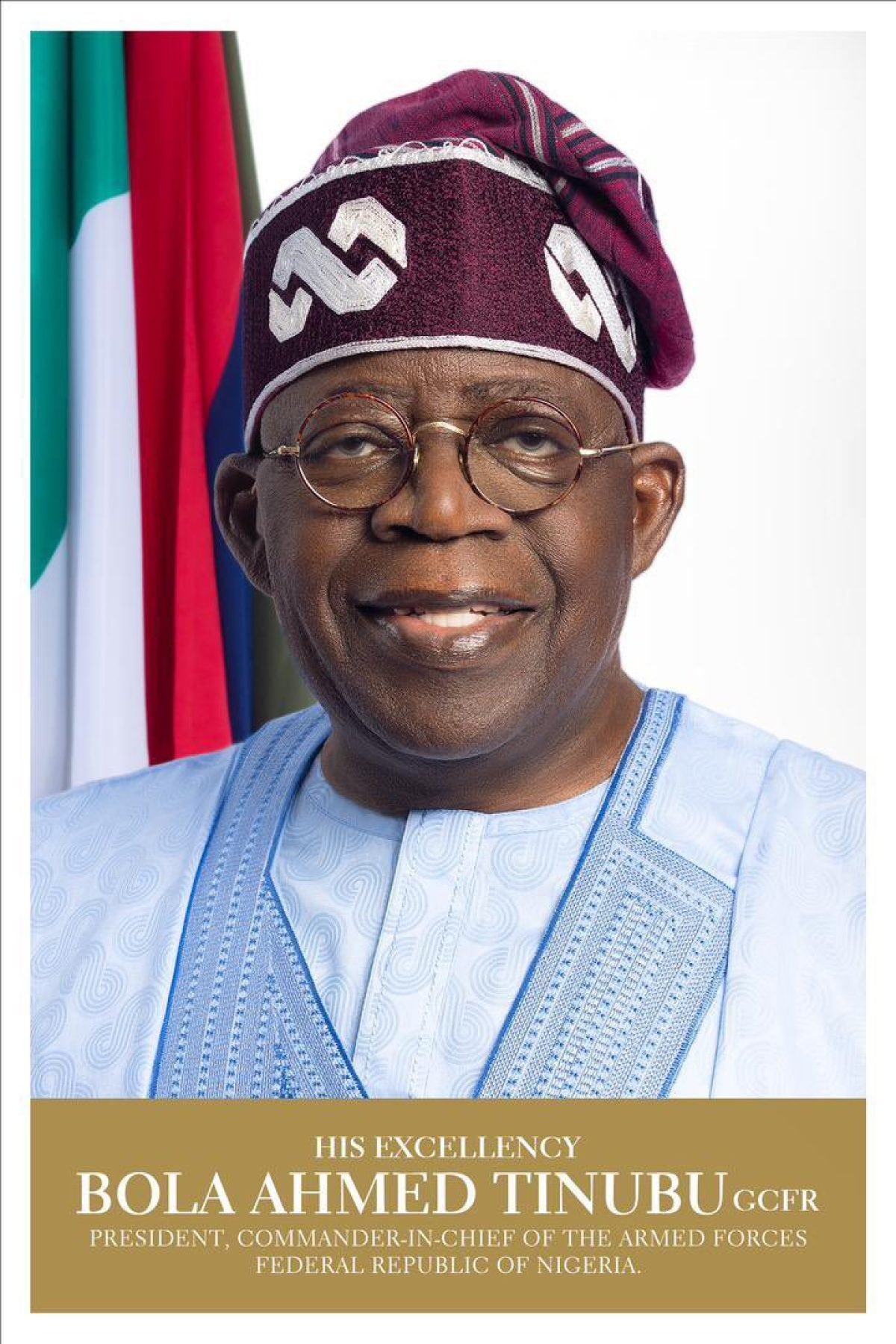
On Sunday, the All Progressives Congress (APC) concluded its primaries for all elective offices and announced President Bola Ahmed Tinubu as its presidential candidate for the 2027 election.
In a largely predictable primary, President Tinubu won 10,999,162 votes, defeating his challenger, Mr. Stanley Usifo, who received 16,503. Former Senate President Pius Anyim, chairman of the presidential primary committee, announced the results at the APC National Collation Centre in Abuja.
Senator Anyim gave other election details to include total registered voters as 12,643,306; accredited voters as 11,069,756; total votes cast as 11,015,665, with President Tinubu scoring 99.85% of total votes) while his opponent, Stanley Osifo, scored less than 1% of the total votes cast.
The direct primary election took place across all 36 states and the Federal Capital Territory, spanning 8,809 wards and 774 local government areas. It was the climax of the party’s primary elections.
President Tinubu won the 2023 presidential election with 8.9 million votes. Based on the primary results, more Nigerians appear to have joined his support base since that election. However, the NDR could not confirm whether the APC’s total vote count matched the membership register submitted to the Independent National Electoral Commission (INEC), which acknowledged receiving party registers without disclosing total membership figures.
The All Progressives Congress (APC) primary elections for the 2027 general elections took exactly 9 days to complete, running from 15 May to 23 May 2026.
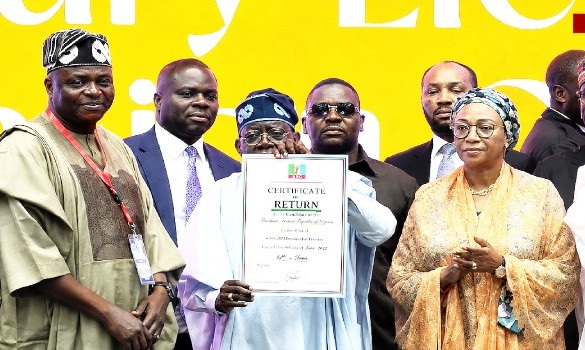
After the announcement of the results, the APC National Working Committee, led by National Chairman Prof. Nentawe Yilwatda, formally presented President Tinubu with his Certificate of Return and the official party flag. In his acceptance speech, President Tinubu extended a hand of fellowship to his critics and political opponents, calling for a collaborative effort toward national unity and development.
Before the results were announced, the sole challenger left his seat to congratulate President Tinubu, who welcomed him with a handshake. Mr Osifo then whispered a few words to the President, drawing a smile before returning to his seat.
In his acceptance speech, President Tinubu extended a hand of fellowship and called for a collaborative effort toward national unity and development.
“In accepting this nomination, I renew my commitment to serve our nation with even greater determination”.
Brimming with confidence. As if the presidential election was a done deal, President Tinubu said, “With another four years of disciplined focus and national cooperation, we will firmly place Nigeria on an irreversible path of economic expansion, industrialisation, energy security, infrastructure development, food sufficiency, and democratic consolidation,” President Tinubu said.
President Tinubu thanked governors, members of the National Assembly, the presidential primary elections committee, the APC National Executive Council, the National Working Committee and party members for giving him another opportunity to fly the party’s flag in next year’s election.
President Tinubu said his administration has achieved a lot in the last three years and urged party members to take pride in and showcase the party’s achievements since 2015, especially in the last three years.
“Our economy has undergone significant structural reform, supported by new tax laws and fiscal policies that have boosted revenue collection for the federation.
“We promised to remove the financial barriers to higher education for our youth. Today, we have established the Nigerian Education Loan Fund, with over N282 billion disbursed and over 1.5 million beneficiaries.
“We promised an improved power supply and an end to estimated billing. In the past three years, we have closed the metering gap by supplying 2.5 million meters via the Presidential Metering Initiative. We have established a N4 trillion bond programme to settle verified legacy debts owed to GENCOs and GASCOs. Under our administration, power generation sometimes peaked at 6000MW, 50 per cent higher than we had inherited. Our strategy is focused on redesigning the power sector into a bankable, investable, and capable sector that delivers power to homes and industries.
“We moved away from wasteful fuel subsidies, unstable exchange rates, and weak infrastructure. Today, we are witnessing a turnaround: the naira is strengthening, foreign reserves are rising, and our economic outlook is positive despite the inflationary disruption caused by the war in Iran and the geopolitical crisis in the Middle East.
“We have strengthened macroeconomic stability through improved revenue performance, financial management, and better fiscal coordination,” the President stated.
“We are building concrete, durable roads and superhighways along the coast and on the Sokoto-Badagry route that will last for over 100 years. We are improving our airports and seaports after decades of neglect. We have reformed the oil and gas sector and are attracting billions of dollars in fresh investment in a sector that was almost comatose.”
“Our mission remains clear: To build a Nigeria where every life, including property, is secure, where enterprise thrives, where workers earn with dignity, where young people find opportunity, and where farmers prosper. And where every Nigerian, regardless of background, can dream big and succeed.
“To those who may disagree with us politically, we extend a hand of partnership in nation-building. To those who differ with our philosophy, we offer dialogue and engagement, confident that the sincerity of our purpose and the results of our work will speak for themselves.
“Democracy is sustained not by uniformity, but by diversity, by a shared belief in the nation and the blending of ideas.”
The event drew many of the APC’s top figures, including all its state governors, who announced results from their respective states as chief returning officers.
Some criticisms that have greeted the primary elections include a lack of proper accreditation, as party members were admitted to voting areas with their digital registration slips without their names being cross-checked against the registers; another is the bloated system of counting by skipping numbers.