Only two women will appear as governorship candidates in the November 8, 2025, election, notwithstanding that women constitute 49.3 per cent of registered voters. The female candidates in the 2025 governorship race are Chioma Grace Ifemeludike of the African Action Congress (AAC) and Ndidi Christy Olieh representing the National Rescue Movement (NRM). There are, however,
Only two women will appear as governorship candidates in the November 8, 2025, election, notwithstanding that women constitute 49.3 per cent of registered voters. The female candidates in the 2025 governorship race are Chioma Grace Ifemeludike of the African Action Congress (AAC) and Ndidi Christy Olieh representing the National Rescue Movement (NRM).
There are, however, six female Deputy-Governorship Candidates, namely, Appolonia Ezeadili, Accord (A), Uche Lilian Ekwunife, All Progressives Congress (APC), Blessing Ebele Okeke, Action People’s Party (APP), Happiness Ugboma, Boot Party (BP), Ifeoma Veronica Okaro, Labour Party (LP), Chibuzo Faith Obi, Zenith Labour Party (ZLP).
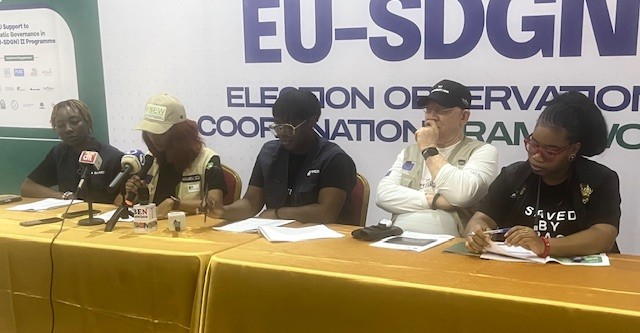
ElectHER, which is monitoring the election for gender inclusivity and barriers against women, is one of the seven EU-SDGN implementing partners that have set up a situation room to monitor the Anambra governorship election. Others are the Kukah Centre, YIAGA Africa, International Press Centre (IPC), Centre for Media and Society (CEMESO), Nigeria Women Trust Fund (NWTF), ElectHER and TAF Africa. They are operating from a unified Election Observation Hub designed to ensure coherence, message alignment and shared visibility throughout the poll.
According to INEC, 2,769,137 out of 2,802,790 registered voters successfully collected their cards following an extension of the collection deadline across all 326 Registration Areas in the state.
In ts pre-assessment analysis for the election ElectHER Chief Executive Officer, Ibijoke Faborode, emphasised the paradox in Anambra politics, where women account for up to 50 per cent of new voter registrants in the state yet occupy just 0.6 per cent of elected positions.
Female participation in Anambra’s governorship elections has fluctuated over time; from no female contenders between 1999 and 2003, to 14.3% in 2007, dropping to 8.33% in 2010 and disappearing entirely in 2013. It surged to 13.5% in 2017, then slightly declined to 11.76% in 2021 and rose again to 12.5% in 2025.
While inconsistent, these trends point to a gradual yet meaningful shift toward women’s increased visibility in political leadership.
Anambra’s 2025 governorship election reflects both progress and persistent gaps in gender inclusion. Only 1 in 8 governorship candidates is a woman, though a higher share of deputy governorship candidates are female, suggesting parties may be using these roles to boost gender optics rather than promote women’s leadership. Over 4 in 5 women intend to vote, yet nearly one-third face challenges accessing PVCs, and fewer than half perceive female candidates as visible.
Strategic Recommendations are as follows:
- Strengthen candidate visibility:
Political parties and civil society should amplify female candidate campaigns through targeted media strategies and voter outreach initiatives, particularly in underrepresented constituencies.
- Address systemic barriers to participation: Electoral authorities should ensure that challenges in PVC collection and other logistical hurdles disproportionately affecting women are mitigated ahead of election day.
- Promote gender parity in nominations: Parties should institutionalise measures to encourage more women to contest governorship positions, not only deputy slots, to shift from token representation to substantive leadership.
- Leverage technology and social platforms: Given women’s lower share of online reach, digital campaigns and social mobilisation should be strategically expanded to enhance awareness and engagement.
- Ensure gender-sensitive election security: Security agencies and electoral bodies must proactively address risks of violence against women and other vulnerable groups, particularly in flashpoint LGAs, to create a safe environment for participation.
In sum, while Anambra shows encouraging signs of female political engagement, realising meaningful gender inclusivity requires both structural reforms within parties and systemic support from electoral institutions to convert intent and potential into actual political influence.
However, political analysts have narrowed the contest to only four candidates, namely: the incumbent governor, the candidate of the All Progressives Congress (APC), Nicholas Ukachukwu, the candidate of the Labour Party (LP), George Moghalu, and the candidate of the African Democratic Congress (ADC), John Chuma-Nwosu.