The tortuous journey of the tax reform bills to the final reached a remarkable conclusion on Thursday, as President Bola Tinubu gave his assent to the legislation to reform Nigeria’s tax system today. The President signed four tax bills into law at the Presidential Villa in a ceremony attended by members of the National Assembly,
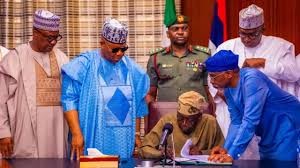
The tortuous journey of the tax reform bills to the final reached a remarkable conclusion on Thursday, as President Bola Tinubu gave his assent to the legislation to reform Nigeria’s tax system today.
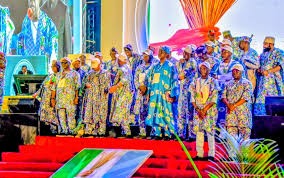
The President signed four tax bills into law at the Presidential Villa in a ceremony attended by members of the National Assembly, including legislators, governors, ministers, and aides of the president. A new tax regime will become effective in the country in January 2026.
The four bills are the Nigeria Tax Bill 2024, intended to reform the nation’s taxation policy, and the Tax Administration Bill, designed to establish a clear legal framework and resolve ongoing tax disputes. Additionally, there is the Nigeria Revenue Service Establishment Bill, which proposes to replace the Federal Inland Revenue Service Act with the Nigerian Revenue Service, and the Joint Revenue Board Establishment Bill, which aims to create a tax tribunal and tax ombudsman.
During the bill-signing ceremony, the President stated that the tax system reform extends beyond simplifying tax codes. The goal is to implement tax cuts intended to benefit low-income earners, small businesses, and families.
He emphasised that the new laws will address the issues in the country’s tax system, which he called “complex, inequitable, and burdensome,” affecting the vulnerable and concealing inefficiencies.
“We are laying the foundation for a tax regime that is fair, transparent, and fit for a modern, ambitious Nigeria. A tax regime that rewards enterprise, protects the vulnerable, and mobilises revenue without punishing productivity.
“The four bills – the Nigeria Tax Bill (Fair Taxation), Nigeria Tax Administration Bill, Nigeria Revenue Service (Establishment) Bill, and the Joint Revenue Board (Establishment) Bill, will unify our fragmented tax system, eliminate wasteful duplications, cut red tape, restore investor confidence, and entrench transparency and coordination at every level.
“For too long, our tax system has been a patchwork—complex, inequitable, and burdensome. It has weighed down the vulnerable and shielded inefficiency. That era ends today.
“We are laying the foundation for a tax regime that is fair, transparent, and fit for a modern, ambitious Nigeria. A tax regime that rewards enterprise, protects the vulnerable, and mobilises revenue without punishing productivity. We are also building a framework for the Nigeria of tomorrow — leaner, fairer, and laser-focused on unlocking opportunities for all.
“I commend the Presidential Fiscal Policy and Tax Reform Committee for its tireless work, the National Assembly for its rigorous review, our subnational partners for their critical contributions, and, most importantly, the Nigerian people for keeping faith with this vision of reform,” he said.
He further promised Nigerians of his intention to further develop the country as he insisted that the country is ready for business. “We are not just signing tax bills but rewriting the social contract. We are not there yet, but we are firmly on the road.”
The bills were signed after facing strong opposition from stakeholders and key figures, who feared they might harm the northern region’s economic viability.
They also expressed their concerns that the bill might impoverish the northern region, which is currently not contributing much due to economic fragility besieging the region, as the sharing formula might create a dichotomy between the north and the south.
This concern also stirred concerns among some governors of the federation who were not convinced about the development. As a result, the two chambers of the National Assembly suspended their discussions on the tax bills for further consultations and public hearings before they later reached a consensus.
After consultations, the Senate committee proposed a new VAT revenue sharing plan: 15% for the federal government, 50% for states and the FCT, and 35% for local governments. The original plan allotted 10%, 55%, and 35% respectively.
The committee also proposed that 50% of the VAT revenue intended for states be distributed equally among all states, 20% be distributed based on each state’s population, and 30% be distributed based on the location where the goods and services from which the VAT was collected were consumed.
Moreover, the Senate committee recommended that 30% be allocated based on the population of each local government and 70% be divided equally among all locals. Additionally, the committee recommended that the Nigerian Revenue Service (NRS) take over the role of the Federal Inland Revenue Service (FIRS) as the agency responsible for collecting federal taxes.
Following the President’s signing of the new law, attention will now be on its implementation and how it will affect Nigerians in the days ahead.