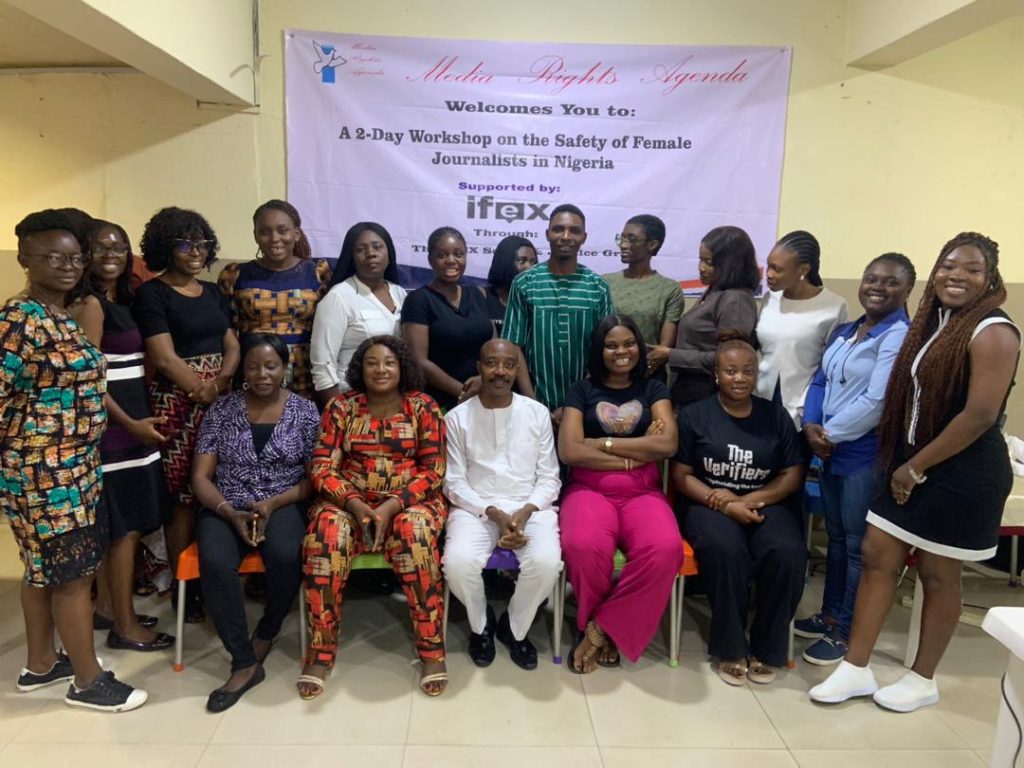
Amid rising attacks on female journalists, the Media Rights Agenda urges greater journalist safety by promoting awareness of legal protections and available redress mechanisms at all levels. The MRA announced in a communique that, with support from IFEX’s Safety and Justice Grant, it held a two-day workshop on female journalists’ safety at the International Press
Amid rising attacks on female journalists, the Media Rights Agenda urges greater journalist safety by promoting awareness of legal protections and available redress mechanisms at all levels.
The MRA announced in a communique that, with support from IFEX’s Safety and Justice Grant, it held a two-day workshop on female journalists’ safety at the International Press Centre in Lagos on July 29–30.
The communique stated that female journalists from various government and private media outlets across print, broadcast, and online platforms attended the workshop, along with resource persons such as a media proprietor, journalist, civil society activists, and a legal practitioner.
In his remarks, Mr Ayode Longe, MRA’s Deputy Executive Director, stated that female journalists face attacks due to both their gender and profession. He stressed the importance of equipping them with the knowledge and skills needed to document rights abuses, seek justice, and continue their work despite growing threats.
To combat increasing attacks on female journalists, the MRA Deputy Director urged for increased awareness of international protections and practical safety guides among journalists, as well as educating media organisations and staff about the dangers they face.
The communique stated that participants observed female journalists encounter significant and occasionally severe threats and attacks related to their professional work. It was also noted that these risks are often specific to women and should be addressed through comprehensive and systematic measures.
Participants expressed concern that media organisations often do not support journalists facing threats or attacks, leaving them vulnerable and isolated.
“They decried the pervasive climate of impunity in Nigeria, as perpetrators of attacks, including security agents, political actors, media employers and managers, professional colleagues, and online trolls, among others, are hardly ever investigated and never prosecuted, even when their actions amount to criminal conduct.
The participants identified the absence of gender-sensitive safety policies and mechanisms within media organisations, professional bodies, and regulatory institutions, in addition to the fact that frameworks that seek to protect journalists do not adequately address gender-specific threats or attacks and do not provide sufficient deterrence for gender-based attacks.
“Observing that there was an alarming increase in gender-based threats, harassment, and violence targeted at women journalists both online and offline, they called for concerted efforts and measures to mitigate the situation.
To correct the anomalies, MRA and the media practitioners in the workshop recommended that “the federal and state governments must publicly condemn all attacks on journalists, particularly against female journalists, and ensure that thorough investigations are conducted while perpetrators are prosecuted and punished by the law.
“Further to the above, the National Assembly and the respective State Houses of Assembly should review existing laws within their domain to ensure that they contain provisions that explicitly protect female journalists from gender-based violence and threats.
“Stakeholders should establish and strengthen preventive mechanisms, capacity building, and collaborative efforts to create a safer and more enabling environment for female journalists in Nigeria to carry out their duties without fear or intimidation, in line with the UN Plan of Action on the Safety of Journalists.
“Further to the above, media organisations should adopt and enforce gender-sensitive workplace policies, including sexual harassment prevention protocols, whistleblower protections, and access to legal and psychosocial support, while employers should make adequate arrangements and provisions to ensure the safety of female journalists on assignments, particularly during elections, protests, or other potentially dangerous assignments.
“Stakeholders, particularly media organisations, media professional associations, and journalists, should actively collaborate and engage with law enforcement and security agencies to develop and implement effective strategies that guarantee the safety and protection of female journalists.
“Media outlets, journalists’ unions and associations, and families of female journalists should be sensitised to provide necessary support, including emotional, psychological, legal, and institutional support, to female journalists, especially when they face threats, harassment, or attacks in the course of their work. This includes standing by them publicly and pursuing redress, where necessary.
“Female journalists should be encouraged and trained to conduct regular threat assessments and environmental scans of locations where they intend to report from. They should develop and communicate a clear strategy to ensure their safety in case of emergencies or escalating threats.
“Media organisations should take primary responsibility for the safety of their female staff. This includes providing legal support, access to digital and physical security training and facilities, psychological counselling, and other resources needed to protect and empower female journalists in the face of danger or intimidation.
“Female journalists in different parts of the country should build a national protective network, cutting across media organizations and existing divides, through which they can demonstrate or strengthen solidarity and peer support, as well as undertake joint advocacy for the implementation of the UN Plan of Action on the Safety of Journalists in Nigeria and push for the adoption of any other national safety framework that may be necessary. Such a protective network may be anchored on the Nigeria Association of Women Journalists (NAWOJ).
Participants emphasised that journalists should prioritise their well-being and take regular breaks. The communique states that female journalists, like all media professionals, should use their annual leave to rest and recharge, helping prevent burnout and health issues.
“Media organisations should fulfil their obligations to support the safety and well-being of female journalists by providing necessary resources, including transportation, safe accommodation such as short lets, and financial support, especially when assignments require them to work late or cover high-risk events.
“Furthermore, media houses should establish and promote open-door policies that encourage younger female journalists to report incidents of harassment, threats, or any form of abuse in the newsroom. Senior colleagues and management must be approachable and responsive to such reports to foster a safe and supportive work environment.