

Limited Access for PWDs in AMAC FCT Area Council Elections
The just-concluded Federal Capital Territory (FCT) Area Council elections had poor provisions for Persons with Disabilities (PWDs) at many polling stations in the Abuja Municipal Area Council (AMAC),...

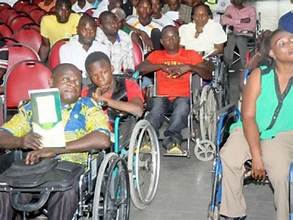
The just-concluded Federal Capital Territory (FCT) Area Council elections had poor provisions for Persons with Disabilities (PWDs) at many polling stations in the Abuja Municipal Area Council (AMAC), sparking fresh worries about how inclusive Nigeria’s voting process really is.
Most polling units lacked adequate support for many types of PWDs, despite INEC’s repeated promises to improve disability inclusion in elections.
PWDs include persons with physical disabilities, such as those using wheelchairs or crutches; persons with visual impairments (the blind and partially sighted); persons with hearing impairments (the deaf); and individuals with intellectual or developmental disabilities.
Although some polling stations had sign language interpreters to support deaf voters, it seemed that other groups with disabilities were not given the same consideration.
Several voters with physical disabilities experienced difficulties navigating uneven terrain, requiring support from family members or other individuals present.
Several Polling Units under AMAC displayed fliers with detailed voting procedures for deaf voters.
“HOW TO VOTE – EC 30E (PWD) – For the Deaf.”
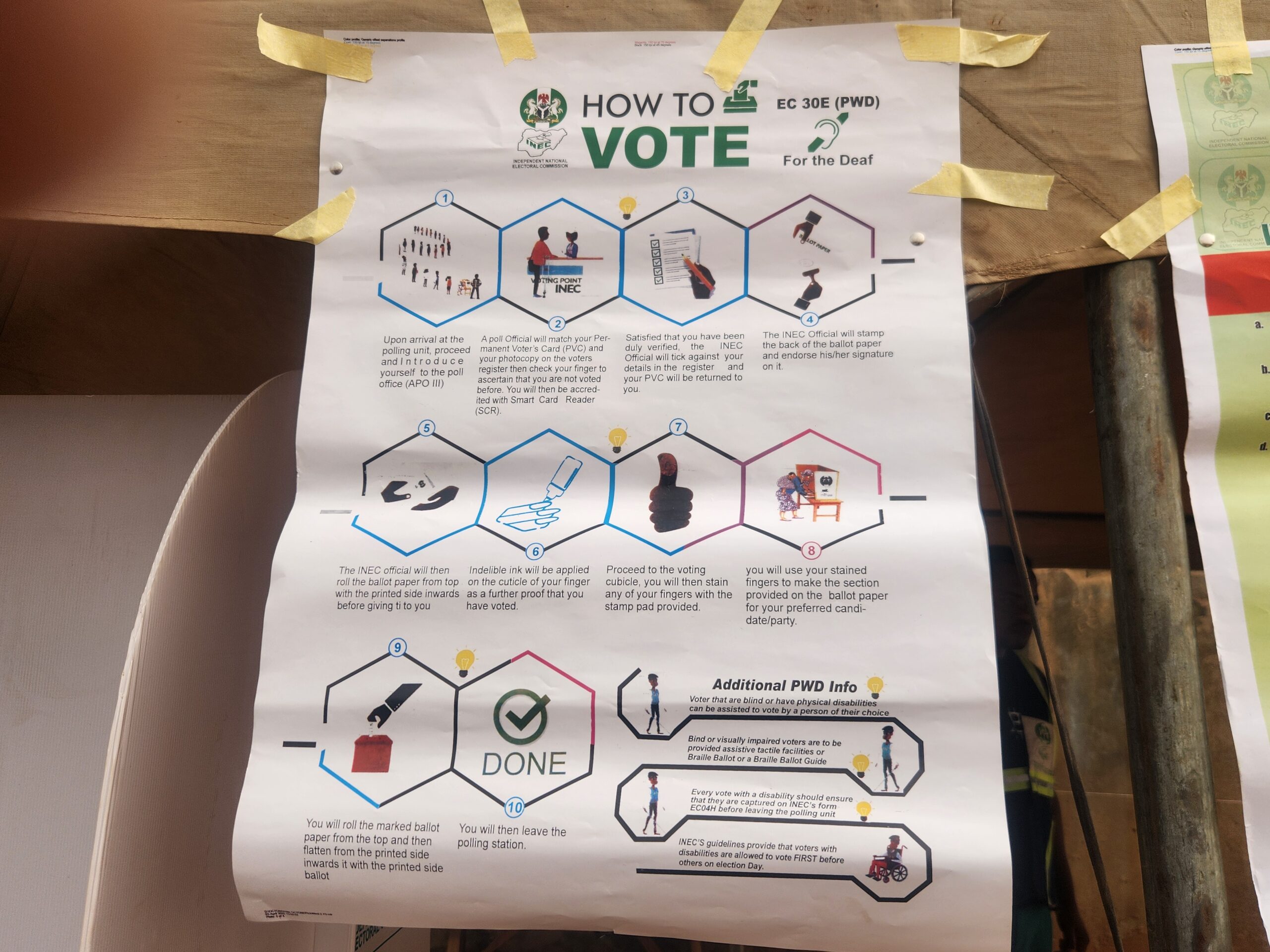 The flier listed the following steps:
Upon arrival at the polling unit, proceed and introduce yourself to the Poll Officer (APO II).
“A poll official will match your Permanent Voter’s Card (PVC) and your photograph on the voter register, check your finger to ensure you have not voted before, and accredit you using the Smart Card Reader (SCR).
—Once verified, the INEC official will tick against your details in the register and return your PVC.
—The official will stamp the back of the ballot paper and endorse it with his/her signature.
—The ballot paper will be rolled from the top with the printed side inwards before being handed to you.
—Indelible ink will be applied to the cuticle of your finger as proof that you have voted.
—Proceed to the voting cubicle and stain any of your fingers with the stamp pad provided.
—Use your stained finger to mark the section provided on the ballot paper for your preferred candidate or party.
—Roll the marked ballot paper from the top and flatten it with the printed side inwards.
—Leave the polling station.”
The flier also provided additional information stating that blind or physically challenged voters could be assisted by a person of their choice; that blind or visually impaired voters should be provided assistive tactile facilities or Braille ballot guides; that every voter with a disability should be captured on INEC Form EC40H before leaving the polling unit; and that INEC guidelines allowed voters with disabilities to vote first on election day.
However, observations across several polling units showed that while these guidelines were clearly articulated on paper, implementation was uneven for other categories of People With Disabilities (PWDs).
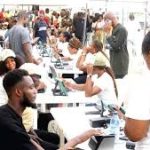
In contrast to earlier elections that supplied chairs, numerous polling units this time had no seating available.
Some People With Disabilities (PWDs) were seen resting against walls and iron structures because there were no seating arrangements provided by INEC.
Other residents brought chairs from their homes, while others, particularly elderly persons and those with mobility challenges, stood for extended periods under the sun to cast their votes.
Presiding officers claimed that there was no provision for seating arrangements for voters, as the commission only provided chairs for INEC officials.
The Presiding Officer at P.U 103, Ward 10, Mr Josephin, said, “There are no chairs available aside from the ones for us. We have no idea since, but when I look around, if we could get any, I’ll let them have their seats.”
However, priority was given to elderly persons, pregnant women, nursing mothers, and other special citizens to cast their votes before other voters.