The Independent National Electoral Commission Chairman hopes a new electoral act will emerge before the 2027 general elections after submitting 142 post-election recommendations to federal lawmakers. Speaking with reporters at the presidential villa on Tuesday, where two national commissioners of the electoral body were sworn in, Professor Mahmood Yakubu was optimistic that a new electoral
The Independent National Electoral Commission Chairman hopes a new electoral act will emerge before the 2027 general elections after submitting 142 post-election recommendations to federal lawmakers.
Speaking with reporters at the presidential villa on Tuesday, where two national commissioners of the electoral body were sworn in, Professor Mahmood Yakubu was optimistic that a new electoral act would emerge after the public hearing to be conducted by the National Assembly on the impending law. He stated that the commission is collaborating with the National Assembly to deliver the amendments before the next election.
“We are here today, basically for the swearing in of two national commissioners.” The commission comprises a chairman and 12 national commissioners, with two commissioners from each geopolitical zone. So, vacancies existed for the North West and the South East, and the Senate has screened and confirmed the nominees, and Mr President today performed the swearing-in.
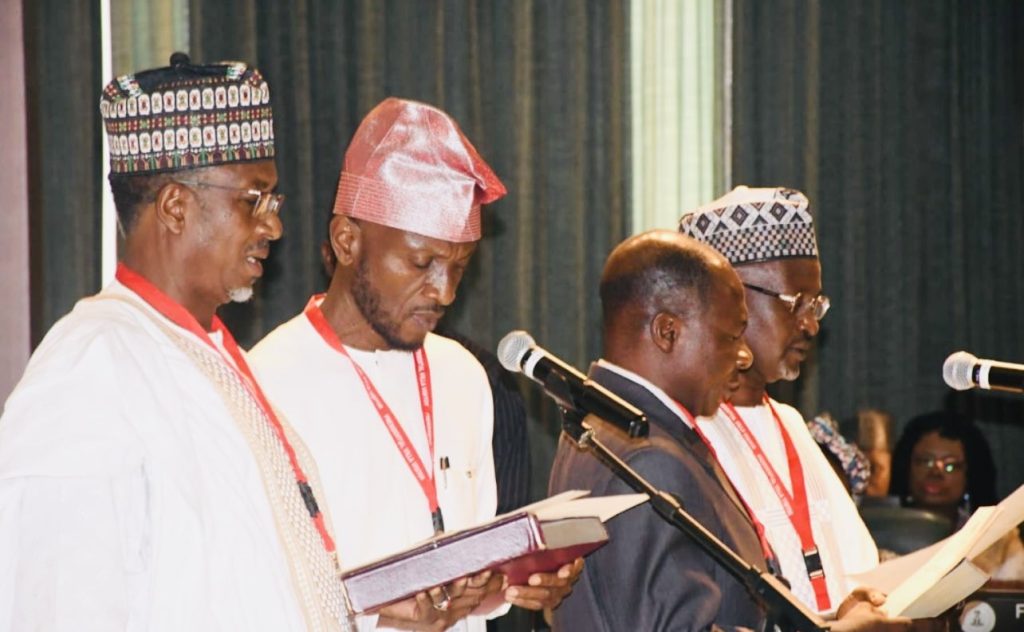
Prof. Yakubu witnessed two INEC National Commissioners—Abdulrazak Tukur (North West) and Professor Sunday Aja (South East)—take the oath of office before President Bola Tinubu. He observed further, “So, we have almost the full complement of commissioners of the commission. As we are also aware, about two weeks ago or so, we lost one of our commissioners, Major General Modibbo Alkali (retd.); may his soul rest in peace. So now, we have almost the full complement of commissioners.”
On the impending Electoral Act amendments, Prof. Yakubu said, “We’ve been interfacing with the National Assembly… We are pleased with our discussions and with the speed at which they want to proceed so the necessary changes are enacted well before the 2027 general elections,” he told State House Correspondents at the Aso Rock Villa, Abuja.
Some of INEC’s Proposed Amendments
Special Voting and Inclusion: Amendments to Sections 72(2), 117(1), 132(5), and 198 of the 1999 Constitution to allow early special and diaspora voting. This would enable essential service providers, election officials, and Nigerians living abroad to participate in elections.
INEC’s Appointment Powers: Proposal to empower INEC to appoint Heads of its State and FCT Offices, strengthening its autonomy and efficiency.
Creation of New Agencies: Recommendation for establishing an Electoral Offences Commission and a Political Party Regulatory Agency to tackle the persistent challenges of political party management and electoral crimes.
Affirmative Action for Inclusion: Suggested amendments to Sections 48, 49, 71, and 91 to create special seats for women and individuals with disabilities (PwDs), fostering more equitable representation.
Other key areas within the Electoral Act 2022 that have been identified for amendment include:
Fixing Confusion: Correcting unclear language, mistakes, and conflicting rules about how results are shared and counted in Sections 60, 64, and 65.
Review of Election Results: Amending Section 65(1) to clearly define INEC’s power to review election results.
Special Voting Provisions: Adjusting Sections 12(2) and 45 to support early and special voting for designated groups, both domestically and abroad.
Strengthening Party Regulation: moving responsibilities for party registration, monitoring and deregistration to a proposed Political Party Regulatory Agency, which would require consequential amendments across more than 15 sections of the Act.
Operational and procedural adjustments: other proposed changes include clarifying timelines for candidate substitution under Section 31, redefining INEC’s role in managing and printing PVCS, regulating party primaries more strictly, and banning unaccredited agents at collation centres.
INEC’s Two INEC Commissioners
Two new National Commissioners of the Independent National Electoral Commission (INEC) were sworn in on Tuesday by President Bola Ahmed Tinubu at the Aso Rock Presidential Villa, Abuja: Alhaji Abdulrazaq Tukur Yusuf and Professor Sunday Nwambam Aja, representing the North West and South East geopolitical zones, respectively.
Tukur possesses a Bachelor of Arts degree in English from Bayero University, Kano; a postgraduate diploma in Economics from Bradford University, England; and a Master of Arts degree from Leeds University, also in England. He has substantial experience in electoral planning and administration, having worked in various senior and management capacities at INEC for over 24 years before retiring as a director.
Aja acquired a Bachelor of Education (B.Ed.) degree in Guidance and Counselling from the University of Nigeria (UNN), Nsukka, in 1998; a Master of Education (M.Ed.) degree in Educational Administration and Planning, also from UNN, in 2004; and a Doctorate (PhD.) in the same discipline from Ebonyi State University in 2012. He taught at the Ebonyi State University from 2006 until his new appointment.