



Fact-Check: Health Minister’s Claim That More Than 2,000 Primary Healthcare Centres Have Been Fully Upgraded is Exaggerated.
Claim: Dr. Iziaq Adekunle Salako, Minister of State for Health, stated at a recent South-West Stakeholders’ Forum that over 2,000 primary healthcare centres have been upgraded to full functionality....


Claim: Dr. Iziaq Adekunle Salako, Minister of State for Health, stated at a recent South-West Stakeholders’ Forum that over 2,000 primary healthcare centres have been upgraded to full functionality.
Verdict: Exaggerated
Background Story
The National Health Insurance Authority (NHIA) Act, signed into law on May 19, 2022, replaced the ineffective National Health Insurance Scheme (NHIS) Act of 1999. The reform sought to improve healthcare access for Nigerians and reduce out-of-pocket payments by expanding mandatory health insurance coverage.
Before the Act, health financing in Nigeria relied heavily on personal spending. A 2022 report revealed that 69% of healthcare funding came directly from patients, reflecting a weak and inefficient system undermined by corruption, poor institutional capacity, and low political commitment.
The World Health Organisation (WHO) has consistently warned that over one billion people risk poverty due to health expenses consuming 10% or more of their household budgets.
Faced with this reality, the Tinubu administration announced efforts to strengthen the State Social Health Insurance Agencies (SSHIA) in all states, boost the Basic Health Care Provision Fund (BHCPF), and expand primary healthcare delivery nationwide.
At a recent South-West Stakeholders’ Forum, Dr. Salako highlighted these efforts, stating that: Today, over 2,000 primary health care centres have been upgraded to full functionality.”
Given the controversy surrounding the actual progress of these initiatives, NDRFactCheck examined the veracity of the claim.
Verification: PHC Upgrades Claim
The National Primary Health Care Development Agency (NPHCDA) defines an “upgraded facility” as a “revitalised PHC capable of delivering a wide range of healthcare services.”
A “fully functional” facility (Level 2) provides more specialised care, operates 24 hours, and is adequately staffed and equipped.
As of April 2025, as cited in The Guardian, NPHCDA reports that:
- 901 PHCs had been revitalised (fully completed upgrades).
- 2,701 additional PHCs were undergoing upgrades to be completed by the end of 2025.
As of October 30, 2025, available data on the official NPHCDA dashboard shows that 1,640 PHCs have been revitalised, while 1,969 PHCs have been upgraded to full functionality out of 26,756 PHCs nationwide.
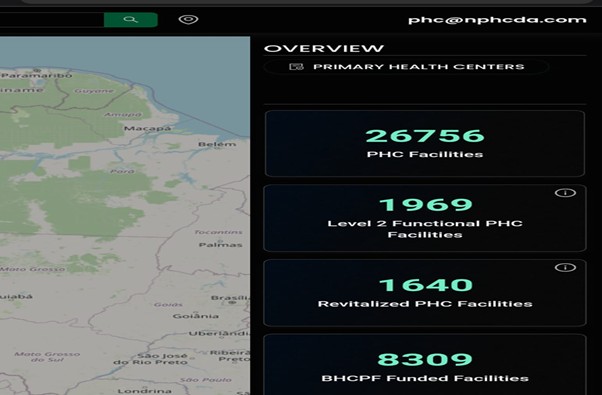 The status of the dashboard as of October 30, 2025,
A clarification request sent to the Ministry’s official email on the status of the claim in relation to the data shown on the dashboard was initially not responded to.
When contacted on WhatsApp to clarify if there was any additional information that was not updated on the dashboard, a director of media and publicity in the Ministry of Health and Social Welfare reiterated the Minister’s claim and redirected the NDR researcher to the same dashboard for confirmation.
When our researcher visited the dashboard again on November 11, 2025, some data had been revised. This time, available data showed that, while 2088 PHCs have been upgraded, 1,965 PHCs have been upgraded to full functionality.
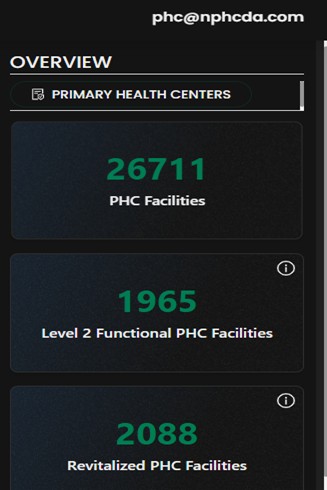 📊 Source: NPHCDA Infographic Dashboard as of November 11, 2025
In summary, the available evidence indicates that while progress has been made under the Renewed Hope Health Sector initiative, the minister’s statement overstates the actual number of upgraded PHCs to full functionality.
While it is correct that over 2000 PHCs have been upgraded, the claim that over 2000 were up to full functionality was inaccurate.
Conclusion
The claim that “over 2,000 PHCs have been upgraded to full functionality” is exaggerated, as verifiable data confirms 1,965 functional PHCs, below the minister’s stated figure.