

EU-SDGN Impact Assessment: How IPC’s Media Training Is Helping Reduce Nigeria’s Political Gender Gap
Although women make up almost half of Nigeria’s population, they are still largely absent from political leadership. Limited media exposure remains a key barrier, reducing their influence and chances...


Although women make up almost half of Nigeria’s population, they are still largely absent from political leadership. Limited media exposure remains a key barrier, reducing their influence and chances of being elected.
The International Press Centre (IPC), supported by the EU-SDGN I & II, has spent eight years running media workshops nationwide to help female candidates in all six geo-political zones strengthen their voices and presence in politics.
These workshops serve as strategic efforts to address the longstanding gender imbalance in media coverage. IPC’s monitoring of the 2015 elections revealed that media reporting mainly favoured male politicians, with female candidates remaining largely unrepresented despite regulations ensuring equal access.
The Nigerian Media Code of Election Coverage (Revised Edition 2018) directs media organisations to actively include underrepresented groups, including women, youth, people with disabilities, and those living in rural areas. It also calls for electoral reporting to present various viewpoints, voter education to be accessible in different formats and languages, and opportunities for marginalised individuals to freely express themselves throughout the election process.
While having access to media is important, knowing how to use that access effectively is what really matters. Advisory documents such as the Nigerian Media Code of Election Coverage ensure fair opportunities for female candidates, yet many women still struggle to make their voices heard in politics if they lack strategic communication skills. This is exactly where the International Press Centre (IPC) provides its support.
IPC’s media training workshops equip female candidates to navigate Nigeria’s media environment, develop effective messaging, and build confidence through practical, hands-on sessions.
Female candidates from 33 political parties have taken part in IPC’s training, with 17 parties currently active. The programme’s wide reach highlights that media visibility is essential for electoral success.
Female Candidate Participation by Party at IPC/EU-SDGN Trainings
The International Press Centre (IPC) held six strategic media training workshops for female political candidates in major Nigerian cities. Women from 33 political parties participated, aiming to enhance their visibility, media skills, and public communication.
Beyond capacity building, the training was an integral component of IPC’s ongoing commitment to advancing gender inclusion and equitable representation within Nigeria’s democratic processes.
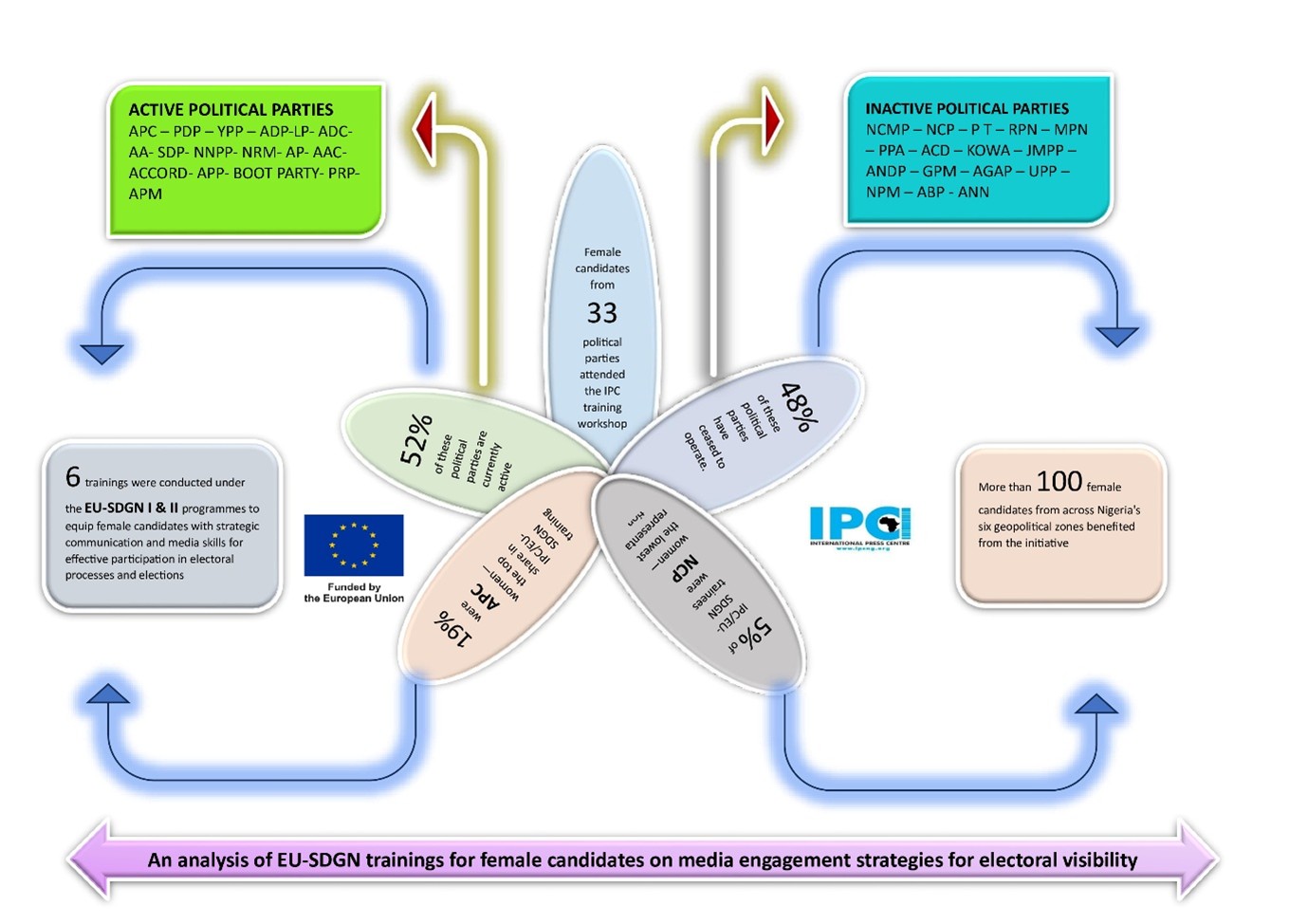
Fig 1.
Findings
- Out of the 33 parties, 52% of these parties are currently active, which means 48% are no longer active
- Female Candidates from 33 political parties attended the training, reflecting IPC’s inclusive reach
- The training reached female candidates from both major and minor parties, including those with limited electoral success and short-lived registration
Implications
- The high rate of inactive political parties underscores the instability of Nigeria’s party system. Many platforms lack institutional longevity, which can hinder consistent support for female political aspirants.
- Despite the inactivity of political parties, the skills and visibility gained by female candidates remain significant. Many are likely to sustain their advocacy or pursue political engagement through alternative platforms or within civil society
- Future programs may consider prioritising active parties to ensure continuity and electoral relevance, while still maintaining inclusive principles.
Recommendations
- Monitor the post-training engagement of female candidates, especially those from deregistered parties, to assess long-term impact.
- Collaborate with active parties to embed media training into their internal candidate development processes.
- Continue offering training to women across political and civic spaces, recognising that political empowerment is not limited to electoral cycles.
Women in Nigerian Politics: A Documentary by IPC
The International Press Centre (IPC), with its EU-SDGN I project, started a groundbreaking programme to help women in politics make their voices heard in a country where men have traditionally held most political leadership roles.
The project’s concluding documentary highlighted the unfiltered and motivating experiences of Nigerian female politicians who overcame challenges, shattered barriers, and changed perceptions about women in government. A key factor in their achievements was IPC’s media training, which gave them the tools to increase their presence, gain recognition, and address the persistent gender disparity in politics.
Dr. Abiola Akinyode-Afolabi, the Executive Director of WARDC, emphasized the pressing need for changes in the law. She pointed out that many other nations embed affirmative action in their constitutions by establishing quotas and policies designed to promote women into leadership positions. Nigeria needs to establish laws that promote gender equality. Although women have long been involved in politics, they have often been left out of leadership roles and decision-making processes. I have played a part in the national discussion on gender legislation because it is essential to make inclusion a permanent part of our institutions.
The documentary included remarks from Ms. Samuela Isopi, who highlighted the significant societal benefits of women’s participation in politics. She stated, “This is not simply desirable—it is indispensable. The active involvement of women at all decision-making levels contributes to peace, prosperity, and sustainable development. Women’s political leadership plays a critical role in addressing many of the global challenges we encounter.”
IPC’s media training was pivotal for many women, including Dr. Charity Ido of the Akwa Ibom State House of Assembly. She noted that the training helped her better engage constituents and highlight her achievements, such as opening a constituency office, supporting women and youth, offering bursaries, building roads, and housing widows. The programme also led to forming a support group in Akwa Ibom to sustain ongoing efforts.
Hon. Adekemi Famuagun-Balogun of Ekiti State highlighted how effective performance can change people’s views. She shared, “My constituency had never been represented by a woman before. Now, after witnessing what women are capable of, my community hopes to see more female leaders in the future.”
Hon. Lilian Nwachukwu from Ebonyi State shared her challenging journey to candidacy. As the sole woman among nine men, she overcame both resistance from male competitors and societal expectations, even after winning four primary elections. The IPC’s training equipped her with the confidence and tactics to continue pushing forward. Now, she chairs the House Committee on Water Resources and is a member of several other committees. During the COVID-19 pandemic, she distributed relief packages, aided widows, and offered skills training to people in her constituency.
Hon. Olubunmi Adelugba from Ekiti State shared how IPC’s training helped her overcome doubts. She recounted commissioning a project where a man admitted he hadn’t voted for her because she was a woman, yet he was impressed by the results she achieved. IPC showed her new opportunities. As Chair of Finance and Appropriation, she encourages women to confront their fears, emphasising that politics isn’t reserved for the wealthy—it’s open to anyone with determination.
Hon. Favour Tomomewo of Ondo State said IPC’s training enabled her to launch social media platforms, which significantly improved her engagement and connection with constituents.
Hon. Yemisi Ayokunle acknowledged the legislative advancements achieved in Ekiti State, stating, “The gender law is a significant milestone. As four women currently serving in the House, we are dedicated to increasing our representation and aspire to reach ten members.”
Hon. Dr. Itam Abang of Cross River State offered a powerful reflection: “When you train a woman, you train a nation. Women bring peace, efficiency, and organisation. No mother would hand her child a weapon or support thuggery. We dare to demand more representation because we’ve proven our worth.”
Amplifying Her Voice goes beyond being just a documentary—it’s inspiring real change. IPC’s media training empowered women not only to engage with the press but also to reshape the narrative of Nigerian politics. Instead of waiting for recognition, these women are now speaking up, leading, and making a difference in their communities. As more voices are elevated, Nigeria moves closer to bridging the political gender gap.