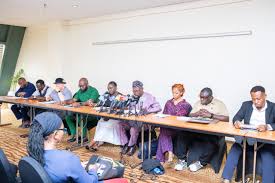
Calls for more electoral reform deepened on Wednesday when a coalition of civil society organisations proposed a comprehensive list of changes to Nigeria’s laws to strengthen democracy to the National Assembly for consideration. Their demand is tagged Citizen’s Memorandum. The memo covers aspects of the Constitution, the Electoral Act, and the INEC Rules and Regulations.
Calls for more electoral reform deepened on Wednesday when a coalition of civil society organisations proposed a comprehensive list of changes to Nigeria’s laws to strengthen democracy to the National Assembly for consideration. Their demand is tagged Citizen’s Memorandum. The memo covers aspects of the Constitution, the Electoral Act, and the INEC Rules and Regulations.
The National Assembly has begun the process of consulting stakeholders towards reforming the electoral system in the country. Different groups have been submitting their contributions towards the new law that is being worked on by the National Assembly joint committee on INEC and electoral reforms.
In response to this, the coalition of 15 civil society organisations, which include the International Press Centre, Yiaga Africa, and Centre for Media and Society among others, submitted a document that contains 37 recommendations, organised under 15 strategic objectives and covering fifteen priority reform areas.
The aim of the citizen’s memorandum, for the reform, is to achieve a more credible, transparent, and accountable electoral process that serves the best interests of all Nigerians and fosters a democratic culture where every vote counts.
Addressing the media on Wednesday in Abuja, the group said: “The memorandum we present today focuses on three core pillars of the electoral legal framework for the conduct of elections: the Constitution of the Federal Republic of Nigeria, 1999, the Electoral Act 2022, and INEC Regulations and Guidelines for Elections. Our recommendations have been carefully divided into two parts I offer twenty-one (21) recommendations for constitution alterations, the statement partly reads.
It further reads “These proposals aim to strengthen the independence of INEC, improve the processes for electoral adjudication, and refine key constitutional provisions to ensure fairness, transparency, and inclusivity in our electoral process. Part II presents sixteen (16) proposals for amending the Electoral Act 2022. These proposals address the inadequacies, complexities, and ambiguities that have hindered the efficient application of the Act. We aim to reposition the electoral legal framework against the backdrop of recent landmark judicial decisions that offer pathways for reform and to make the Act more reflective of our evolving electoral needs”.
The coalition outlined their areas of priority for electoral reform, including electoral offences, INEC independence, professionalism, efficiency, and INEC unbundling. Election adjudication, Diaspora or Out-of-Country voting, Special Seats, Political party reform, Constituency delimitation, Voter accreditation, Voter Register and voter registration, Women, youths, and PWDs political participation (Inclusivity), Early voting, Candidate Selection, Electoral technology, Result management process, Media and elections.
The full statement reads:
“Constitution Alteration Proposals
Proposals for the alteration of the Constitution are tailored towards achieving improved independence and professionalism of the Independent National Electoral Commission and the State Independent Electoral Commissions (SIECs) to ensure credible elections and inspire public trust in the electoral process. Consequently, this Memorandum seeks a review of the process of appointments into INEC; professionalization of INEC appointments; introduction of timelines for INEC appointments; a review of the mode of appointments into SIEC; introduction of timelines for appointment in SIECs; strengthening the criteria for membership of SIECs; safeguarding the operational autonomy of SIECs; a review of the appointment and discipline of Resident Electoral Commissioners (RECs); strengthening the financial autonomy of SIECs; redefining the power and functions of SIECs; unbundling the INEC; establishment of an Electoral Offences Commission; and limiting the exercise of the power of nolle prosequi by the Attorney General, among others.
“Electoral Act Amendment Proposals
The proposals for the reform of the Electoral Act are carefully articulated to achieve the objectives of increasing citizens’ engagement through improved voter and civic education; improving the integrity of the voter register and voter verification; protecting voting rights and inclusiveness of elections; improving the quality of candidate selection; safeguarding the use of electoral technologies to ensure election integrity; and facilitating equal access to media during elections.
Notable among the recommendations are:
a) reviewing the requirements for voter identification by permitting the use of other legally acceptable means of identification for voter verification in addition to the already produced Permanent Voters’ Cards (PVCs);
b) undertaking a transparent and comprehensive independent audit of the voter register to eliminate duplications, multiple registrants, and ineligible voters to enhance the credibility of the voter register.
c) introduction of early voting for eligible voters on essential election duties such as security personnel, INEC staff, election observers, journalists, etc.
d) introduction of sanctions for non-compliance with party register and delegate list submission;
e) compulsory electronic transmission of results;
f) Introduction of legal timelines for testing and mock exercise of electoral technologies;
g) Discounted airtime/advert rates for marginalized groups; and
h) Limiting liability for breach of deadline for media campaigns to media organizations
In total, the Citizens’ Memorandum contains thirty-seven (37) recommendations, organized under fifteen (15) strategic objectives and covering fifteen priority reform areas as earlier itemised. These reforms aim to achieve a more credible, transparent, and accountable electoral process—one that serves the best interests of all Nigerians and fosters a democratic culture where every vote counts.
It is important to note that the Memorandum also aligns with the INEC Memorandum for Administrative Reform, which separately outlines key areas for reviewing INEC’s regulations and guidelines to ensure they are responsive to our electoral needs.
Significance of the Memorandum
Electoral reforms as proposed in the Citizens Memorandum, will play a vital role in strengthening Nigeria’s democracy by addressing various challenges and gaps in the electoral process. The key areas of significance are:
1. Enhancing Electoral Transparency and Credibility
The proposed reform will ensure that election outcomes genuinely reflect the will of the people. The reforms will eliminate ambiguities in the Electoral Act 2022 and align the legal framework with landmark judicial rulings. By introducing clearer procedures for results transmission, and the role of technology, the reforms will reduce the chances of electoral fraud and irregularities.
2. Strengthening the Independence of INEC
The autonomy of INEC will be reinforced, thereby protecting the Commission from political interference. The proposed constitution alterations will enhance INEC’s operational independence. This would empower INEC to act impartially and ensure that its decisions are not influenced by external pressure, ensuring free and fair elections.
3. Strengthening electoral offences prosecution
By unbundling INEC and establishing the National Offences Commission, electoral offenders will be effectively prosecuted. This will address the current challenges militating against such prosecutions as the Commission is already overburdened by election administration and a plethora of litigations arising from pre-election and election disputes. By the proposed reform, electoral offenders will be effectively prosecuted for improved electoral justice dispensation.
4. Promoting Inclusive Participation
All Nigerians, including marginalized groups, can fully participate in the electoral process. The reforms will promote the inclusion of women, youth, and people with disabilities in the political process.
5. Adapting to Technological Advancements
The reforms emphasize the need for robust legal backing for the use of technology in elections, such as mandatory electronic transmission of election results. By doing so, the electoral process will become faster, more accurate, and less susceptible to tampering.
6. Strengthening Voter Confidence and Trust
By addressing the gaps in transparency, efficiency, and fairness, these reforms will inspire greater confidence in the electoral system. Citizens are more likely to participate in elections when they trust that their votes will count and that the process is free from manipulation or undue influence.
7. Enhancing Civic Engagement
The reforms will deepen citizens’ involvement in electoral reforms and governance. The reform process itself involves input from civil society, political stakeholders, and international observers, reflecting a broader participatory approach to governance. This inclusion of diverse voices can lead to greater public engagement, awareness, and accountability in the democratic process.
Conclusion
These electoral reforms are designed to restore integrity, enhance efficiency, and ensure inclusivity in Nigeria’s electoral process, paving the way for more credible, fair, and democratic elections that will strengthen the nation’s political institutions and democratic culture.
We are confident that the adoption of these reforms will go a long way in rebuilding public trust in Nigeria’s electoral process, enhancing the efficiency of our elections, and ensuring that the outcomes of elections reflect the true will of the people.
On behalf of the Coalition of Civil Society Organisations, we express our deepest appreciation to the National Assembly, INEC, civil society organizations, political parties, and other key stakeholders for their continued commitment to electoral reform in Nigeria. We also extend our gratitude to the press for your role in bringing these conversations to the forefront of public discourse.
Thank you all for your presence here today. We look forward to fruitful discussions as we continue to work together to shape the future of Nigeria’s democracy” ” the statement fully stated.
Members of the coalition include Yiaga Africa, the Civil Society Legislative Advocacy Centre, the Centre for Media and Society, Corporate Accountability and Public Participation Africa, ElectHER, International Press Centre, and the International Institute for Democracy and Electoral Assistance.
Also in the coalition are the Justice, Development and Peace Makers Centre, Osogbo; Justice Development and Peace Movement, Oyo; Justice Development and Peace Initiative, Ekiti; The Kukah Centre; Nigeria Women’s Trust Fund; Policy and Legal Advocacy Centre; SOS Children’s Villages; and TAF Africa.