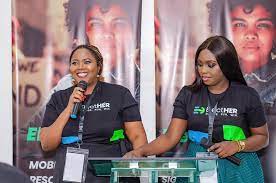
Ahead of the November 11 off-cycle election holding in Imo, Bayelsa and Kogi States, ElectHer, a civil society Organisation that promotes women’s participation and inclusivity in leadership positions has condemned the low participation of women in the polls. In a report recently published by the CSO, ElectHer observed that only 3 women out of the
Ahead of the November 11 off-cycle election holding in Imo, Bayelsa and Kogi States, ElectHer, a civil society Organisation that promotes women’s participation and inclusivity in leadership positions has condemned the low participation of women in the polls.
In a report recently published by the CSO, ElectHer observed that only 3 women out of the 51 candidates in the three states, adding that none of the candidates of the major political parties in those states is woman.
The report further explained that the 3 women who are contesting for the governorship positions are from Kogi and Bayelsa whereby 2 are from Kogi and only 1 is from Bayelsa state. The CSO also noted that only 7 political parties are fielding female deputy governorship candidates including 2 in Bayelsa and Imo and 3 in Kogi state.
“The absence of gender-disaggregated data poses a significant challenge to the quest for a more equitable and inclusive electoral landscape. These data are not mere statistics, they represent the critical lens through which we gauge the progress of women’s participation across the electoral spectrum. Without these insights, we navigate the path to gender parity blindly unable to measure the strides achieved or the vast grounds yet to cover it is incumbent upon all stakeholders to recognize the gravity of this deficit and advocate for its provision, as we work to build a more inclusive and representative democracy for all.
“Limited, or in some cases, non-existent digital presence among some female candidates is a challenge that reverberates through the core of our electoral landscape. In an era where information and digital narratives hold sway, this stands as an impediment to actively engaging with the electorate shaping the narrative and mobilizing resources.
“ This disparity necessitates a critical examination and collective effort as it obstructs the democratic discourse On 11 November, registered voters in Kagi, Imo and Bayelsa will head to the polls to elect governors for the 2024-2028 administrative term. These elections are being held over seven months after the national and state elections on 25 February and 18 March, respectively
“None of the frontrunner political parties is holding a female governorship candidate across these states! 2 less popular political parties are fielding female candidates in Bayelsa, and Kogi, while no political party is fielding a female governorship candidate in Imo. 7 political parties are fielding female deputy governorship candidates, including 2 in Bayelsa and Imo, respectively, and 3 in Kogi state”, it said.
Giving reason for the obvious low participation of women in the off-cycle elections, ElectHer highlighted the absence of disaggregated data to show the composition of the electoral stakeholders during the poll. They also added that the political atmosphere is dominated by male and stereotypical ideas.
The report also submitted that women encounter financial constraints to fuel their political aspirations during the electioneering period has caused political amongst women and has reduced the gender balance in the system.
“Patriarchal value systems, religious and cultural stereotypes, financial constraints, the perception of politics as a ‘dirty game’ due to targeted violence against women, and inadequate education, collectively serve as barriers to women’s candidacy in these states.
“Subnational politics often receive insufficient attention from stakeholders in addressing the challenges faced by women, unlike the federal level
The absence of disaggregated stata showing the gender composition of these electoral officers is unavailable, limiting assessment of the level of women’s participation
“Political party hierarchy in these states is male-dominated, with no political party headed by a female. This patriarchal system which prescribes rigid gender roles excluding women from decision-making positions, is one of the reasons why no major political party is fielding a female candidate.
There are deep-rooted cultural and religious beliefs that dictate that women should not exert themselves as outspoken leaders in their communities. The intensity of this factor varies slightly among these states.
Women in these states encounter obstacles in accessing political funding. Nomination forms of the major political parties were sold for NGN 40 million, and campaigns are extremely costly. Although INEC places a cap of NGN 1 billion on spending for governorship elections, there is little to no pressure to ensure compliance.
“A Gender-Based Violence survey of the 2023 elections conducted by ElectHER, underscored double standards, blackmailing, and smear campaigns in the media as tools actively used against women politicians, resulting in their low influence.
The report, however, called on the electoral commission to ensure adequate security for women and other citizens who will be active during the election.
“INEC must ensure that its logistics and preparations are flawless. However, the biggest responsibility falls on the President to urgently provide the leadership needed to rescue the nation’s electoral and democratic process from irreversible decline, as well as the police and other security agency”.