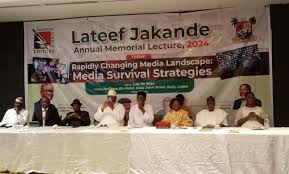
As the landscape of media practices continues to change due to economic factors in the country, owners, editors and top wigs of media houses in Nigeria on Tuesday mulled strategies for the survival of the journalism profession in this dispensation. They gathered at the Lateef Jakande Annual Memorial Lecture 2024, themed “Rapidly Changing Media Landscape:
As the landscape of media practices continues to change due to economic factors in the country, owners, editors and top wigs of media houses in Nigeria on Tuesday mulled strategies for the survival of the journalism profession in this dispensation. They gathered at the Lateef Jakande Annual Memorial Lecture 2024, themed “Rapidly Changing Media Landscape: Media Survival Strategies”.
They also paid tribute to former Lagos State Governor Chief Lateef Jakande for his contributions to the media profession, Lagos State, and the Federal Republic of Nigeria, where he later served as a minister during the Sanni Abacha administration.
The media executives present at the ceremony included the Chairman and Publisher of Vanguard Media Limited, Mr. Sam Amuka-Pemu; Chairman of THISDAY and ARISE Media Group, Mr. Nduka Obaigbena, President of the Nigerian Guild of Editors, NGE, Mr. Eze Anaba, Ike Nwachukwu; Managing Director/Editor-in-Chief of Punch newspapers, Adeyeye Joseph, President of the Guild of Corporate Online Publishers, Maureen Chigbo; Senior Special Assistant (media) to President Bola Tinubu, Tunde Rahman, Executive Director at the International Press Centre, Lanre Arogundade and Executive Director of the Centre for Free Speech organisation, Richard Akintola
Other dignitaries who graced the event were the Lagos State Governor, Governor Babajide Sanwo-Olu of Lagos State, represented by Commissioner for Information and Strategy, Gbenga Omotoso; Minister of Information and National Orientation, Mohammed Malagi, represented by Managing Director of the News Agency of Nigeria, Mr. Muhammed Ali; former Minister of Information and National Orientation, Alhaji Lai Mohammed, and the wife of former Lagos State Governor, Alhaja Sikirat Jakande.
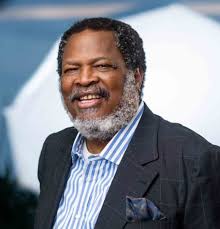 Prince Nduka Obaigbena
As the lead speaker, Prince Nduka Obaigbena, Chairman of THISDAY/Arise Media Group, explained that the narrative in Nigeria has changed since the media’s inception 165 years ago today, adding that the age difference and general gap between the top media practitioners and the youth of this generation is a barrier for the audiences who are constantly on social media to relate to most media publications in this age.
He clarified that although the media is in a state of survival, their readers and audiences are what will ensure their continued existence, so they must prioritise them along with technological advancements like artificial intelligence, which is currently driving global innovation.
He went on to say that although the media’s main responsibility is gathering information, practitioners are expected to use digital media to market their products outside of newspapers, which are traditionally considered the nation’s primary source of news distribution.
“Old-fashioned truth, getting your facts right, telling the story as it is, engaging with your audiences, and building a future. However, that does not mean that journalism is in crisis. We have what they call artificial intelligence.
“So the world we are going to is confronted and challenged by artificial intelligence. What is AI? AI is a conference of software, hardware, and proper algorithms which have an impact across the board. But more importantly, in the media. They can take your face. They can take your voice. They can take your identity. And create anything. So the threat we face is in AI, but AI is a machine.
“We have to train AI. We have to treat AI. We have to challenge AI. Then AI will respond. Are we ready for a world that is being changed by artificial intelligence? We can use it for medicine. We can use it to cure diseases. We can use it to do many other things. So how do we confront the advantages of AI? And use it to promote good journalism? How do we challenge AI? Build our brands. Build our journalism. And ensure that we make our society a better place.
“We are in a country where the young are much more than the old. We need to get them employed and we need to banish poverty. We are here, faced with newspapers and magazines, in the battles for survival. How do we survive, is what I have been told to address today in newspapers and magazines. The first is to have the laws changed. Where intellectual property, IP, is recognised as an asset.
He also charged the journalists to form an alliance on how to make their intellectual properties that the social media platforms are using as content bankable, stating that this would also serve as another means of generating income for themselves.
“If we get paid for our daily work as journalists, we’ll be in a far better place. That’s the first survival instinct that we must build, either as a group, led by the Guild of Editors or by working with the government to ensure that our intellectual property, what we do, is shared every day on social media once that order is paid for. That is the first step. The next step is to be prepared for AI. It’s to promote education and to ensure good governance.”
In his remarks, the publisher of Vanguard Media Group, Uncle Sam Amuka, charged the media practitioners to increase their innovation to expand the reach of the media for survival and to attain more independence in their practice.
“We have to decide, think about what we can do if we want to get a pass. It takes a lot of work to publish a hardcopy paper. It is stressful. You see people in different sectors, including reporters, journalists, and other sections, all involved in its production.
“It takes a lot of work to produce this kind of content, yet we don’t sell it. What is the essence if it is not sold? We must do serious thinking. How many titles are making money now? We need to engage our minds. We need to do more thinking.”
Also speaking, Eze Anaba, chairman of the Nigerian Guild of Editors, praised the late Chief Lateef Jakande’s contribution to the development of Nigerian media in the country, noting that he dedicated his entire professional and political career to advancing the values of liberty and social justice.
“He also exemplified the values of honesty, integrity, courage, and fairness. He told the stories of the fathers and held the powerful to account. He demonstrated commitment to our journalistic freedom and long-term survival. When he and his colleagues founded the Guild in 1961, the purpose was to address the issue and preserve the media data.
“He and his colleagues lit the torch for us to chart a way forward in addressing our issues today. This quest has led to a determined effort by many to search for contemporary and effective solutions. Besides, the circumstances in which we report, produce, distribute, and obtain the news have changed so dramatically. The cost of production has hit the roof. Sales have fallen heavily because of a depressed economy.
Speaking on the relevance of the media in the country, the Executive Director of the International Press Centre, Mr. Lanre Arogundade, encouraged the media to prioritise being part of the solution to society’s problem by setting people’s agendas for the government.
He encouraged the media to imbibe professionalism and ethical reporting, adding that the media can also survive by not reporting based on the pictures in their heads. He advised media practitioners to connect with the people in their engagements to hold the authority accountable.
Governor Sanwo-Olu, represented by the Lagos State Commissioner for Information, Mr Gbenga Omotoso, urged the media to use the trust it has earned from society as a weapon to promote its relevance in the country through the use of available technology. He also encouraged them to invest in the next generation by involving students in their plans.
“The media have one big asset – people trust them. They have found them as a very good source of credible information. So, I would want to advise that we still go to all of that. All the values that people have seen in us have made them stay with us 165 years ago”.