

Fact-Check: Adeleke’s Claim of Introducing State Policing to the Senate Is Misleading
Claim: Osun State Governor Ademola Adeleke claimed he introduced the idea of state policing to the Nigerian Senate. Verdict: Misleading. Full Story At an Arise News town hall meeting ahead of the...

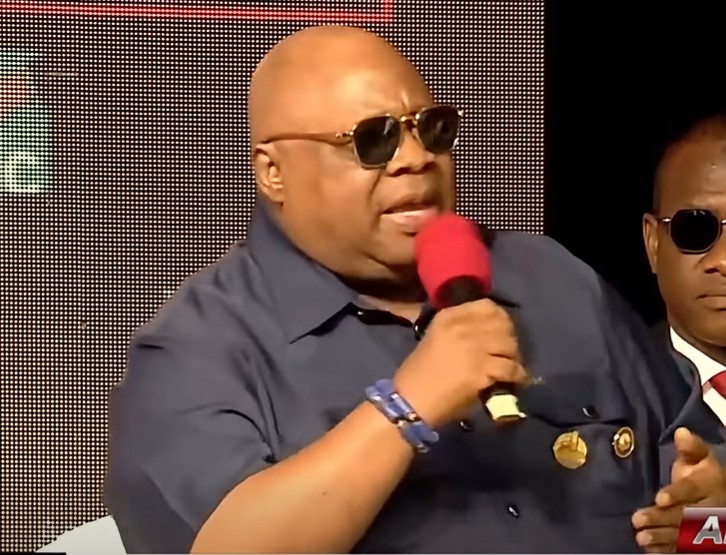
Claim: Osun State Governor Ademola Adeleke claimed he introduced the idea of state policing to the Nigerian Senate.
Verdict: Misleading.
Full Story
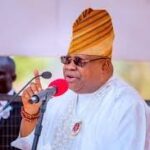
At an Arise News town hall meeting ahead of the 2026 Osun governorship election on Tuesday, August 11, 2026, Osun Governor Adeleke said he introduced state policing in the Senate.
The claim requires context: although Adeleke was a senator when decentralised policing was being debated, available records do not show that he introduced state policing to the Senate.
On February 6, 2018, Senator Adeleke sponsored a motion at the Senate titled “The Need to Post Junior Cadres of the Nigeria Police Force to Their States and Local Government Areas to Enhance Community Policing.”
The Senate adopted the motion and directed its Committee on Police Affairs to invite the then Inspector General of Police, Ibrahim Idris, to recommend ways to actualise community policing.
Reports indicate that Adeleke argued for posting junior police officers to their states of origin to strengthen community policing. According to Punch, the motion was Adeleke’s first in the Senate, and it focused on community policing.
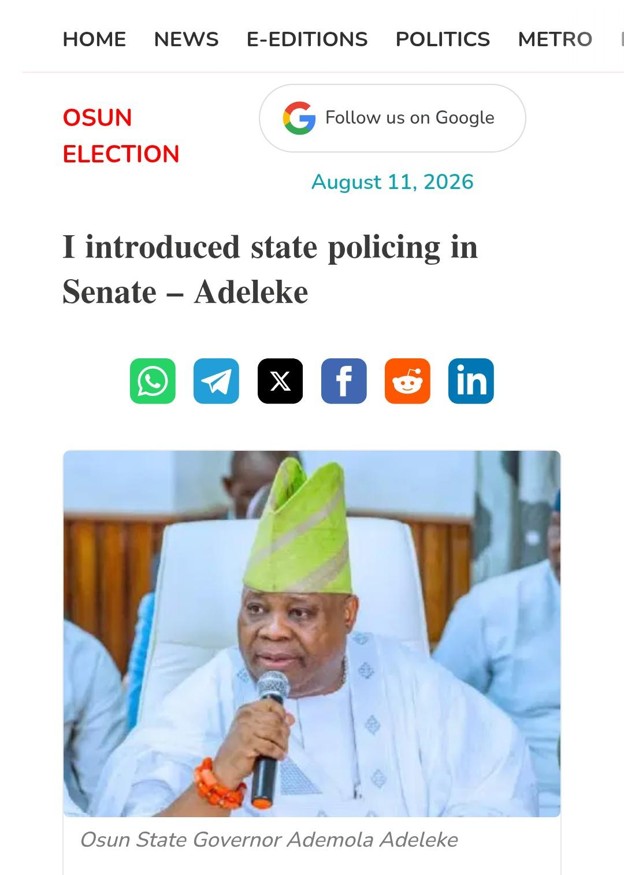
The distinction matters because community policing and state policing are two different arrangements. Community policing relies on cooperation between police and local communities, while state policing relies on constitutionally recognised police forces established at the state level. This distinction is central to assessing the governor’s claim against the documented timeline.
The Senate’s official records also provide a clearer timeline. On July 4, 2018, the National Assembly reported that the Senate resolved to direct its constitutional review committee to begin the process of amending the Constitution to allow the creation of State Police. The official account says this came after a debate on killings across the country and a Point of Order raised by Senator Jonah Jang of Plateau State. Jang said a total of 155 people were killed in the last Plateau attack by herdsmen, out of whom 98 were from Mangu Local Government.
Media reports say that prayers for creating state police were supported by other Senators, including Olamilekan Adeola (APC Lagos West), Godswill Akpabio (PDP Akwa Ibom) and Barnabas Gemade (APC Benue North East), who supported the call for the creation of state police as the surest way out of the problem.
The process continued on July 12, 2018, when a bill seeking constitutional amendments to permit state and community police passed first reading. The Guardian reported that Deputy Senate President Ike Ekweremadu sponsored the bill, with 75 other senators co-sponsoring it.
Adeleke’s contribution, however, cannot be erased. He was among the senators who advocated decentralised and community-oriented policing in 2018. However, claiming that he introduced state policing overstates what the legislative record establishes.
The issue resurfaced in July 2025, when Adeleke joined other South-West governors at a constitutional review hearing to call for state police and true federalism. In 2026, the Senate passed a constitutional alteration bill seeking to establish State Police Services.
Conclusion
Available legislative records do not support the claim that Ademola Adeleke introduced state policing to the Senate. He sponsored a community-policing motion in February 2018, while the Senate’s specific action on state police came in July 2018 after Jang’s motion. Ekweremadu later sponsored the State and Community Police bill, with support from 75 other senators.
Adeleke can accurately be described as an early participant in the Senate’s 2018 debate on decentralised policing, but the evidence does not support describing him as the senator who introduced state policing to the Senate.