


Between late last year and early this year, there were allegations that President Tinubu and the APC intended to establish a one-party state in the country. Opposition politicians said President Tinubu did not want an election but a coronation, and not an election, by muzzling all the opposition political parties. The internal conflicts faced by the main opposition parties seemed deliberately caused by the ruling party, rather than being just a coincidence.
The political class pushed back and built a strong coalition against the incumbent President and the APC, with political bigwigs converging in the African Democratic Congress. The group comprised prominent individuals, including Atiku Abubakar, Peter Obi, Chibuike Amaechi, Rabiu Musa Kwankwaso, Senator David Mark, and Ogbeni Raufu Aregbesola, as well as numerous other esteemed leaders.
This coalition aimed to unify their efforts and present a formidable challenge to Tinubu’s administration, signalling a potential shift in the political landscape as they rallied support from disenchanted voters across the nation.
A formidable opposition, reeling from the errors of the 2023 presidential election, where their votes were dispersed, was uniting against the Tinubu presidency, which is viewed as robust, by utilising the ADC as a strategic vehicle to mobilise votes from Nigerians nationwide against President Tinubu. The strategy was working for a while, causing jitters.
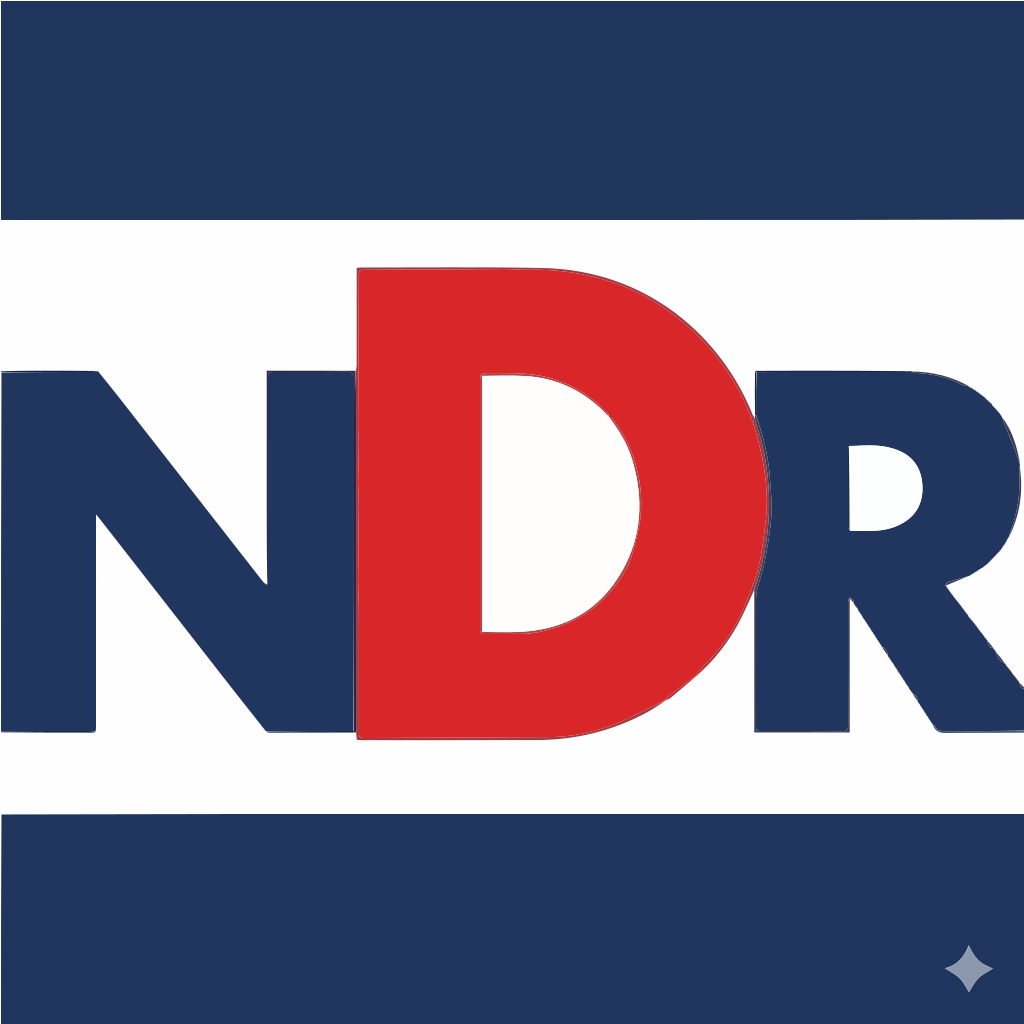
In the last week, the coalition collapsed. The party’s collapse began when prominent political figures such as Peter Obi, who garnered six million votes in the 2023 presidential election, and Musa Kwankwaso, who received more than one million votes, decided to leave. They have since joined the Nigeria Democratic Congress (NDC), a new party. Like a pack of cards, the hitherto octopus coalition has crumbled. On Tuesday, eighteen members of the party in the House of Representatives resigned from the party.
The political situation for the opposition is back to the pre-2023 levels. The opposition will disperse its votes and invariably pave the way for a smooth victory for President Tinubu, who enjoys the support of thirty-one governors across the different political parties. That was why the APC members jubilated when Peter Obi and Kwankwaso abandoned the coalition ship. Because his exit from the coalition makes their job easier, with a fragmented opposition.
If Peter Obi becomes the NDC’s presidential candidate, he is likely to secure significant votes from the South East and South South regions, particularly in Edo and Delta states. Should Kwankwaso be selected as his vice-presidential running mate, the NDC can expect strong support in Kano and additional votes from various other northern states.
If Atiku Abubakar emerges as the presidential candidate of the ADC, he will harvest his votes from the north, as the northerners are perceived to be angry against President Tinubu for his appointments and policies. The north feels wronged after losing its previously favourable status in government. If Amaechi emerged as his vice, their joint ticket would get votes from the South-South states. Conversely, if Seyi Makinde were to join the ADC—as some people are predicting—and secure the vice-presidential spot on their ticket, he would likely win significant support in the southwest, particularly in Oyo and Osun states. President Tinubu was defeated in both Osun and Lagos States in the 2023 elections.
Despite concerns regarding Nigeria potentially evolving into a one-party system, projections indicate that at least eight political parties may emerge as principal entities following the 2027 elections. These parties are expected to have elected officials serving across various tiers of government. Included among them are the APC, ADC, NDC, PDP (led by either Wike or Makinde), APGA (represented by Governor Soludo), Accord Party (under the leadership of Governor Ademola Adeleke of Osun State), LP (with Governor Otti of Abia State), and APM (headed by Governor Bala Mohammed of Bauchi State).
The choices before Nigerians are varied and wide. The campaigns promise to be interesting if they focus on issues. But will they? Very doubtful. Will presidential candidates have the opportunity to participate in debates? Additionally, will President Tinubu take part in a debate, or will he opt for town hall and sectoral meetings as was done during the 2023 elections?
Between the ADC and the NDC, which will be the dominant opposition party? Will the prediction of a run-off presidential election made by Mallam El-Rufai happen? Numerous questions remain for politicians to answer, and many events will unfold once decisions are made on the party candidates.