Twenty-four hours after casting their votes, Nigerians now await the outcome of the elections of what has gone down as the most competitive contest in more than four decades. The Electoral umpire, INEC said the national collation centre would open at noon today but the final results may not be known until all results from
Twenty-four hours after casting their votes, Nigerians now await the outcome of the elections of what has gone down as the most competitive contest in more than four decades. The Electoral umpire, INEC said the national collation centre would open at noon today but the final results may not be known until all results from 176,606 polling units spread across the 36 states and the federal capital territory, Abuja are received.
Finally, Nigerians heaved a sigh of relief and trooped out to elect a new President, putting to rest all apprehensions of whether the election would hold or not. The elections held but with some challenges here and there. INEC that had promised there would be no logistics challenge in this election, came out apologizing for late distribution of materials in some states which caused voting to commence late.
Elections would continue today in some polling units where they could not hold yesterday. But INEC was not specific on the exact details of the polling units, their wards and the states where such would take place today. This led to circulation of fake stories about the affected places. Realising, the potential confusion this may activate, INEC said late night “INEC did not extend voting period in 16 states. The story is false and should be disregarded. An extension of time was granted voters in areas where polling units did not open at 8;30am. Voters on the queue before 2:30pm are then allowed beyond the 2:30pm stoppage time.
But, at his second daily briefing on Friday, the Independent National Electoral Commission (INEC) announced postponement of election in some parts of Bayelsa and Edo states. In Edo state, the constituency election in Esan North, Esan South and Igueben due to the omission of a political party’s logo on the ballot was deployed. In Bayelsa, he said, the election is postponed in four wards with 141 Polling Units. Voting will continue there tomorrow.
In Yenagoa, voting was disrupted and the commission mobilised security officials to escort the ad hoc staff to continue voting. However, the NYSC ad hoc staff were scared to go back, prompting the commission to postpone voting in the areas, Mr Yakubu said.
Though reports from across the country indicate that registered voters came out in their numbers to cast their votes and the election was also generally peaceful but there were skirmishes in a few places. There were disruptions to voting in many places including Lagos and there were attempts to manipulate the results in a few isolated centers.
As voting progressed, the social media was awash with real time information on happenings from different polling units across the country. A lot of voters could not locate their polling units. They were mainly those who were moved from densely populated polling units to new ones but who did not hearken to INEC’s advice that voters should check their polling units ahead of the election day.
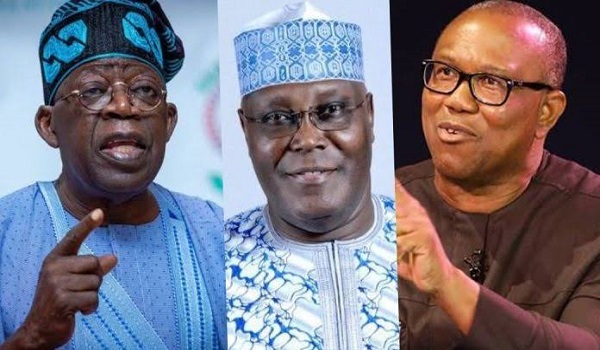
On the ballot yesterday were 18 presidential candidates, amongst them only one woman and several senatorial candidates and House of Representative candidates. Out of them 109 Senators will emerge and 360 Representatives. But as the polls closed yesterday only three of the presidential candidates have a pathway towards breasting the electoral tape. Hitherto, Nigerians have been used to a two-horse race but that has given way to a three-horse race, with a strong showing by the Labour Party candidate in the election.
The outcome of the election is still too early to call as the situation rooms of the different parties are doing mathematical computations to chart their path to victory. Facts are also being assembled for legal minds to see options that could be explored to win in the court room on technical grounds, if the outcome does not favour them. The last time Nigerians witnessed something close to this year’s election was in 1979, when it took mathematical calculation of two-thirds of the number of states, then 19, to declare a winner at the Supreme Court.
The two top contenders then, were Alhaji Shehu Shagari of the National Party of Nigeria (NPN) and Chief Obafemi Awolowo of the Unity Party of Nigeria (UPN). Since the return to democracy in 1999, there have always been two dominant parties contesting elections, though many parties have always been on the register.
The INEC has drawn a lot of flaks from Nigerians for some of the shortcomings associated with the election especially on its logistics for the distribution of materials to polling units but fairly, INEC was able to deliver on its promises of a free, fair, transparent and credible elections and its deployment of technology through the use of BVAS worked optimally well across the country. There were hiccups based on handling in a few polling units but all of them were resolved and there was no resort to the use of incident forms or manual accreditation.
It is also a positive thing for INEC that it is not being accused of biased or working in favour of any of the political parties. Observed mistakes were not directed at any of the parties neither were they restricted to a particular area that could be tagged strongholds of any of the contestants. Other developments like disruption of voting, snatching of ballot boxes were outside the direct control of INEC but within the purview of security agencies.