National President, Nigeria Association of Women Journalists (NAWOJ) Mrs Ladi Bala has observed that the training organized by the the International Press Center organised for female journalists is like removing a scale in their eyes as they have been empowered to earn a living from their skills. Speaking on Monday at the venue of a
National President, Nigeria Association of Women Journalists (NAWOJ) Mrs Ladi Bala has observed that the training organized by the the International Press Center organised for female journalists is like removing a scale in their eyes as they have been empowered to earn a living from their skills.
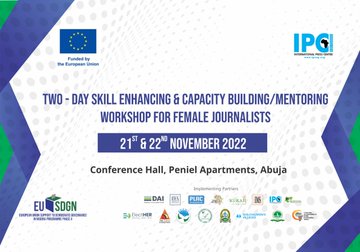
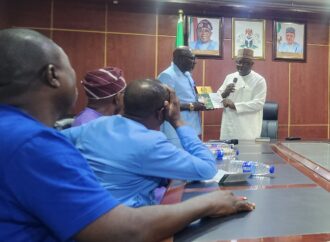
Speaking on Monday at the venue of a two-day capacity training for female journalists in Abuja, Mrs Bala said the training is “engaging, interactive and one could feel the vibe and see the way participants listened attentively and some are saying journalism is a gold mine they have previously failed to explore”.
 Commending the International Press Center, as organisers and the European Union as funders of the workshop for making her dream at empowering female journalists come true, Mrs Bala called on other Civil Society Organisations (CSO) to organised more trainings for female journalists.
Executive Director (IPC) Mr Lanre Arogundade said the objectives and expectations of the workshop from its resource persons and their topics were carefully decided upon with the task to make something to change in participants so that “something can in turn change in Nigeria’s electoral process and democracy”, he said.
“As you may have noticed in our previous communications with you, this workshop is one of the activities being implemented by IPC, as lead partner, and the Institute for Media and Society (IMS) under Component 4: Support to Media of the European Union Support to Democratic Governance in Nigeria (EU-SDGNII) project.
“Because the project seeks to make the media catalysts of credible elections, the actions, including media engagements like this, seek to strengthen the media for fair, accurate, ethical and inclusive coverage of electoral processes in Nigeria to achieve six results as follows:
The enhancement of the professionalism of media practitioners, especially women; “The strengthening of media professional capacity to deal with electoral misinformation/disinformation; The enhancement of media platforms’ ability to diversify, deepen the coverage of the electoral process and deliver civic and voter education;
“The improvement of media awareness and use of FOI Act for increased accountability; and
The strengthening of the National Broadcasting Commission (NBC) to perform its mandate; and
the improvement of media engagement in promoting women, youths and marginalized groups in politics.
“I welcome you all to this workshop designed to attain the key objective of enhancing your professional skill in a way that you can engage in impactful, inclusive and public interest reporting of the on-going electoral processes in general and particularly, the 2023 elections.
“We are delighted to have as a worthy partner in this exercise, the Nigeria Association of Women Journalists (NAWOJ), under the leadership of Ladi Bala, which underscores our joint commitment to ensuring that female journalists are equipped to help strengthen the democratic processes. To make journalism better for women journalists and women journalists better for journalism, is therefore the slogan we have adopted as we intensify our efforts.
“The strengthening of media professional capacity to deal with electoral misinformation/disinformation; the enhancement of media platforms’ ability to diversify, deepen the coverage of the electoral process and deliver civic and voter education;
The improvement of media awareness and use of FOI Act for increased accountability; and
The strengthening of the National Broadcasting Commission (NBC) to perform its mandate; and
The improvement of media engagement in promoting women, youths and marginalized groups in politics.

“Obviously, this workshop relates directly to the first result, but it is also aimed at ensuring that participants contribute to the realisation of the other five. That is why our expectations include the fact that you will make use of the skills acquired in the next two days to combat fake news; provide civic and voter education and inspire other forms of engagement with the media that encourage the people particularly underrepresented groups like women, youths and persons with disabilities to vote and be voted for; and make FOI requests for the purpose of investigative reporting of accountability and transparency issues in the electoral process.
“The big questions that we expect each and every one of you to ask at the end of this training are:
Yes, I have attended this training – and so what? What is my goal thereafter? What can I change with my story and media engagement? What stories can I do that will bring about that change?
The investment of EU-SDGNII, for which we are grateful to the European Union, and the efforts of IPC in putting together this workshop would only be deemed productive if in the aftermath we are able to identify the impact of your work on the electoral processes and the 2023 elections in visible and significant ways.
Against the background of the above objectives and the expectations, our resource persons and their topics were carefully decided upon. Their task is to make something to change in you so that something can in turn change in Nigeria’s electoral process and democracy.
“Along this line, the first session on Factual accuracy and combating fake news: The place of fact checking and data use in reporting of 2023 elections will be facilitated by David Ajikobi, Editor Africa-Check; the second on Impactful Reporting of Electoral Processes and 2023 Elections: Focussing on Issues & Telling Stories That Matter by Mr. Taiwo Obe, Founder of the Journalism Clinic; and the third on Electoral Processes & 2023 Elections: According Priority to Issues of Women and other underrepresented groups by Mrs. Moji Makanjuola, MFR and CEO of International Society of Media in Public Health.
I will also make a presentation on Conflict-sensitivity and safety in election reporting because we do not take your well-being for granted. I like to conclude by passionately appealing to you give the workshop the desired attention and avoid distractions that may prevent the attainment of the objectives of our convergence.
Media icon, Mrs Moji Makanjuola in her paper called on participants to always back their stories with research and be determined to make a difference in inclusion issues. While urging participants to read widely and improve their use of English, Mrs Makanjuola charged them to always report verifiable facts. She urged them to always share their stories with colleagues to have lasting impact.
Founder/ Director,The Journalism Clinic, Mr. Taiwo Obe recommended what he called “RUSH”- Reporting Until Something Happens- for the participants. Mr. Obe called on the participants to always look at an issue for reportage and report it consistently until the desired result is achieved.