


2023 Elections: More Women Voted into State Houses of Assembly Than in 2019
…They won 4.7% of Total Seats Across the Country Despite the issue of gender inequality in the polity, more women continue to prove their mettle at different levels, as the outcome of the 2023...

…They won 4.7% of Total Seats Across the Country
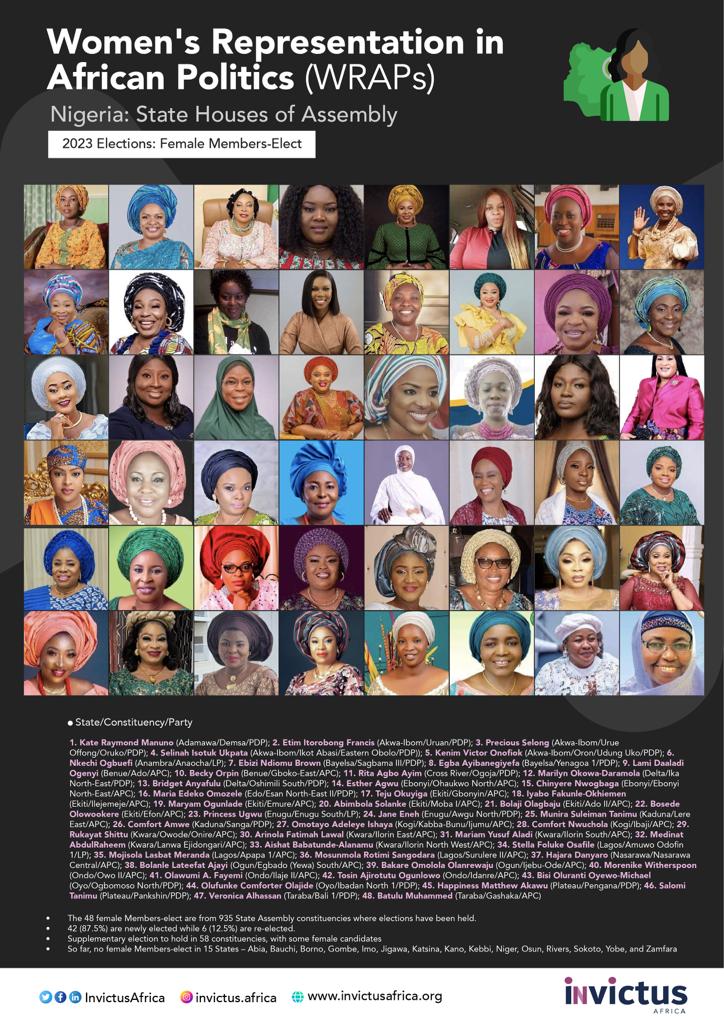
Despite the issue of gender inequality in the polity, more women continue to prove their mettle at different levels, as the outcome of the 2023 elections have shown the presence of more women at the sub-national parliamentary level. Though just a marginal increase, there will be 48 women out of 993 legislators in the various State Houses of Assembly. This performance is better than 2019 when there were only 45 women in similar positions..
As the dust gradually settles from the general elections, it is becoming evident that there has not been a significant improvement in the inclusion of women in Nigerian governance, both at the federal and state levels. It would appear that the political parties did not keep to their promises of giving women about 30 percent of their elective positions.
According to available data, there were 10, 232 candidates who ran for 993 seats in state houses of assembly across the country, with 1,049 of them being women and the other 9, 221 being men. However, only 48 females, representing 4.7% of the 1,049 female candidates, were elected to their respective state houses of assembly.
There were projections that the 2023 general elections would usher in a new narrative of gender inclusivity in Nigerian political leadership, it is fairly obvious that the trend of women’s absence or sparing participation in Nigerian democracy has not taken a different shape from its previous position.
On March 18th, 2023, governorship elections were held in 28 states and states Houses of Assembly elections across the 36 states of the federation. The unimpressive outing by women particularly at the state houses of the assembly speaks largely to the need to be intentional about proper legislation on women’s participation. The gender-based groups will need to intensify more efforts and change strategies so as to get more women into political positions.
The National Gender Policy formulated to promote 35% affirmative actions for women to fulfil the demands that 35 per cent of women have to be involved in all governance processes would appear not to have permeated the political parties. It was so bad than a man was made the chairman of women committee in one state House of Assembly.
According to the Independent National Electoral Commission (INEC) women constituted 47% of 93 million registered voters in Nigeria. This huge population should present better and higher representation, if and when well harnessed.
While the number of women elected as winners in the 2023 general election is higher than in the 2019 election, where only 45 women were elected to the same position across the country, it should be noted that the increase is less than 1%.
A further breakdown of the available data for the 48 female candidates shows that southwest produced the highest number of women in the state parliaments with a total of 16 winners while Ekiti state produced the highest number in the region, delivering 6 seats for women out of the 26 in the house.
Similarly, Kwara and Akwa Ibom followed the chain of states with the most female lawmakers, producing five and four members of their states’ houses of assembly respectively to become next to Ekiti state.
Recall that Ekiti state only has four female members of the house of house assembly among its outgoing legislatures, while Kwara does not have any, and Akwa Ibom only produced two among its outgoing lawmakers.
Meanwhile, Lagos state did not change its position in the 2023 elections, as it continues to retain only three female members of the State House of Assembly it produced in the 2019 elections.
However, there are 15 states without female members of their Houses of Assembly; these states include Abia, Bauchi, Borno, Gombe Imo, Jigawa, Katsina, Kebbi Kano, Niger, Osun, Rivers, Sokoto, Yobe and Zamfara.
According to the available statistics, only Kaduna out of the seven states in the northwest produced a female lawmaker in the 2023 elections, the other six states will be flooded by male-dominated houses of assembly.
Furthermore, Taraba and Adamawa states are the only two in the country’s northeast with female members of the houses of assembly, while the other four will be dominated by men. As a result, Taraba will have two female legislators out of 24 total, while Adamawa will now have only one of the state’s 25 seats.
In conclusion, further analysis revealed that no state houses of assembly will have 35 per cent of women representation across the 36 states in Nigeria as stipulated by the National Gender Policy affirmative action.