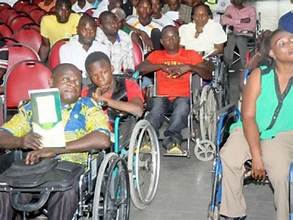
The Joint National Association of Persons with Disabilities (JONAPWD) has highlighted significant shortcomings in how Persons with Disabilities (PWDs) are included, particularly in media coverage and election observation. It is urging immediate reforms to improve accessibility, representation, and genuine involvement, which are essential for maintaining electoral integrity in the country. A recent policy brief by
The Joint National Association of Persons with Disabilities (JONAPWD) has highlighted significant shortcomings in how Persons with Disabilities (PWDs) are included, particularly in media coverage and election observation. It is urging immediate reforms to improve accessibility, representation, and genuine involvement, which are essential for maintaining electoral integrity in the country.
A recent policy brief by JONAPWD highlights that media coverage of Nigerian elections often emphasises the perseverance of voters with disabilities, rather than addressing institutional barriers to their participation. As a result, elections may be deemed credible despite many voters with disabilities being effectively excluded.
The body further analysed that most elections, which the media and international and local observers report to be free and fair, are usually not putting the experience of the PWDs, which is a significant part of the electorate, into their reports. The policy brief further stressed that an election cannot be considered fully legitimate if citizens with disabilities are unable to participate on equal terms.
JONAPWD also argues for the integration of disability indicators into standard CSO observation frameworks and media reporting, calling for a shift from the regular activity-based visibility to access-based indicators, making independent participation a non-negotiable benchmark for a credible election.
Identifying the key gaps in the media reports and election observations of the PWDS, JONAPWD noted that “exclusion begins much earlier in the electoral cycle, during voter registration, party primaries, candidate nomination, and campaign activities; when disability inclusion is introduced late in the cycle, interventions tend to be rushed and fragmented, leaving structural barriers unaddressed.” As a result, election observation often captures only a narrow snapshot of accessibility while missing systemic exclusion.
“Disability Data Without Consequence: Even where disability data is collected, it is often relegated to sub-sections or annexes of final reports rather than incorporated into headline findings. When accessibility failures are separated from core election assessments, they are perceived as secondary concerns. A polling unit without ramps or accessible voting materials may still be described as peaceful and orderly, even though some voters were effectively excluded. Accessibility failures should be reported as electoral irregularities, not as isolated welfare concerns. Without integration into headline findings, disability data has little influence on assessments of election credibility.
“Flawed Checklists: Measuring Presence Rather than Participation Standard observer checklists often emphasise quantitative measures that fail to capture the quality of participation. Observation tools frequently record whether persons with disabilities were present at polling stations.
JONAPWD further in the policy brief noted that media reports and election observation reports often ignore disability diversity, as mainstream observation frameworks often treat persons with disabilities as a homogeneous group without taking cognisance that different disability groups face distinct barriers.
For instance, the document noted that while voters with visual impairments require tactile ballot guides, Deaf voters require interpretation support, and persons with mobility impairments require physically accessible polling units, the generic “disability inclusion” indicators fail to capture these differences, resulting in incomplete and misleading data.
The policy brief also noted that the exclusion of PWDs from taking an observer role is a key gap, as persons with disabilities are frequently the subjects of observation but rarely serve as observers themselves. “Domestic observation recruitment processes rarely prioritise persons with disabilities as field monitors. As a result, observation teams often lack the lived experience that could help. Identify accessibility barriers. Observers without direct experience of disability may overlook issues such as inaccessible entrances, poorly positioned ballot boxes, and inadequate assistive devices.”
JONAPWD also faulted the tokenism media framing issues of PWDs, making society have the Charity approach towards them instead of adopting the human rights approach. The body maintained that media reporting on disability and elections often focuses on individual stories of resilience rather than institutional accountability.
“Coverage frequently highlights the determination of voters with disabilities to participate despite barriers, reinforcing a narrative of personal struggle instead of systemic failure. These framing shifts attention away from the responsibility of institutions such as the Independent National Electoral Commission (INEC) to provide accessible electoral processes. Rights-based reporting requires journalists to ask why barriers exist and who is responsible for removing them.
In its recommendation, JONAPWD called for a shift from activity-based indicators and a move towards access-based indicators, stating that Priority metrics should include “Percentage of accessible polling units”. Availability and use of assistive devices. Percentage of voters with disabilities able to vote independently. Accessibility of voter education materials. Measure Access, Not Activities. Develop Standard Disability Observation Modules. Co-Design Observation Methodologies. Recruit Observers with Disabilities: Integrate Accessibility into Headline Findings
The recommendation further calls on the relevant stakeholders to “develop Standard Disability Observation Modules Domestic observer coalitions should develop standardised disability observation modules that can be integrated into all major observation missions. Standardised tools will improve the comparability of data and ensure disability indicators are consistently measured.
“Co-Design Observation Methodologies: Organisations of Persons with Disabilities should be engaged at the design stage of observation missions, not only during implementation.
“Recruit Observers with Disabilities; server recruitment processes should actively include persons with disabilities to strengthen data quality and credibility.
“Integrate Accessibility into Headline Findings—Accessibility failures should be reflected in overall assessments of polling unit performance and election credibility.”
In conclusion, JONAPWD urged the Media to “adopt Rights-Based Reporting Guidelines – Editorial policies should shift from sympathy-based Report Responsibly Investigate Systemic Issues Focus on structural barriers and Share Personal Narratives. Focus on individual ripeness and Drive Data Driven Reporting Use data to report on exclusion.
“Report Institutional Responsibility. Focus on accountability for actions, reporting toward accountability, and reporting focused on institutional responsibility. For example, instead of focusing solely on the resilience of a voter who crawled to a ballot box, journalists must investigate why the polling unit lacked a ramp.”