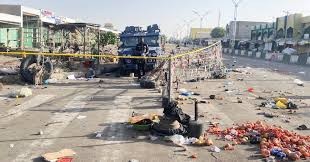
Claim: The General Officer Commanding (GOC), 6 Division, Nigerian Army, Maj.-Gen. Emmanuel Emekah, claims that the Division recorded zero cases of violent pipeline vandalism and that no oil company operating within its Area of Responsibility (AOR) reported any pipeline breach due to vandalism between January 24 and December 2025. Verdict: Misleading, the Presidency itself acknowledged
Claim: The General Officer Commanding (GOC), 6 Division, Nigerian Army, Maj.-Gen. Emmanuel Emekah, claims that the Division recorded zero cases of violent pipeline vandalism and that no oil company operating within its Area of Responsibility (AOR) reported any pipeline breach due to vandalism between January 24 and December 2025.
Verdict: Misleading, the Presidency itself acknowledged militant-related pipeline vandalism during the same period.
Full Story
During a media tour of the Headquarters, 6 Division, Nigerian Army, and the Land Component of Operation DELTA SAFE, defence correspondents were told by the GOC, Maj.-Gen. Emmanuel Emekah, that no violent pipeline vandalism was recorded within the Division’s AOR in 2025. He further stated that oil companies operating in the region did not report any pipeline breach attributed to vandalism within the period.
Violent pipeline vandalism refers to the wilful and illegal destruction, tampering, or hacking of oil and gas infrastructure, often involving armed actors, to steal petroleum products or sabotage facilities for economic, political, or social reasons.
Historically, pipeline vandalism has been a persistent problem in Nigeria. Official records show that over 7,000 pipeline vandalism incidents were recorded between 2017 and 2021, while the Nigeria Extractive Industries Transparency Initiative (NEITI) reported billions of dollars in losses to oil theft and sabotage between 2022 and 2023.
Since Maj.-Gen. Emekah assumed command of the 6 Division, reports have indicated a significant reduction in crude oil theft, with some independent oil companies reporting zero incidents in recent times. The Army’s claim was widely reported by several media outlets here, here and here. The military also maintained that any pipeline failures recorded were due to aging infrastructure rather than deliberate sabotage.
However, the statement sparked debate on social media.
On Facebook, Samuel Itudje asked, “But crude oil was still stolen from the region—how come?”
Another user, Garba (@Nigerian_01), shared a flier referencing an Oando pipeline in Bayelsa State reportedly hit by a sabotage attack in April 2025.
To determine the accuracy of the claim, NDRFact reviewed publicly available reports and official disclosures.
Verification
Findings show that violent incidents affecting oil infrastructure were reported within the period under review.
On March 17 and 18, 2025, an explosion occurred on Nigeria’s Trans-Niger Pipeline, one of the country’s major crude oil pipelines transporting oil from the Niger Delta to the Bonny export terminal. Reports cited by oilprice.com said the blast occurred at Bodo, Gokana Local Government Area of Rivers State, triggering a massive fire.
On March 18, the Presidency, in a State House release, confirmed the explosion, describing it as “incidents of vandalisation of pipelines by some militants”.
Similarly, in April 2025, Reuters reported that Nigerian oil producer Oando Plc disclosed sabotage attacks on its infrastructure, including the 18-inch Tepidaba–Brass crude oil pipeline in Brass Local Government Area and the 24-inch Ogboinbiri/Obiobi gas pipeline in Southern Ijaw, Bayelsa State.
However, not all oil companies reported attacks.
In December 2025, Chevron Nigeria publicly stated that it recorded no incidents of oil theft or sabotage on its pipelines throughout 2025, attributing this to improved security conditions.
Additionally, S&P Global, citing the Nigerian Upstream Petroleum Regulatory Commission (NUPRC), reported a reduction in crude oil theft, from about 11,300 barrels per day in 2024 to approximately 9,600 barrels per day in 2025.
Conclusion
The Nigerian Army’s claim is accurate only within its narrow military classification framework. While some oil companies reported no incidents, others documented sabotage and attacks on their facilities, and the presidency itself acknowledged militant-related pipeline vandalism during the same period.
Verdict: The claim is misleading, as pipeline violent security challenges were not entirely absent in 2025 as confirmed by the presidency.