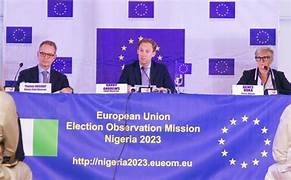
Before the Courts reach their verdicts on the 2023 elections, some other non-partisan participants in the elections have reached important conclusions. A delegation of the European Parliament which joined and the EU EOM in observing the elections with a total of 110 observers from 25 EU Member States as well as Norway, Switzerland, and Canada
Before the Courts reach their verdicts on the 2023 elections, some other non-partisan participants in the elections have reached important conclusions. A delegation of the European Parliament which joined and the EU EOM in observing the elections with a total of 110 observers from 25 EU Member States as well as Norway, Switzerland, and Canada has faulted the general election on transparency saying: “The 2023 general elections did not ensure a well-run transparent, and inclusive democratic process as assured by the Independent National Electoral Commission (INEC)”
In a 92-page document titled the “European Union Election Observation Mission Nigeria 2023 Final Report” also noted that in its Executive Summary that “Public confidence and trust in INEC were severely damaged during the presidential poll and was not restored in state level elections, leading civil society to call for an independent audit of the entire process. The pre-poll environment was volatile and challenging, affected by economic crises. Fundamental freedoms of assembly and movement were broadly respected, yet the full enjoyment of the latter was impeded by insecurity in some parts of the country.
“Abuse of incumbency by various political office holders distorted the playing field and wide-spread vote buying detracted from an appropriate conduct of the elections. Incidents of organised violence shortly before and on election days in several states created an environment deterring voter’s participation. Media raised voters’ awareness, fact-checkers stood up against disinformation and civil society demanded INEC’s accountability. The overall outcome of the polls attests to the continued underrepresentation of marginalised groups in political life. Positively, candidates and parties disputing outcomes took their complaints to the courts, although the number of such cases was extensive.
On Violence During Campaigns
The EU EOM recorded 101 violent incidents during the campaign, including at least 74 fatalities. Assassination attempts and killings increased closer to the polls, creating a particularly insecure environment in the southern states. In several northern states, systematic attacks by political thugs on rallies and political opponents was observed. Use of violence obstructed the campaign, disturbed the elections, and supressed voter participation.
On Campaign Finance
Campaigning was also distorted by an influx of unrecorded money and despite campaign finance being comprehensively regulated the law appears largely ineffective. EU EOM observers received reports of and saw widespread distribution of goods and vote buying. Several state agencies tried to tackle corrupt practices, yet their results were modest. This is evidencing that political will, enhanced institutional capacity, and robust enforcement synergy are needed to ensure transparency and genuine accountability.
On Media Performance
Media offered extensive campaign coverage, with APC and PDP getting equitable exposure. During interviews, politicians rebuffed merit-based questions, focusing instead on inter and intra party mudslinging. Analytical reporting was scant as, fearing retribution from the governor, many state-level outlets practiced self-censorship. The broadcast media regulator imposed at least 43 fines without a due process, while numerous attacks on journalists went unpunished.
Overall, police inaction compounded by institutional pressures impeded freedom of expression and hindered voters’ access to diverse information on electoral choices. Social media was an important campaigning and mobilisation tool for candidates, especially in close contests. It was further used by political camps to create false impressions of support or to attack opponents, as well as to spread false information.
Social Media
However, social media also provided a platform for citizens to express their views and stimulated important debates about the elections. Unfortunately, authorities often used the Cybercrimes Act to supress freedom of expression online. Online and offline media joined forces with civil society and fact-checkers to safeguard the integrity of the information environment. Real-time fact checking of gubernatorial and other contestants’ debates strived to hold candidates accountable, while various formats of voter information raised awareness.
On Civil Society Groups
Civil society played a crucial and positive role in the electoral process, offering a non-partisan assessment of INEC’s conduct and, after the 25 February polls, calling for greater transparency and accountability. Statements by citizen observer groups also pointed to INEC’s failures, while their leaders took part in online and offline discussions focusing on the impact of thuggery, violence, and intimidation on voters, and called for a thorough independent review of the 2023 elections.
Active involvement of youth was expected to be a decisive feature of the 2023 elections, especially considering the 2020’s wave of civic activism. However, despite targeted voter information efforts, political parties were seen to exploit youth, many of whom were vulnerable to pressure or coercion on social, financial, and educational grounds. This underlines the need for greater efforts to protect genuine youth engagement in elections.
The general elections highlighted a clear commitment among Nigerian voters to the democratic process but also demonstrated an urgent need for transparent and inclusive legal and operational reforms to tackle enduring systemic weaknesses of the electoral process. The EU EOM is offering 23 recommendations to improve electoral processes and to uphold regional and international commitments. They include six priority recommendations:
Priority Recommendations
1. Protect the interests of voters through certainty of law for all stages and aspects of electoral processes by eliminating from electoral law and regulations errors and ambiguities to avoid potential for conflicting interpretations, and ensuring the revision processes are inclusive.
2. Establish a robust operational framework for the independence, integrity, and efficiency of electoral administration through an inclusive and publicly accountable mechanism for selecting candidates to the posts of INEC commissioners and RECs based on clear criteria of evaluation of merits, qualifications, and verified non-partisanship.
3. Protect the free expression of the will of the voter and integrity of elections by establishing a robust, transparent, and easily verifiable results processing system with clear rules. These include uploading polling unit results from the polling unit only and in real time, at each level of collation results forms to be uploaded in real time, and all forms to be published in an easily trackable and scrapable database format.
4. Afford adequate protection to freedom of expression by developing a comprehensive operational framework underpinned by the skills and means for ensuring prompt investigation and prosecution of all types of attacks against media practitioners.
5. Undertake urgent and robust affirmative action to ensure meaningful women’s representation through special measures in line with the Beijing principles and the National Gender Policy to increase the representation of women as candidates and in elected office, further supported by cross-sectoral, intensified, and sustained capacity building and sensitisation to eliminate discrimination.
6. Address impunity for electoral offences through robust, well-defined, and effective inter-agency co-ordination governed by clear rules on non-partisanship, optimisation of resources, delivery of effective investigation and sanctioning, and provision of regular public consolidated information on outcomes.
Please see the Full Report Attached:European Union – EOM Final Report on 2023 Elections