
The Senate’s amendment of the Electoral Act continues to face criticism from stakeholders, as the International Press Centre (IPC), the Centre for Media and Society (CEMESO) and other civil society organisations have urged lawmakers to follow the House of Representatives’ stance on electronic transmission of results, downloadable voter cards, and maintaining electoral timelines. This information
The Senate’s amendment of the Electoral Act continues to face criticism from stakeholders, as the International Press Centre (IPC), the Centre for Media and Society (CEMESO) and other civil society organisations have urged lawmakers to follow the House of Representatives’ stance on electronic transmission of results, downloadable voter cards, and maintaining electoral timelines.
This information was contained in a press statement released on Monday, jointly signed by the Centre for Media and Society (CEMESO), the Kukah Centre, International Press Centre (IPC), ElectHer, Nigerian Women Trust Fund, TAF Africa, Yiaga Africa, Spaces 4 Change, Corporate Accountability and Public Participation, and WARDC.
At a press conference at the International Press Centre in Ogba, Lagos, Executive Directors Mr Lanre Arogundade of IPC and Dr. Akin Akingbulu of CEMESO emphasised that electoral reform is more than just a procedural matter; it should serve as the cornerstone for ensuring credibility, transparency, and predictability in democratic transitions.
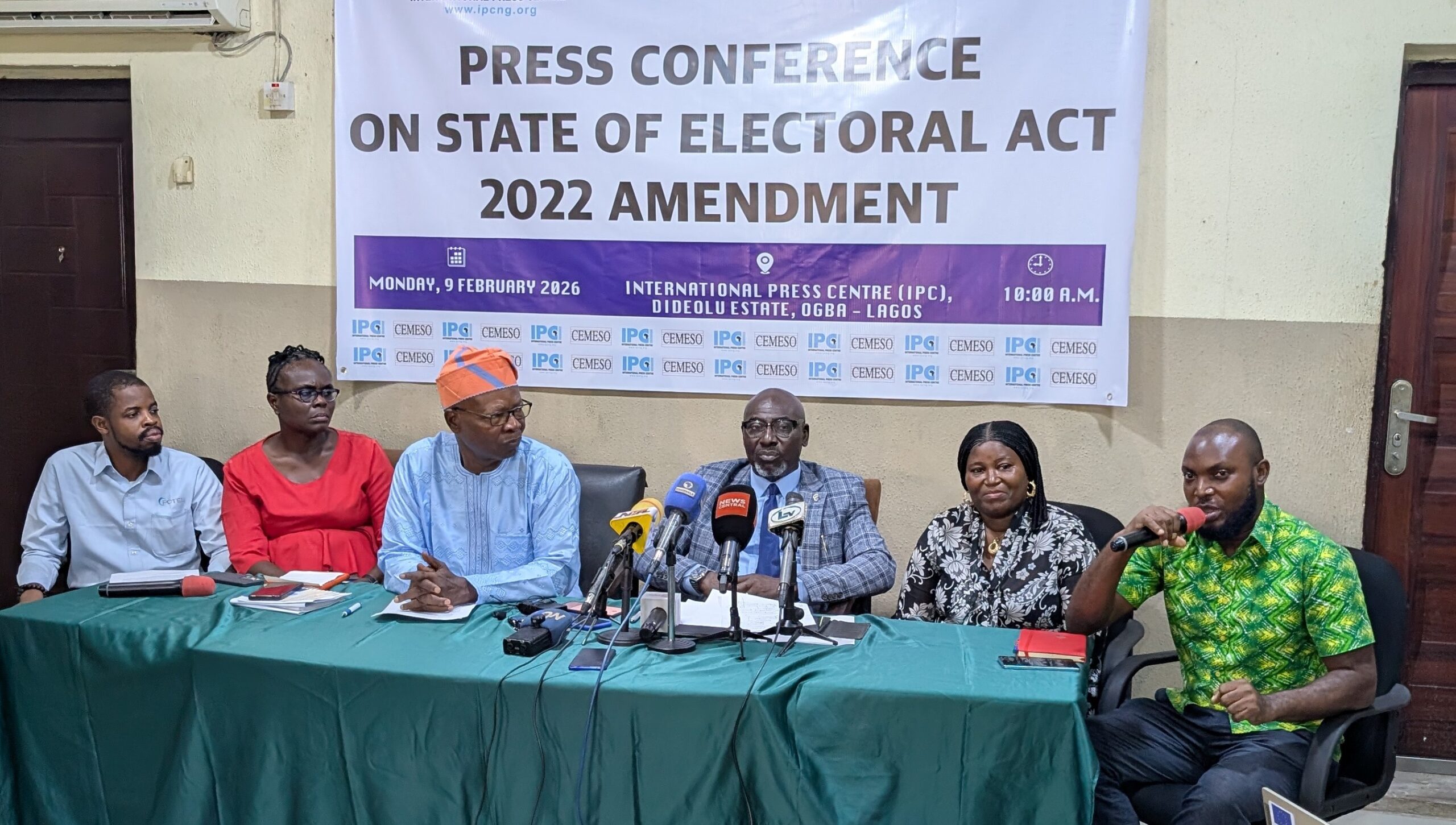 The organisations stated that delays in amending the electoral process have caused legal uncertainty, hindered INEC’s election preparations, and possibly affected credible elections. They also noted that the Senate’s recent passage of the Electoral Act has led to confusion among Nigerians and stakeholders.
The Senate recently passed amendments to the electoral law ahead of the 2027 general elections. On February 4, 2026, senators made several changes related to election timelines, technology, and penalties, while keeping some existing rules intact. Among the key points, they refused to make electronic transmission of results mandatory and also shortened the election notice period from 360 days to 180 days before election day.
The Senate also reduced the days for submission of the candidate lists from 180 days to 90 days before the general election, as well as the rejection of a proposed 10-year prison sentence for the buying and selling of PVCs. Instead, it retained the two-year imprisonment term and increased the fine from ₦2 million to ₦5 million.
While the Senate has responded to the public criticism that it has not rejected the electronic transmission of results, it only allowed the INEC to work within its discretion. IPC, CEMESO and other organisations insisted that the lawmakers have created “conflicting narratives regarding the precise position of the Senate. Three competing narratives have emerged: First, that the Senate approved real-time electronic transmission; Second, that existing Electoral Act 2022 provisions granting INEC discretionary powers over the procedure for results management were retained; and third, that the Senate substituted “transmit” with “transfer” and removed the qualifier “real-time” from its version. It is deeply concerning that legislation of such significance is mired in political contestation.”
They also emphasised the need for INEC to issue the election timetable and schedule for the 2027 general election in accordance with the provisions of the Electoral Act 2022 without further delay, stating that since the Act is still binding as a law, doing such would “fulfil statutory obligations and insulate the Commission from legal challenge; provide political parties, candidates, and civil society with certainty necessary for systematic preparation; and establish baseline timelines that subsequent amendments can modify through transitional provisions if necessary.” Indefinite postponement of notice issuance pending legislative resolution creates a vacuum that compounds administrative challenges and legal vulnerabilities.”
Acknowledging the Senate’s decision to convene an emergency plenary session on Tuesday, February 10, 2026 and it being believed that the sitting is convened to address matters related to the electoral amendment, the organisations urged the Senate to utilise the opportunity to adopt “unambiguous provisions through its Votes and Proceedings that explicitly adopt mandatory, real-time electronic transmission and collation of results, downloadable missing and unissued voter cards and retention of timelines for notice of elections, submission of a list of nominated candidates and publication of a list of candidates by INEC”.
They urged the conference committee, formed by the Senate and House of Representatives, to support the House’s requirement for electronic transmission, but with adjustments to avoid overly specific technology references. The present wording, which specifically mentions the INEC Result Viewing (IReV) portal, may create unnecessary rigidity.
As electoral technology advances, laws that mention specific platforms must be updated whenever the technology changes. This method is consistent with the Electoral Act’s treatment of the Bimodal Voter Accreditation System (BVAS), which allows for ‘BVAS or any other technological device’ during accreditation. Such wording sets a precedent for legal frameworks that are not tied to technologies, ensuring mandatory requirements are met while still allowing flexibility in how they’re implemented.
Referring the lawmakers to the modification to Clause 60 (3), which states that “The designated election official shall electronically transmit all election results in real time, including the number of accredited voters, directly from the polling units and collation centres to a public portal and the transmitted result shall be used to verify any other result before it is collated”, the organisations further stated that real-time transmission of means sending the official polling units results recorded on form EC8A electronically from the polling unit directly” a central results portal immediately after voting has ended, ballots have been counted, and the results have been publicly announced at the polling unit.
They further insisted that this would happen “in the presence of party agents, observers, and voters at the polling unit. It ensures that the exact results recorded at the polling unit are uploaded and available for public verification before they are physically transported for collation. Real-time transmission creates an electronic copy of the result at the point where it is first declared. Real-time does not mean automatic transmission of votes as voters cast their ballots, nor does it mean electronic collation of results.”
The statement further reads, “the conference committee should adopt the position of the House of Representatives, which approves downloadable missing and unissued voters’ cards. Data from INEC’s 2023 general election cycle indicate that approximately 6.2 million registered voters failed to collect their PVCs, resulting in effective disenfranchisement despite completed registration. Downloadable PVCs eliminate such barriers to voter participation.
“Regarding electoral timelines, we strongly recommend retaining current provisions: 360 days for notice of elections, 180 days for submission of candidate lists, and 150 days for publication of nominations by INEC. Compressing these timelines increases logistical risk, constrains ballot paper production and distribution, and heightens the chances of operational failures.
“Section 65 of the Electoral Bill empowers INEC to review election results within seven days where declarations are made under duress or in violation of procedures for result collation prescribed in the bill. However, the bill provides that all reviews of elections shall be conducted only when a report is filed by an INEC official. This provision bars political parties, candidates, accredited observers, and their agents from activating the review process, even where they tender compelling evidence of a manipulated and unlawful results declaration.
“Restricting the power of review to reports filed by INEC officials, some of whom may be complicit, is against the spirit behind the power of review vested in INEC. Evidence from recent elections revealed instances of INEC officials actively undermining elections. Election petition tribunal judgements from 2023 include multiple findings of Returning Officers announcing results under political pressure, Collation Officers falsifying result sheets, and Presiding Officers colluding with party agents to manipulate figures.
“We therefore recommend that the scope of persons eligible to file reports should be broadened to include political parties, candidates, accredited party agents, and observers present during the collation of results. This multi-stakeholder approach creates distributed accountability mechanisms that reduce vulnerability to administrative or process capture.
“We call on the conference committee members to approach the harmonisation deliberations guided by national interest, institutional integrity, and democratic accountability rather than narrow partisan calculations. We reiterate our recommendation that the National Assembly should expeditiously conclude the amendment process and transmit the final bill to the President within two weeks.
“As key stakeholders in the electoral process, we urge citizens and all stakeholders to demand accountable representation from their legislators in the National Assembly by pressuring them to prioritise the public interest and the integrity of the elections by passing the provisions on real-time electronic transmission of election results, curtailing the disenfranchisement of voters by introducing downloadable PVCs, and resisting any attempt to weaken established timelines that are crucial for conducting credible elections.”
Whilst giving remarks during the interaction with the media, Dr Akin Akingbulu further reiterated the demands, stating that the lawmakers must not hand their jobs to the electoral commission; instead, they are expected to do their jobs, while INEC will follow the law as it is stated.
Similarly, Mr Lanre Arogundade said it is the duty of the citizens and, most importantly, the media to ensure the politicians are held accountable as public servants, stating that the negligence of the public would always allow for impunity to thrive and that can further undermine the progress that should be in the country’s electoral system.
Speaking on the essence of the real-time transmission of votes, Robert Ogbe, the communication officer of the Corporate Accountability and Public Participation Africa (CAPPA), insisted that the real-time transmission is supposed to be the actual law in the amended Electoral Act, not an exemption. He called on the lawmakers to renege on their earlier passed legislation and heed to public outcry.