


INEC Reaffirms Commitment to Women’s Inclusion in Democratic Governance
The Independent National Electoral Commission (INEC) has reaffirmed its commitment to strengthening women’s leadership and promoting inclusivity within Nigeria’s democratic governance and electoral...

The Independent National Electoral Commission (INEC) has reaffirmed its commitment to strengthening women’s leadership and promoting inclusivity within Nigeria’s democratic governance and electoral system.
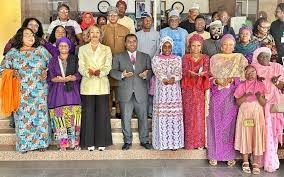
This was disclosed during the International Women’s Day celebration held on Tuesday at the Commission’s headquarters in Abuja.
The INEC Chairman, Prof. Joash Amupitan, expressed concern about the growing trend of gender-based disinformation and digital harassment targeting female political aspirants ahead of future elections.
Delivering the opening remarks, the INEC Chairman said the commemoration provided an opportunity to assess the progress made in promoting women’s participation in leadership while acknowledging the work that still lies ahead.
He said, “As we approach the 2027 electoral cycle, female candidates are increasingly subjected to online harassment and fake news aimed at discouraging their political ambitions. The electoral space must be a sanctuary for ideas, not a battlefield of gender-targeted attacks,” he warned.
Prof. Amupitan urged political parties to strengthen internal democracy and ensure greater inclusivity during their primary elections, noting that the Commission would intensify scrutiny of party processes to prevent the systematic exclusion of women.
Also, he emphasised that inclusive leadership is critical to strengthening democratic institutions and governance outcomes.
“For us at INEC, gender inclusion is not mere rhetoric; it is a deliberate commitment. Credibility and legitimacy in democratic governance are strengthened when all segments of society, including women, are adequately represented,” he said.
However, Prof.Amupitan highlighted the growing representation of women within the Commission’s leadership structure, revealing that INEC currently has two female National Commissioners and a female Secretary to the Commission. He added that six female Resident Electoral Commissioners and eight female Administrative Secretaries are serving at the state level.
According to him, women also occupy significant positions at the directorate level, with 10 out of the Commission’s 23 directors being women, representing more than 43 per cent of the directorate cadre. Nationwide, 218 out of 774 Electoral Officers are women.
He noted that the Commission had taken deliberate steps to strengthen gender inclusion, including the establishment of a Gender and Inclusivity Department in 2021 and the appointment of Hadiza Abubakar Talba as Special Assistant on Gender and Inclusivity.
Speaking during the event, the Chairman of the Organising Planning Committee (OPC), Abdu Zuru, said the celebration served as both a reflection and a call to action for institutions to evaluate their progress in advancing gender inclusion.
According to him, the philosophy of “Give to Gain” reflects the belief that institutions grow stronger when opportunities are extended to everyone.
“International Women’s Day is not merely ceremonial. It invites institutions like ours to pause, reflect on progress made and recommit to purposeful action. When we give opportunities, we gain collectively and humanity prospers,” he said.
He noted that the Commission was recognising women who have risen to leadership positions across departments, units and divisions within the institution, including those serving as national commissioners, resident electoral commissioners, administrative secretaries, directors and other senior officials.
He described them as women of substance who have performed exceptionally while also opening pathways for others to rise within the institution.
“This is a clear reflection of our resolve to build a Commission where leadership is determined by competence, integrity and equitable opportunity,” he added.
The Secretary to the Commission, Rose Oriarian-Anthony, outlined the progress made toward achieving the 35 per cent affirmative action target for women within the Commission.
She said the gains recorded so far were the result of deliberate policies, including gender mainstreaming, inclusive recruitment practices, leadership development programmes and institutional reforms.
According to her, women now occupy key leadership positions in the Commission, including national commissioners, directors, resident electoral commissioners and administrative secretaries.
“It is not a coincidence that the longest-serving National Commissioner is a woman and that the last two successive Secretaries to the Commission are women,” she said.
Mrs Oriarian-Anthony further revealed that out of the 23 departments at the Commission’s headquarters, 10 are currently headed by women, while 15 women serve as Administrative Secretaries across various states, representing about 41 per cent.
Despite the progress recorded, she noted that more work remains to be done to fully achieve the 35 per cent affirmative action target across the Commission.
“The theme ‘Give to Gain’ perfectly captures our experience. By giving women opportunities, visibility and institutional support, INEC has gained enhanced productivity, improved stakeholder trust and stronger governance structures,” she said.