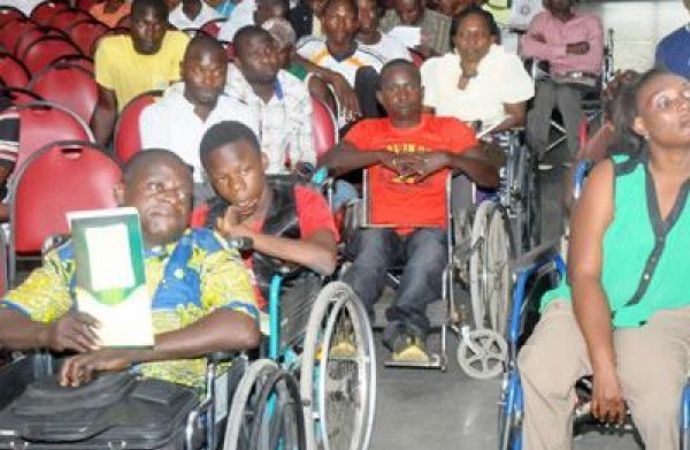
In commemoration of the International Day of Persons with Disabilities, the Centre for Citizens with Disabilities(CCD) has called on the federal government to implement the disability law. The Non-Governmental organisation has also charged political parties and their candidates to include the PWDs into the manifestoes. In a statement issued by the David Anyaele, the Executive
In commemoration of the International Day of Persons with Disabilities, the Centre for Citizens with Disabilities(CCD) has called on the federal government to implement the disability law. The Non-Governmental organisation has also charged political parties and their candidates to include the PWDs into the manifestoes.
In a statement issued by the David Anyaele, the Executive Director of CCD, commended the 19 States in the country that have adopted the Discrimination against Persons with Disabilities (Prohibition) Act 2018 and called on the remaining 18 States to follow the positive steps.
Similarly, he frowned at the government Ministries, Departments and Agencies that are responsible for PWDs affairs but failed to incorporate the PWDs into their respective budgetary allocations, stating that the MDAs are relegating them into beggars.
He commended the Independent National Electoral Commission for its inclusion of the PWDs community into the electioneering process and called on the election umpire to proffer lasting solutions to the electoral violence which is ravaging the political atmosphere already.
He also charged the PWDs to eschew voting apathy and ensure participation in the coming elections. In his words, he encouraged them to collect their Permanent Voters Cards and exercise their franchise rights.
The statement partly reads:
“The observance of the Day aims to promote an understanding of disability issues, and mobilize support for the dignity, rights and well-being of persons with disabilities. It also seeks to increase awareness of gains to be derived from the integration of persons with disabilities in every aspect of political, social, economic, and cultural life.
“We are impressed with State governments that have adopted the Discrimination against Persons with Disabilities (Prohibition) Act 2018 or passed disability laws in their respective States. The last time we checked the following States have a law that protects their citizens with disabilities: North Central (Kogi, Kwara, Nasarawa, Niger, and Plateau States), Northeast (Bauchi State), Northwest (Jigawa, Kaduna, Kano, Sokoto and Zamfara States), Southeast (Abia, and Anambra States), Southsouth (Cross River, and Edo States) and Southwest (Ekiti, Lagos, Ondo, and Oyo States).
“We are calling on Akwa Ibom, Adamawa, Bayelsa, Benue, Borno, Delta, Ebonyi, Enugu, Imo, Ogun, Osun, Katsina, Kebbi, Gombe, Rivers, Taraba, and Yobe States government to take appropriate measures to protect their citizens with disabilities without further delay through the adoption of the Disability Act.
“We are concerned that Section 2 of the Disability Act, which provides that the Federal Ministry of Information shall make provisions for promotion of awareness regarding- (a) the rights, respect and dignity of persons with disabilities, (b) the capabilities, achievements and contributions of persons with disabilities to the society; this has not happened for four years after the passage of the Act. Line Ministries, Departments and Agencies (MDAs) of the Federal and States governments are doing little or nothing to ensure the full implementation of the disability law.
“This is made obvious through the *none* prioritization of disability issues in budgetary provisions by 16 Federal MDAs responsible for disability affairs in Nigeria. This is made worse in States with a disability commission with little or no resources for operations, turning them into institutions of begging. Therefore, if the governments are not implementing the disability laws in the land, who will protect the rights of PWDs? We call on members of the Federal and States House of Assembly to demand for the budgetary provisions and activities from all Ministries, Departments, and Agencies for the full implementation of the Disability Law.
“This is indicative that the in-coming government may struggle to prioritize inclusion and participation of persons with disabilities in government programs and activities as their operational documents do not indicate how citizens with disabilities would be part of the government.
“People with disabilities and their families as well as concerned citizens should demand from political parties’ candidates’ agenda for persons with disabilities. PWDs and their organisations must document disability related promises made by candidates in order to hold them to account for the general elections.
“We appreciate the efforts of the Independent National Electoral Commission’s (INEC) efforts in implementing their framework on Access and Participation of Persons with Disabilities (PWDs) in the Electoral Process.
“Evidence from the last election conducted by INEC shows that there is relative improvement in terms of inclusion and access to the electoral process. As the last phase of activities before the 2023 general elections is about to commence, we are seriously worried about the rate of insecurity and lack of political tolerance among political parties and their candidates.
“This situation is a driver of voter apathy, low participation of vulnerable groups in the electoral process. We are calling on the INEC to improve on the successes recorded in Osun State to ensure equal voting access for persons with disabilities. People with disabilities should be encouraged to go for early collection of their Permanent Voters Cards (PVC) even as we request for priority considerations in line with the provisions of the National Disability Act and INEC Framework on PWDs.
“We are also calling on the security agencies to push back this ugly scenario as the 2023 general elections provides an important opportunity for each and every registered voter to decide his or her future. No one should be left behind in the electoral process by reason of insecurity”, David Anyeale noted.