
Complaints, Observations Mount as Polls Close in Ekiti Governorship Election
Voting concluded early at the scheduled 2:30 pm, followed by sorting and counting of the votes. However, there have been complaints from the candidates in the election who allege intimidation,...

Voting concluded early at the scheduled 2:30 pm, followed by sorting and counting of the votes. However, there have been complaints from the candidates in the election who allege intimidation, vote-buying, and delays due to malfunctioning BVAS.
Voting ended as scheduled at 2:30 pm, after which officials began sorting and counting ballots. However, candidates have raised complaints alleging intimidation, vote buying, and delays caused by malfunctioning BVAS machines.
By 4:00 pm, counting had ended in several polling units, where results were announced and displayed. No violence was reported in Ado-Ekiti and several other local government areas, though minor skirmishes occurred elsewhere.
Complaints by the Candidates
Some candidates raised complaints while speaking to reporters after casting their votes. Dr Wole Oluyede said only a few voters had cast their ballots after more than an hour at his polling unit and alleged voter intimidation in parts of Ikere, his hometown.
African Democratic Congress candidate Amb Dare Bejide alleged that APC members brought large sums of money to his ward and distributed it to voters. He said the election was tainted by vote-buying malpractice.
Accord Party candidate Hon Falegan Opeyemi David said on Facebook that his decade of philanthropic work in Ekiti outweighed the combined achievements of the other candidates. He criticised voters for prioritising N20,000 during the election, saying they would “squander it for another four years”, and asked rhetorically whether vote-buying was the fault of INEC or the people.
Coalition of CSOs’ Observations on the Election
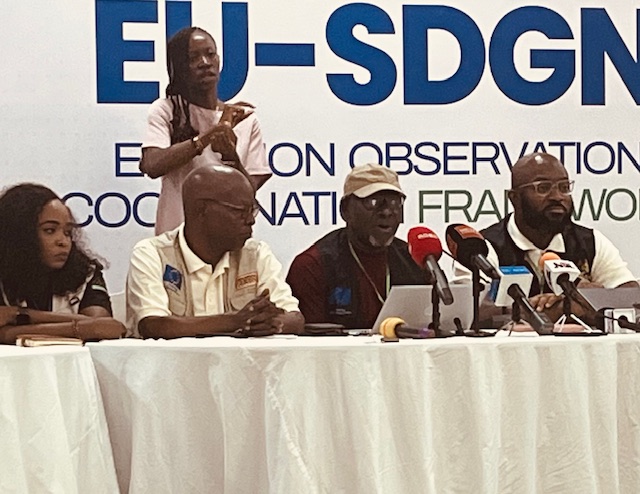
A coalition of civil society organisations under the European Union Support to Democratic Governance in Nigeria (EU-SDGN), on Saturday, expressed concern over multiple issues, including isolated cases of violence, organised voter inducement, alleged vote buying and voter intimidation, observed in the ongoing Ekiti State off-cycle governorship election.
The group’s assessment of the 2026 governorship election was read by Mr Lanre Arogundade, the executive director of the International Press Centre (IPC). They noted that the conduct of the Ekiti State governorship election has been threatened by “isolated cases of violence and well-organised voter inducement and vote-buying schemes”.
According to the Observation Hub, there have been 24 reported incidents of violence across 10 local government areas, namely in Irepodun/Ifelodun, Ado-Ekiti, Emure, Ido-Osi, Ilejemeje, Ijero, Ise/Orun, Gbonyin, Ikole and Oye.
Reports from nine LGAs cited 24 incidents of vote-buying and voter intimidation, mainly in Irepodun/Ifelodun and Ado-Ekiti, allegedly aimed at undermining ballot secrecy.
The members of the EU-SDGN monitoring the election include the Kukah Centre, TAF Africa, the Nigerian Women Trust Fund (NWTF), Yiaga Africa, the International Press Centre (IPC) and the Centre for Media and Society (CEMESO).
Earlier, Yiaga Africa had raised concerns over inconsistencies in election materials deployed by the Independent National Electoral Commission (INEC) for the Ekiti State governorship election, warning that the discrepancies could create confusion during voting and collation.
The election observation group made the remarks in its preliminary statement on Saturday, noting that 96 per cent of its observers deployed across 250 randomly selected polling units were present at their locations as of 8:30 a.m. to monitor the exercise.
According to Yiaga Africa, its preliminary findings revealed significant mismatches between ballot papers, result sheets, and INEC’s official list of candidates.
The organisation said while Form EC8A polling unit result sheets contain spaces for 15 political parties, the ballot papers currently in circulation include 19 parties. It further noted that INEC’s final list of candidates published on its website as of June 18, 2026, shows that only 14 political parties fielded candidates in the election.
Yiaga Africa acknowledged that the discrepancies may be linked to post-primary legal and administrative developments, including court rulings that affected party nominations, particularly the Peoples Democratic Party (PDP), as well as subsequent adjustments by the electoral commission.
Early Results
As the results have started trickling in, it is becoming more obvious that the APC and the incumbent governor may take the lead, followed by the PDP candidate. Several of the candidates scored zero in many polling units.