2027 Elections: G-100 Opposition Group Holds Summit on Strategy to Defeat President Tinubu
…To Form “Government of National Competence “ The G-100 opposition group, made up of leading opposition political parties, held a summit on Monday to discuss strategies for building a...

…To Form “Government of National Competence “
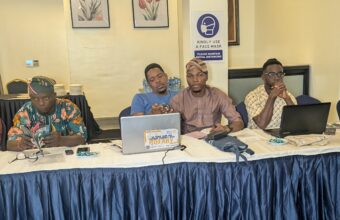
The G-100 opposition group, made up of leading opposition political parties, held a summit on Monday to discuss strategies for building a united front against President Bola Tinubu and the ruling All Progressives Congress.
The group considered several options for defeating the incumbent president, with some presidential hopefuls indicating they were willing to set aside their ambitions in the collective interest. Participants also reaffirmed their commitment to working together to mount a strong challenge against the APC in the 2027 general elections.
The presidential candidate of the Peoples Redemption Party (PRP) and former Cross River State governor said he would stay committed to the opposition unity process, regardless of the outcome of negotiations among participating parties. “We will support any political party that emerges in 2027. Whatever decision is arrived at today, I will not walk away but will strive all along because that’s what the people want to see,” Duke said.
The meeting’s conveners said the summit did not focus on party mergers or on asking any presidential candidate to step down. Instead, they said it aimed to establish a framework for opposition collaboration and cooperation strong enough to challenge the incumbent.
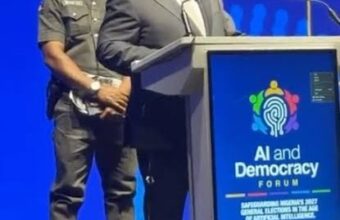
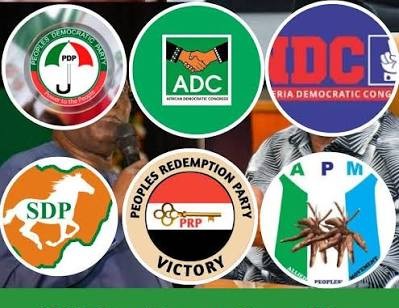
Convened by the G100 in partnership with the House of Representatives Minority Caucus, the summit brought together leaders and candidates from six opposition parties: the African Democratic Congress (ADC), Allied Peoples Movement (APM), Nigeria Democratic Congress (NDC), Peoples Democratic Party (PDP), Peoples Redemption Party (PRP) and SDP.
In opening remarks delivered on behalf of the G100, Mallam Salihu Moh. Lukman said the opposition could effectively challenge the ruling party in 2027 only by overcoming the divisions that cost it the 2023 presidential election. Lukman said the opposition could effectively challenge the ruling party in 2027 only by overcoming the divisions that cost it the 2023 presidential election. He said opposition parties won about 13 million votes combined in 2023, compared with fewer than nine million for the winner, but lost because their votes were split among several candidates.
“Nobody stole 13 million votes. We divided them ourselves, openly and fully aware of the consequences,” he said. He recalled the opposition alliance before the 2015 election, when parties negotiated cooperation terms and agreed on a process for selecting a common candidate before deciding who would run on the ticket.
He said the key lesson from 2015 was that opposition parties must first agree on the rules before negotiating positions. “What they had was not affection. What they had was sequence. They agreed on the rules before they knew the outcome,” Lukman said.
He clarified that the summit was not calling for any political party to dissolve or for any presidential candidate to withdraw immediately. “It is not asking any party to dissolve. It is not asking any party to disappear into another party. It is not asking any candidate to stand down this morning,” he said. Instead, Lukman said the G100 was asking the parties to authorise a process for developing a framework through which their interests could be negotiated.
The G100 said the meeting, with the theme, ‘A Framework for Opposition Cooperation and Coordination’, would provide a platform for the parties to discuss the terms, institutions and principles that could guide their proposed collaboration.
The proposed framework provides for three standing coalition structures: a Central Leadership Committee, a Publicity and Communication Committee, and a Legal Committee. It also proposes five working groups to draft documents on democratic renewal, a four-year transition plan, a national reform programme, opposition unity and a roadmap for selecting a common presidential candidate.
The working groups were expected to complete their papers within four weeks for review at a second summit. The proposed coalition would seek to form a “Government of National Competence” and implement a four-year National Reset Programme backed by an enforceable Transition Charter. He warned, however, that its success would depend on political leaders’ willingness to make concessions and accept outcomes that may not serve their personal ambitions.
Lukman said the ultimate objective was to give Nigerians a credible alternative government in 2027. “Our only interest is the one stated in the Doctrine we published on August 2: that a democracy is sustained not merely by holding elections but by the credible possibility of an alternative government,” he said.
Meanwhile, some parties participating in the summit have expressed some reservations about its workability. The SDP doubts whether the proposed opposition collaboration can translate into a workable political coalition.
The party’s National Secretary, Dr Olu Agunloye, said the SDP supported opposition cooperation ahead of the 2027 elections but noted that the real challenge was how such an alliance would function. He urged the parties to draw lessons from the Coalition of United Political Parties (CUPP), formed before the 2019 election, which he said had a strong concept but weak implementation.